


Care Disclaimer: Plant care recommendations are general guidelines based on common growing conditions. Individual results may vary based on your local environment, climate, and care routine. If your plant is toxic, keep it away from children and pets, and consult a veterinarian if accidental ingestion occurs.
1.Beaucarnea Stricta — Overview
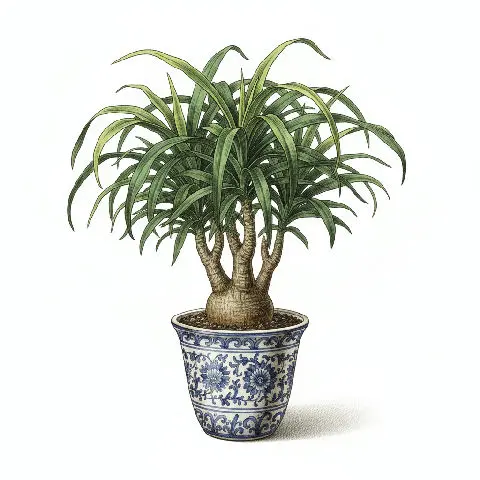
Beaucarnea stricta, commonly known as the Narrow-Leaved Ponytail Palm or Stiff Ponytail Palm, is a distinctive succulent tree indigenous to the arid and semi-arid regions of southeastern Mexico, particularly thriving in Oaxaca and extending into parts of Puebla and Guerrero. Despite its common name, it is not a true palm but a member of the Asparagaceae family, specifically within the Nolineae subfamily, placing it botanically closer to genera like Agave, Yucca, Dasylirion, and Nolina. This captivating plant is renowned for its striking morphological adaptations to drought, most notably its massive, swollen caudex at the base of the trunk. This bulbous structure, which can reach several feet in diameter, serves as a crucial water-storage organ, enabling Beaucarnea stricta to endure prolonged dry periods in its native habitat of rocky slopes and dry tropical deciduous forests, often in acidic volcanic soils.
From this robust, tortoise-shell patterned caudex, a single, typically unbranched trunk emerges, eventually forming a few branches after its first flowering. Each branch terminates in a dense, pompom-like rosette of long, slender, and notably stiff, bluish-gray leaves. These rigid, grass-like leaves, which can extend up to 90 cm in length, distinguish it from its more common relative, Beaucarnea recurvata, by their narrower profile and greater rigidity. The leaf margins are finely serrated, culminating in sharp tips.
Historically, Beaucarnea stricta has been prized primarily for its exceptional ornamental value and architectural form, making it a popular choice for xeriscaping in warm climates and a resilient indoor specimen globally. While specific traditional medicinal uses for this particular species are not extensively documented, its taxonomic classification within a family known for diverse phytochemicals hints at potential biological activities, prompting emerging scientific interest in its chemical constituents.
Trusted Scientific References
1. Authoritative external sources for Beaucarnea stricta
1.1 Wikipedia — Beaucarnea stricta
1.2 Kew POWO (Plants of the World Online)
1.3 PubMed — peer-reviewed research
1.4 NCBI Taxonomy Browser
1.5 GBIF — Global Biodiversity
1.1.Beaucarnea Stricta — Key Features
- ✓ <strong>Distinctive swollen caudex</strong> — Distinctive swollen caudex for water storage, adapted to arid environments.
- ✓ <strong>Long, slender, and notably stiff, bluish</strong> — gray leaves arranged in dense rosettes.
- ✓ <strong>Native to southeastern</strong> — Native to southeastern Mexico, thriving on rocky slopes and dry forests.
- ✓ <strong>Belongs to the</strong> — Belongs to the Asparagaceae family, not a true palm despite its common name.
- ✓ <strong>Highly drought</strong> — tolerant and low-maintenance, ideal for xeriscaping.
- ✓ <strong>Slow</strong> — growing evergreen succulent tree, reaching 15-20 feet over many years.
- ✓ <strong>Produces creamy white</strong> — Produces creamy white flowers infrequently, typically after first flowering.
- ✓ <strong>Excellent ornamental plant</strong> — Excellent ornamental plant for both outdoor gardens and indoor container culture.
- ✓ <strong>Genus Beaucarnea is</strong> — Genus Beaucarnea is protected under CITES, regulating international trade.
- ✓ <strong>Contains potential phytochemicals</strong> — Contains potential phytochemicals like steroidal saponins and flavonoids, prompting scientific interest.
1.2.Beaucarnea Stricta — Quick Summary
- ✓ Unique succulent tree native to Mexico, part of Asparagaceae family.
- ✓ Features a prominent water-storing caudex and stiff, narrow leaves.
- ✓ Highly drought-tolerant and valued for its architectural ornamental appeal.
- ✓ Limited historical medicinal use; modern research explores potential phytochemicals.
- ✓ Genus is CITES protected, emphasizing conservation.
- ✓ Requires full sun, well-drained soil, and infrequent watering.
2.Beaucarnea Stricta — Scientific Identity
3.Beaucarnea Stricta — Quick Facts
4.Beaucarnea Stricta — Appearance & Identification
5.Beaucarnea Stricta — Native Habitat
6.Beaucarnea Stricta — Water Requirements
- Beaucarnea stricta is a hardy and drought-tolerant plant, making it relatively easy to cultivate under appropriate conditions, especially in arid and semi-arid environments.
- ✓ Soil Requirements — Plant in well-drained soil; a sandy or gritty succulent mix is ideal, mimicking its native acidic volcanic soils to prevent root rot.
- ✓ Light Exposure — Requires full sun to light shade for optimal growth, thriving in bright conditions.
- ✓ Watering Regimen — Water deeply but infrequently, allowing the soil to dry out completely between waterings; its caudex stores water, making overwatering detrimental.
- ✓ Temperature Tolerance — Hardy to short duration freezes, tolerating temperatures down to 20-25°F (-6 to -4°C), making it more cold-tolerant than some other Beaucarnea species.
- ✓ Container Growing — Excellent as a potted specimen, particularly for those with limited space or in colder climates where it can be brought indoors during winter.
- ✓ Propagation — Primarily propagated from seeds, though offset removal from mature plants is also possible, requiring careful handling to avoid damage.
- ✓ Growth Rate — Exhibits a very slow growth rate, making it a long-term specimen plant in gardens or containers.
Reviewed by the Flora Medical Global Botanical Review Panel
Multi-disciplinary editorial group · Botany · Ethnobotany · Herbal-medicine literature
Who reviewed this: This page was checked by the Flora Medical Global Botanical Review Panel — an in-house editorial group of botany graduates, ethnobotany researchers, and horticulture practitioners who collectively maintain our 7,000+ plant encyclopedia. Meet the team.
Our 4-step verification process
1. Taxonomic verification
Scientific names and synonyms cross-checked against Kew POWO, World Flora Online, and The Plant List.
2. Phytochemical & medicinal cross-reference
Active compounds, traditional uses, and reported activities are cross-referenced with PubMed, USDA Dr. Duke's database, and peer-reviewed ethnobotanical literature.
3. Conservation & distribution check
Distribution, ecology, and conservation status confirmed against GBIF occurrence records and the IUCN Red List.
4. Editorial & safety review
Every entry passes an editorial pass for clarity, originality, and safety notices (toxicity, contraindications, dosage caveats) before publication.
Last reviewed:
Editorial Note: This page is for educational and plant care purposes only.
Written by: Flora Medical Global Editorial Team
Reviewed by: Flora Medical Global Botanical Review Panel
Last Updated: June 15, 2026







Beaucarnea Stricta — Comments & Community Reviews
Rate this plant