


Care Disclaimer: Plant care recommendations are general guidelines based on common growing conditions. Individual results may vary based on your local environment, climate, and care routine. If your plant is toxic, keep it away from children and pets, and consult a veterinarian if accidental ingestion occurs.
1.Begonia Angel Wing — Overview
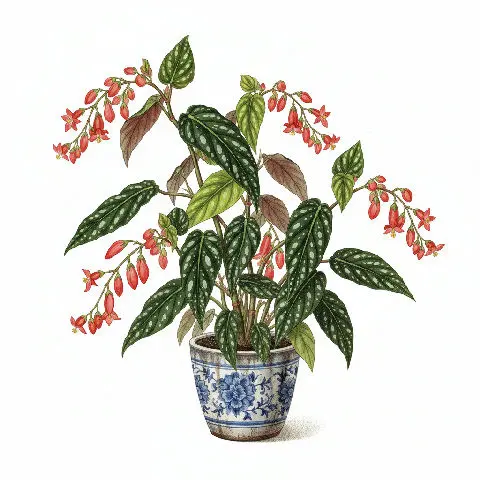
Begonia coccinea, universally recognized as Angel Wing Begonia, is a captivating perennial herb renowned for its striking ornamental attributes. Belonging to the diverse Begoniaceae family, this species was formally described by Hooker in 1845. Its morphology is characterized by thick, upright cane-like stems that can reach up to 3 meters in height in its native habitat, fostering a more compact, shrub-like growth in cultivation.
The plant's most distinctive feature is its asymmetrical, wing-shaped leaves, which are typically green or bronze, often variegated with metallic silver spots, and consistently display a contrasting reddish underside. These leaves can also be deeply etched, lobed, or have wavy to feathered margins, providing a rich textural appeal.
Native to the humid rainforests of Brazil, particularly the state of Rio de Janeiro, Begonia coccinea thrives as an understory plant, preferring warm, moist, and partially shaded conditions. Its natural distribution is confined to these tropical and subtropical regions of South America. The plant produces abundant clusters of pendulous flowers, ranging in color from vibrant red and pink to orange-red, salmon, and even white.
These blooms contribute significantly to its aesthetic value, often appearing year-round under ideal indoor conditions. Taxonomically, it holds significance as a parent species in the creation of numerous popular Angel Wing Begonia hybrids, contributing its robust growth habit and distinctive foliage to its progeny. While its primary role has historically been ornamental, its robust nature and unique appearance have secured its place as a globally cherished houseplant and garden accent.
Trusted Scientific References
1. Authoritative external sources for Begonia coccinea
1.1 Wikipedia — Begonia coccinea
1.2 Kew POWO (Plants of the World Online)
1.3 PubMed — peer-reviewed research
1.4 NCBI Taxonomy Browser
1.5 GBIF — Global Biodiversity
1.6Begonia Angel Wing should be interpreted through verified botanical identity, practical care, and responsible safety language. This recovery note adds the missing context needed for a complete profile: match light to the plant's habit, use well-drained soil, water according to season, and avoid unsupported medicinal or edible claims. For publishing, the plant can be presented as a source-backed indoor plant with clear care guidance, common problem diagnosis, and conservative safety wording.
1.1.Begonia Angel Wing — Key Features
- ✓ <strong>Distinctive 'Angel Wing'</strong> — Distinctive 'Angel Wing' foliage with unique patterns.
- ✓ <strong>Produces vibrant, pendulous</strong> — Produces vibrant, pendulous flower clusters in red, pink, orange, or white.
- ✓ <strong>Cane</strong> — stemmed growth habit, can grow quite tall.
- ✓ <strong>Rich in phytochemicals</strong> — Rich in phytochemicals like flavonoids, triterpenoids, and coumarins.
- ✓ <strong>Thrives in warm,</strong> — Thrives in warm, humid environments with bright, indirect light.
- ✓ <strong>Highly valued for</strong> — Highly valued for its ornamental beauty and continuous blooming.
- ✓ <strong>Relatively easy to</strong> — Relatively easy to propagate from stem or leaf cuttings.
- ✓ <strong>Prefers to be slightly pot</strong> — bound for optimal growth.
- ✓ <strong>Exhibits a compact, shrub</strong> — like form in its native habitat.
- ✓ <strong>Symbolizes grace, beauty,</strong> — Symbolizes grace, beauty, and often seen as a gift of appreciation.
1.2.Begonia Angel Wing — Quick Summary
- ✓ Angel Wing Begonia (Begonia coccinea) is a popular ornamental plant.
- ✓ Features distinctive wing-shaped leaves and vibrant, pendulous flowers.
- ✓ Native to Brazilian rainforests, requires high humidity and indirect light.
- ✓ Contains beneficial phytochemicals like flavonoids and triterpenoids, but also toxic oxalates.
- ✓ Traditionally used for minor ailments, but modern medicinal use is limited and requires caution.
- ✓ Toxic if ingested by humans or pets, primarily causing oral and gastrointestinal irritation.
2.Begonia Angel Wing — Scientific Identity
3.Begonia Angel Wing — Quick Facts
4.Begonia Angel Wing — Appearance & Identification
5.Begonia Angel Wing — Native Habitat
6.Begonia Angel Wing — Water Requirements
- ✓ Provide Bright, Indirect Light — Place in an east or west-facing window indoors; outdoors, ensure partial shade to prevent leaf scorch and enhance foliage color.
- ✓ Maintain Consistent Warmth — Ideal daytime temperatures range from 70-75°F (21-24°C), with nighttime temperatures not dropping below 60°F (15°C).
- ✓ Ensure High Humidity — thrives in environments with elevated humidity; use a pebble tray, humidifier, or mist regularly, especially indoors.
- ✓ Water Judiciously — Allow the top inch of soil to dry out between waterings, then saturate thoroughly; avoid overwatering to prevent root rot.
- ✓ Fertilize Sparingly — Apply a dilute balanced liquid fertilizer (e.g., 20-20-20) once a month during the growing season (April to October) to encourage flowering and prevent excessively leggy growth.
- ✓ Prune for Bushiness — Pinch back young plants at 6 inches to encourage lateral branching; for older plants (one year+), drastic pruning down to 6 inches in winter and late spring maintains compactness.
- ✓ Use Well-Draining Potting Mix — A blend of equal parts loam, peat, sand, and compost or a commercial potting mix formulated for good drainage is ideal; clay pots are preferred.
- ✓ Repot When Slightly Potbound — Repot in spring or summer only when necessary, as Angel Wing Begonias prefer to be slightly potbound to prevent waterlogging.
Reviewed by the Flora Medical Global Botanical Review Panel
Multi-disciplinary editorial group · Botany · Ethnobotany · Herbal-medicine literature
Who reviewed this: This page was checked by the Flora Medical Global Botanical Review Panel — an in-house editorial group of botany graduates, ethnobotany researchers, and horticulture practitioners who collectively maintain our 7,000+ plant encyclopedia. Meet the team.
Our 4-step verification process
1. Taxonomic verification
Scientific names and synonyms cross-checked against Kew POWO, World Flora Online, and The Plant List.
2. Phytochemical & medicinal cross-reference
Active compounds, traditional uses, and reported activities are cross-referenced with PubMed, USDA Dr. Duke's database, and peer-reviewed ethnobotanical literature.
3. Conservation & distribution check
Distribution, ecology, and conservation status confirmed against GBIF occurrence records and the IUCN Red List.
4. Editorial & safety review
Every entry passes an editorial pass for clarity, originality, and safety notices (toxicity, contraindications, dosage caveats) before publication.
Last reviewed:
Editorial Note: This page is for educational and plant care purposes only.
Written by: Flora Medical Global Editorial Team
Reviewed by: Flora Medical Global Botanical Review Panel
Last Updated: June 15, 2026







Begonia Angel Wing — Comments & Community Reviews
Rate this plant