
Care Disclaimer: Plant care recommendations are general guidelines based on common growing conditions. Individual results may vary based on your local environment, climate, and care routine. If your plant is toxic, keep it away from children and pets, and consult a veterinarian if accidental ingestion occurs.
1.Begonia Chloroneura — Overview
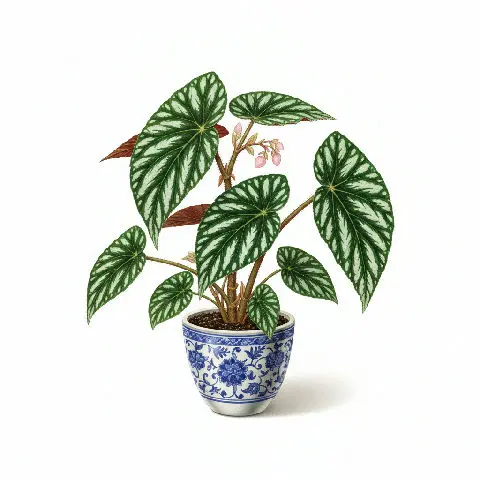
Begonia chloroneura, often celebrated as the 'Silver-Veined Begonia' due to its distinct foliar patterns, is a captivating broadleaf evergreen perennial belonging to the diverse Begoniaceae family. This species is indigenous to the humid cloud forests of Central and South America, particularly thriving in regions of Mexico and Central America. Its natural habitat includes shaded, moist environments, where it can be found growing terrestrially on the forest floor or epiphytically, clinging to moss-covered trees. The plant's discovery and botanical classification contribute to the extensive exploration of the Americas' rich flora.
Morphologically, Begonia chloroneura is distinguished by its striking, velvety, dark green to brownish-purple elliptical leaves, which are dramatically etched with iridescent silver or chartreuse venation, giving rise to its specific epithet 'chloroneura', meaning 'green-nerved'. The undersides of these leaves present a vivid contrast, typically displaying a rich reddish-purple hue. Young leaves often exhibit a fascinating covering of bright red hairs, imparting a fuzzy texture that gradually recedes to the leaf edges as they mature. This compact species typically reaches a mature size of 6 to 12 inches in both height and width.
While primarily cultivated for its exceptional ornamental foliage, Begonia chloroneura also produces small, relatively inconspicuous pinkish-white flowers. These blooms appear in the summer, borne on slender stems that rise modestly above the vibrant leaf canopy, adding a subtle charm to its overall aesthetic.
Trusted Scientific References
1. Authoritative external sources for Begonia chloroneura
1.1 Wikipedia — Begonia chloroneura
1.2 Kew POWO (Plants of the World Online)
1.3 PubMed — peer-reviewed research
1.4 NCBI Taxonomy Browser
1.5 GBIF — Global Biodiversity
1.6Begonia Chloroneura should be interpreted through verified botanical identity, practical care, and responsible safety language. This recovery note adds the missing context needed for a complete profile: match light to the plant's habit, use well-drained soil, water according to season, and avoid unsupported medicinal or edible claims. For publishing, the plant can be presented as a source-backed indoor plant with clear care guidance, common problem diagnosis, and conservative safety wording.
1.1.Begonia Chloroneura — Key Features
- ✓ <strong>Ornamental Foliage</strong> — Highly prized for its visually striking leaves.
- ✓ <strong>Velvety Texture</strong> — Leaves possess a unique velvety feel.
- ✓ <strong>Iridescent Venation</strong> — Prominent silver or chartreuse veins that shimmer.
- ✓ <strong>Compact Size</strong> — Reaches 6-12 inches tall and wide, suitable for small spaces.
- ✓ <strong>Shade Loving</strong> — Thrives in low light conditions, ideal for indoors or deep shade.
- ✓ <strong>Humidity Tolerant</strong> — Requires and adapts well to high humidity environments.
- ✓ <strong>Evergreen Perennial</strong> — Retains its foliage year-round in suitable climates.
- ✓ <strong>Pink Flowers</strong> — Produces small, delicate pinkish-white blooms in summer.
- ✓ <strong>Native to Central/South America</strong> — Originates from tropical cloud forest regions.
- ✓ <strong>Begoniaceae Family</strong> — Member of a large genus known for diverse ornamental species.
1.2.Begonia Chloroneura — Quick Summary
- ✓ Botanical Name — Begonia chloroneura P. Wilkie & Sands
- ✓ Common Names — Silver-Veined Begonia
- ✓ Key Feature — Striking dark green leaves with iridescent silver venation and reddish-purple undersides.
- ✓ Habitat — Native to humid cloud forests of Central and South America.
- ✓ Primary Use — Highly valued ornamental foliage plant for indoor and shaded gardens.
- ✓ Safety Note — Contains oxalic acid; not for internal consumption.
2.Begonia Chloroneura — Scientific Identity
3.Begonia Chloroneura — Quick Facts
4.Begonia Chloroneura — Appearance & Identification
5.Begonia Chloroneura — Native Habitat
6.Begonia Chloroneura — Water Requirements
- ✓ Light Requirements — Begonia chloroneura thrives in bright shade to mostly shaded conditions, making it an ideal indoor plant or suited for deeply shaded outdoor garden spots; direct sunlight should be avoided to prevent leaf scorch.
- ✓ Watering Frequency — Maintain consistent moisture with regular watering, ensuring the soil remains damp but not waterlogged; occasional watering is acceptable once established, but avoid prolonged dryness.
- ✓ Soil Needs — Plant in average, well-drained soil rich in organic matter; a slightly acidic to neutral pH is generally preferred for optimal growth.
- ✓ Humidity Preference — This species is highly humidity tolerant, preferring high ambient moisture, which can be achieved indoors with humidifiers, pebble trays, or grouping with other plants.
- ✓ Temperature Range — Best grown in USDA Zones 10a-12, requiring warm temperatures typical of tropical environments; protect from cold drafts and temperatures below 50°F (10°C).
- ✓ Fertilization — Feed sparingly during the growing season (spring and summer) with a balanced liquid fertilizer diluted to half strength, reducing frequency in fall and winter.
- ✓ Propagation — Easily propagated from stem or leaf cuttings, which root readily in moist soil or water, especially with high humidity.
- ✓ Pruning — Minimal pruning is required, primarily to remove any leggy growth or dead leaves to maintain its compact, attractive form.
Reviewed by the Flora Medical Global Botanical Review Panel
Multi-disciplinary editorial group · Botany · Ethnobotany · Herbal-medicine literature
Who reviewed this: This page was checked by the Flora Medical Global Botanical Review Panel — an in-house editorial group of botany graduates, ethnobotany researchers, and horticulture practitioners who collectively maintain our 7,000+ plant encyclopedia. Meet the team.
Our 4-step verification process
1. Taxonomic verification
Scientific names and synonyms cross-checked against Kew POWO, World Flora Online, and The Plant List.
2. Phytochemical & medicinal cross-reference
Active compounds, traditional uses, and reported activities are cross-referenced with PubMed, USDA Dr. Duke's database, and peer-reviewed ethnobotanical literature.
3. Conservation & distribution check
Distribution, ecology, and conservation status confirmed against GBIF occurrence records and the IUCN Red List.
4. Editorial & safety review
Every entry passes an editorial pass for clarity, originality, and safety notices (toxicity, contraindications, dosage caveats) before publication.
Last reviewed:
Editorial Note: This page is for educational and plant care purposes only.
Written by: Flora Medical Global Editorial Team
Reviewed by: Flora Medical Global Botanical Review Panel
Last Updated: June 15, 2026







Begonia Chloroneura — Comments & Community Reviews
Rate this plant