
Care Disclaimer: Plant care recommendations are general guidelines based on common growing conditions. Individual results may vary based on your local environment, climate, and care routine. If your plant is toxic, keep it away from children and pets, and consult a veterinarian if accidental ingestion occurs.
1.Begonia Darthvaderiana — Overview
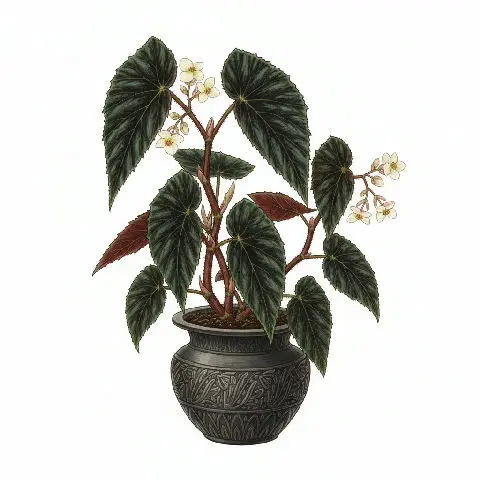
Begonia darthvaderiana, a captivating and exceptionally rare species within the vast Begoniaceae family, is celebrated for its dramatically dark, almost black foliage and intricate patterns. This unique begonia was first discovered in 2013 by researcher Che Wei Lin in the state of Sarawak, on the island of Borneo, and subsequently described in 2014.
It thrives in the specific microclimates of humid, shaded understories within tropical rainforests, particularly around limestone karsts, at elevations around 140 meters. The plant's intriguing name, 'Darthvaderiana,' is a playful yet apt tribute to the iconic Star Wars character, reflecting its strikingly dark, almost menacingly beautiful appearance.
Morphologically, Begonia darthvaderiana is a shrubby perennial, typically growing erect to a maximum height of about 70 cm. Its alternate, asymmetric leaves are oblong-oval, reaching up to 22 cm in length and 13 cm in width. The most striking feature is their coloration, ranging from very deep violet or intense red to an almost opaque black, often adorned with a distinctive yellowish-silver border that can appear iridescent. The leaf surface is velvety and frequently bullate (blistered), with serrated margins, adding to its dramatic aesthetic.
Unlike many other begonias cultivated for their blooms, B. darthvaderiana is primarily prized for its exceptional foliage. Its inconspicuous flowers, which are monoecious (having separate male and female flowers on the same plant) but mature at different times, emerge on terminal panicles. Staminate (male) flowers typically have two coral-pink tepals, while pistillate (female) flowers bear five reddish-pink tepals.
The fruit develops into a capsule approximately 1.8 cm long. This species is closely related to Begonia chlorosticta, with which it can naturally hybridize, yielding offspring of considerable horticultural value.
Trusted Scientific References
1. Authoritative external sources for Begonia darthvaderiana
1.1 Wikipedia — Begonia darthvaderiana
1.2 Kew POWO (Plants of the World Online)
1.3 PubMed — peer-reviewed research
1.4 NCBI Taxonomy Browser
1.5 GBIF — Global Biodiversity
1.1.Begonia Darthvaderiana — Key Features
- ✓ <strong>Strikingly dark, almost</strong> — Strikingly dark, almost black foliage with iridescent qualities.
- ✓ <strong>Unique oblong</strong> — oval, asymmetric leaves with a velvety, bullate texture and serrated margins.
- ✓ <strong>Endemic to the</strong> — Endemic to the humid, shaded understory of limestone karsts in Sarawak, Borneo.
- ✓ <strong>Recently discovered in 2013, making it a highly sought</strong> — after collector's plant.
- ✓ <strong>Named 'Darthvaderiana' for</strong> — Named 'Darthvaderiana' for its resemblance to the iconic Star Wars character.
- ✓ <strong>Inconspicuous, pale pinkish</strong> — red monoecious flowers, with foliage being the main appeal.
- ✓ <strong>Requires very high humidity (90</strong> — 100%) and stable warm temperatures (20-27°C).
- ✓ <strong>Closely related to</strong> — Closely related to Begonia chlorosticta, with potential for hybridization.
- ✓ <strong>Contains anthocyanins, flavonoids,</strong> — Contains anthocyanins, flavonoids, and triterpenoids, as per nascent phytochemical studies.
- ✓ <strong>Not recognized for</strong> — Not recognized for any traditional or modern medicinal uses; primarily ornamental.
1.2.Begonia Darthvaderiana — Quick Summary
- ✓ Begonia darthvaderiana is a rare, exotic begonia from Borneo, known for its strikingly dark, almost black foliage.
- ✓ Discovered in 2013, its name is a playful nod to the Star Wars character Darth Vader.
- ✓ It requires very specific, high-humidity, low-light, and warm conditions for cultivation, making it challenging for home growers.
- ✓ Primarily an ornamental plant; there are no established medicinal uses or traditional applications for this species.
- ✓ Early phytochemical research indicates the presence of anthocyanins, flavonoids, and triterpenoids.
- ✓ Ingestion is potentially toxic due to oxalic acid, common in Begonia species.
2.Begonia Darthvaderiana — Scientific Identity
3.Begonia Darthvaderiana — Quick Facts
4.Begonia Darthvaderiana — Appearance & Identification
5.Begonia Darthvaderiana — Native Habitat
6.Begonia Darthvaderiana — Water Requirements
- Cultivating Begonia darthvaderiana is considered challenging due to its highly specific environmental requirements, making it best suited for experienced growers or specialized setups:
- ✓ Humidity Management — Requires exceptionally high relative humidity, ideally between 90% and 100%, necessitating terrariums, humidifiers, or glass domes to replicate its native rainforest understory.
- ✓ Temperature Control — Prefers warm, stable temperatures around 25°C (77°F), with a tolerance range of 20°C to 27°C (68-81°F). Temperatures below 17°C (63°F) can halt growth and cause damage.
- ✓ Light Conditions — Thrives in very low, dappled light, mimicking the heavy shade of its natural habitat. Avoid direct sunlight, which can scorch its delicate leaves. Grow lights with a blue spectrum are often beneficial.
- ✓ Substrate Requirements — Needs a well-draining yet moisture-retentive substrate, typically a mix of sphagnum moss, perlite, and orchid bark, to prevent root rot while maintaining consistent moisture.
- ✓ Watering Technique — Water with distilled or rainwater when the top layer of substrate begins to dry, ensuring thorough drainage. Avoid letting the plant sit in stagnant water.
- ✓ Air Circulation — Despite high humidity, good air circulation is crucial to prevent fungal issues, especially in enclosed environments like terrariums.
- ✓ Fertilization — Fertilize sparingly during the growing season with a diluted, balanced liquid fertilizer, typically once a month, to avoid nutrient burn.
Reviewed by the Flora Medical Global Botanical Review Panel
Multi-disciplinary editorial group · Botany · Ethnobotany · Herbal-medicine literature
Who reviewed this: This page was checked by the Flora Medical Global Botanical Review Panel — an in-house editorial group of botany graduates, ethnobotany researchers, and horticulture practitioners who collectively maintain our 7,000+ plant encyclopedia. Meet the team.
Our 4-step verification process
1. Taxonomic verification
Scientific names and synonyms cross-checked against Kew POWO, World Flora Online, and The Plant List.
2. Phytochemical & medicinal cross-reference
Active compounds, traditional uses, and reported activities are cross-referenced with PubMed, USDA Dr. Duke's database, and peer-reviewed ethnobotanical literature.
3. Conservation & distribution check
Distribution, ecology, and conservation status confirmed against GBIF occurrence records and the IUCN Red List.
4. Editorial & safety review
Every entry passes an editorial pass for clarity, originality, and safety notices (toxicity, contraindications, dosage caveats) before publication.
Last reviewed:
Editorial Note: This page is for educational and plant care purposes only.
Written by: Flora Medical Global Editorial Team
Reviewed by: Flora Medical Global Botanical Review Panel
Last Updated: June 15, 2026







Begonia Darthvaderiana — Comments & Community Reviews
Rate this plant