


Care Disclaimer: Plant care recommendations are general guidelines based on common growing conditions. Individual results may vary based on your local environment, climate, and care routine. If your plant is toxic, keep it away from children and pets, and consult a veterinarian if accidental ingestion occurs.
1.Begonia Pavonina — Overview
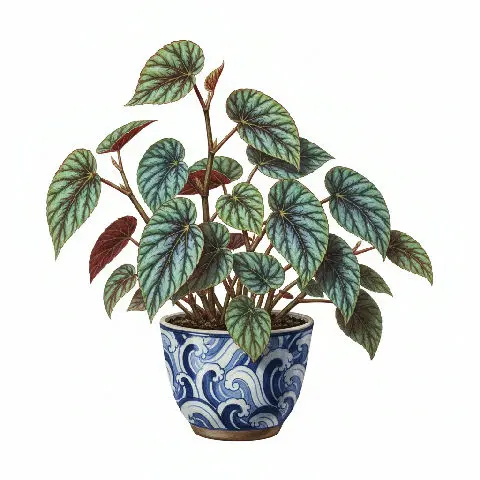
Begonia pavonina, widely recognized as the Peacock Begonia or Peacock Jewel Begonia, is a captivating species belonging to the diverse Begoniaceae family. This unique plant is indigenous to the humid, high-elevation tropical rainforests of Peninsular Malaysia, typically found at altitudes between 1400 and 1800 meters. Unlike many Begonia species celebrated for their vibrant floral displays, B.
pavonina is prized almost exclusively for its extraordinary foliage. The leaves exhibit a mesmerizing metallic blue-green sheen under low light conditions, a striking phenomenon attributed to specialized chloroplast-derived structures known as iridoplasts within its epidermal cells. These iridoplasts are arranged in a photonic crystal-like formation, an evolutionary adaptation that enhances photosynthetic efficiency in the deep shade of its understory habitat.
This mechanism allows the plant to more effectively absorb blue-green light and reflect green light, capturing a greater usable light spectrum where sunlight is scarce.
Its growth habit is rhizomatous, typically creeping along the substrate and branching as it matures, though some cultivated forms, often hybrids, may display a more upright, cane-like structure. The leaves can reach up to 6 inches in length, often featuring subtly jagged edges and hairy petioles, with a deep crimson-red coloration on their undersides.
The distinction between the true species and the more commonly cultivated 'blue form', which is suspected to be a Begonia grandis x pavonina hybrid, is important for cultivation, as the hybrid often exhibits 'hybrid vigor' and is easier to grow. This remarkable plant offers significant ornamental value and is a subject of ongoing botanical research into its unique light-harvesting adaptations.
Trusted Scientific References
1. Authoritative external sources for Begonia pavonina
1.1 Wikipedia — Begonia pavonina
1.2 Kew POWO (Plants of the World Online)
1.3 PubMed — peer-reviewed research
1.4 NCBI Taxonomy Browser
1.5 GBIF — Global Biodiversity
1.1.Begonia Pavonina — Key Features
- ✓ <strong>Iridescent Foliage</strong> — Displays a captivating metallic blue-green sheen, shifting with light angle.
- ✓ <strong>Photonic Crystal Adaptation</strong> — Possesses specialized iridoplasts to optimize photosynthesis in low light.
- ✓ <strong>Native to Malaysia</strong> — Indigenous to high-altitude, humid tropical rainforests of Peninsular Malaysia.
- ✓ <strong>High Ornamental Value</strong> — Exceedingly popular among plant enthusiasts and collectors for its unique beauty.
- ✓ <strong>Low Light Specialist</strong> — Thrives in deep shade, a testament to its highly efficient light-gathering mechanism.
- ✓ <strong>Rhizomatous Growth Habit</strong> — Characterized by creeping rhizomes, forming a spreading, compact plant.
- ✓ <strong>Bicolor Leaves</strong> — Upper surface is iridescent, while the underside typically showcases a deep crimson-red.
- ✓ <strong>Unique Cellular Biology</strong> — A subject of intense scientific interest for its structural coloration and light manipulation.
- ✓ <strong>Begoniaceae Family Member</strong> — Belongs to a diverse genus known for both ornamental appeal and some folk medicinal uses.
- ✓ <strong>Potential Hybrid Forms</strong> — The 'blue form' often encountered in cultivation may be a robust hybrid, offering easier care.
1.2.Begonia Pavonina — Quick Summary
- ✓ Peacock Begonia (Begonia pavonina) boasts iridescent blue-green leaves, a rare botanical marvel.
- ✓ Native to Malaysia's humid, high-elevation tropical rainforests, adapted to deep shade.
- ✓ Features specialized iridoplasts for enhanced light capture, a unique photosynthetic adaptation.
- ✓ Primarily an ornamental houseplant, highly prized by collectors for its stunning aesthetic.
- ✓ Contains oxalic acid, rendering all parts toxic if ingested; not suitable for medicinal use.
- ✓ The widely available 'blue form' is often a more vigorous hybrid, potentially Begonia grandis x pavonina.
2.Begonia Pavonina — Scientific Identity
3.Begonia Pavonina — Quick Facts
4.Begonia Pavonina — Appearance & Identification
5.Begonia Pavonina — Native Habitat
6.Begonia Pavonina — Water Requirements
- ✓ Light — Requires low, indirect light to maintain its characteristic iridescent blue sheen; direct sunlight can diminish coloration and cause leaf scorch.
- ✓ Temperature — Thrives in cool nights (10-18°C) and moderate daytime temperatures (20-25°C), reflecting its high-elevation native habitat.
- ✓ Humidity — Demands very high atmospheric humidity (70-90%), making it ideal for terrariums or humid indoor environments.
- ✓ Soil — Prefers a rich, well-draining, slightly acidic potting mix, often composed of peat, perlite, and orchid bark to mimic rainforest substrate.
- ✓ Watering — Keep the soil consistently moist but never waterlogged; allow the top inch of soil to dry slightly before rewatering to prevent root rot.
- ✓ Propagation — Best propagated through rhizome division or stem cuttings, which root readily under high humidity and warmth.
- ✓ Feeding — Fertilize sparingly during the active growing season (spring and summer) with a diluted, balanced liquid fertilizer (e.g., half-strength).
- ✓ Potting — Utilize shallow, wide pots to accommodate its creeping rhizomatous growth habit, allowing for lateral expansion.
Reviewed by the Flora Medical Global Botanical Review Panel
Multi-disciplinary editorial group · Botany · Ethnobotany · Herbal-medicine literature
Who reviewed this: This page was checked by the Flora Medical Global Botanical Review Panel — an in-house editorial group of botany graduates, ethnobotany researchers, and horticulture practitioners who collectively maintain our 7,000+ plant encyclopedia. Meet the team.
Our 4-step verification process
1. Taxonomic verification
Scientific names and synonyms cross-checked against Kew POWO, World Flora Online, and The Plant List.
2. Phytochemical & medicinal cross-reference
Active compounds, traditional uses, and reported activities are cross-referenced with PubMed, USDA Dr. Duke's database, and peer-reviewed ethnobotanical literature.
3. Conservation & distribution check
Distribution, ecology, and conservation status confirmed against GBIF occurrence records and the IUCN Red List.
4. Editorial & safety review
Every entry passes an editorial pass for clarity, originality, and safety notices (toxicity, contraindications, dosage caveats) before publication.
Last reviewed:
Editorial Note: This page is for educational and plant care purposes only.
Written by: Flora Medical Global Editorial Team
Reviewed by: Flora Medical Global Botanical Review Panel
Last Updated: June 15, 2026







Begonia Pavonina — Comments & Community Reviews
Rate this plant