


Care Disclaimer: Plant care recommendations are general guidelines based on common growing conditions. Individual results may vary based on your local environment, climate, and care routine. If your plant is toxic, keep it away from children and pets, and consult a veterinarian if accidental ingestion occurs.
1.Begonia Rex Escargot — Overview
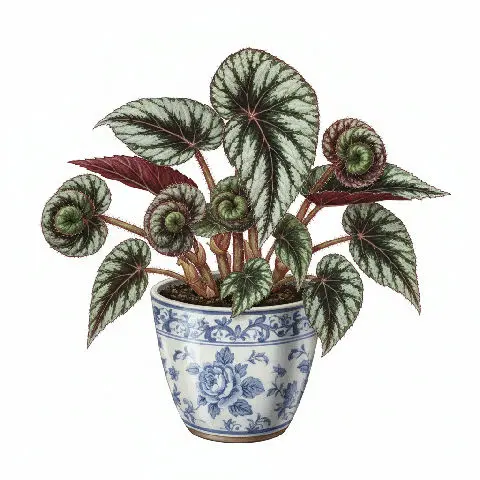
Begonia rex 'Escargot' is a captivating cultivar within the Begonia rex species, widely recognized as the Painted-leaf Begonia or Fancy-leaf Begonia. This particular variety is a marvel of botanical artistry, primarily cherished for its extraordinary ornamental foliage rather than traditional medicinal applications. Its ancestry traces back to the humid, subtropical to tropical forests of Northeast India, Southern China, and Vietnam, where wild Begonia species thrive in the undergrowth.
The 'Escargot' cultivar is immediately identifiable by its truly unique, spiraled leaf pattern, which strikingly resembles a snail’s shell, giving rise to its charming common name. Each mature leaf presents a captivating palette of silvery-green, dramatically contrasting with a prominent, dark purplish-black spiral center and distinct dark green margins. The leaf surface often exhibits a velvety, iridescent texture, a result of numerous fine trichomes.
Growing to a modest height of six to twelve inches, 'Escargot' forms a compact, mounding plant. While it does produce small, pale pink flowers, they are generally inconspicuous and do not contribute significantly to its aesthetic appeal, which is dominated by its intricate and colorful foliage. Its taxonomic placement within the Begoniaceae family underscores its rich diversity and complex hybridization history.
Trusted Scientific References
1. Authoritative external sources for Begonia rex Escargot
1.1 Wikipedia — Begonia rex Escargot
1.2 Kew POWO (Plants of the World Online)
1.3 PubMed — peer-reviewed research
1.4 NCBI Taxonomy Browser
1.5 GBIF — Global Biodiversity
1.6Begonia Rex Escargot should be interpreted through verified botanical identity, practical care, and responsible safety language. This recovery note adds the missing context needed for a complete profile: match light to the plant's habit, use well-drained soil, water according to season, and avoid unsupported medicinal or edible claims. For publishing, the plant can be presented as a source-backed indoor plant with clear care guidance, common problem diagnosis, and conservative safety wording.
1.1.Begonia Rex Escargot — Key Features
- ✓ <strong>Distinctive 'Escargot' spiral</strong> — Distinctive 'Escargot' spiral leaf pattern, uniquely resembling a snail's shell.
- ✓ <strong>Striking foliage coloration</strong> — silvery-green with a prominent dark purplish-black spiral center and dark green margins.
- ✓ <strong>Velvety leaf texture,</strong> — Velvety leaf texture, imparted by a dense covering of fine trichomes on the surface.
- ✓ <strong>Thrives in full</strong> — Thrives in full to partial shade, making it highly suitable for low-light indoor areas and shaded outdoor spots.
- ✓ <strong>Requires high ambient</strong> — Requires high ambient humidity for optimal growth, contributing to lush, healthy leaves.
- ✓ <strong>Considered deer and</strong> — Considered deer and rabbit resistant due to the unpalatability of its hairy foliage.
- ✓ <strong>Highly versatile for</strong> — Highly versatile for container gardening, hanging baskets, and as a prized indoor ornamental plant.
- ✓ <strong>Capable of being</strong> — Capable of being overwintered indoors as an active houseplant or in a dormant state in cooler climates.
- ✓ <strong>Primarily grown for</strong> — Primarily grown for its elaborate and colorful leaves, with its small, pale pink flowers being largely inconspicuous.
- ✓ <strong>Adds unique architectural</strong> — Adds unique architectural interest and a touch of exoticism to diverse plant arrangements and interior designs.
1.2.Begonia Rex Escargot — Quick Summary
- ✓ Stunning ornamental foliage plant with distinctive snail-shell spiral leaves and vibrant coloration.
- ✓ Primarily valued for its exceptional aesthetic appeal and unique texture, not traditional medicinal uses.
- ✓ Thrives in shaded, humid environments, making it an ideal choice for indoor cultivation and container gardens.
- ✓ Contains calcium oxalates, rendering it toxic if ingested by humans or pets, requiring careful placement.
- ✓ Requires specific care regarding watering, humidity, and light to prevent common fungal diseases and ensure vigorous growth.
- ✓ A popular and rewarding choice for adding dramatic visual interest and exotic flair to any plant collection or shaded landscape.
2.Begonia Rex Escargot — Scientific Identity
3.Begonia Rex Escargot — Quick Facts
4.Begonia Rex Escargot — Appearance & Identification
5.Begonia Rex Escargot — Native Habitat
6.Begonia Rex Escargot — Water Requirements
- ✓ Light Requirements — Prefers full shade to partial shade, requiring bright, indirect light; avoid direct afternoon sun to prevent leaf scorch and maintain leaf coloration.
- ✓ Soil & Drainage — Thrives in well-drained, rich organic soil; a blend of high-quality organic potting soil and finished compost (approximately 50:50 ratio) is ideal for container growing.
- ✓ Humidity & Airflow — Demands high ambient humidity, which can be provided by humidity trays indoors, but also requires good air circulation to prevent fungal diseases.
- ✓ Watering Practices — Water thoroughly when the top inch of soil feels dry to the touch, directing water to the soil base and keeping foliage as dry as possible to prevent leaf spot and rot.
- ✓ Fertilization Schedule — Apply a diluted organic, water-soluble houseplant fertilizer every two to three weeks from spring through early autumn; cease fertilization during winter dormancy or reduced indoor growth.
- ✓ Temperature & Overwintering — Protect from temperatures below 55°F (13°C); overwinter indoors as a houseplant in bright, indirect light or induce dormancy in a cool (50-60°F), dimly lit area.
- ✓ Pest & Disease Management — Monitor regularly for common issues such as powdery mildew, botrytis, and root rot, often exacerbated by overwatering or poor air circulation; remove dead foliage promptly.
- ✓ Propagation — Easily propagated from stem or leaf cuttings placed in a humid environment, allowing for the regeneration of new plants from existing stock.
Reviewed by the Flora Medical Global Botanical Review Panel
Multi-disciplinary editorial group · Botany · Ethnobotany · Herbal-medicine literature
Who reviewed this: This page was checked by the Flora Medical Global Botanical Review Panel — an in-house editorial group of botany graduates, ethnobotany researchers, and horticulture practitioners who collectively maintain our 7,000+ plant encyclopedia. Meet the team.
Our 4-step verification process
1. Taxonomic verification
Scientific names and synonyms cross-checked against Kew POWO, World Flora Online, and The Plant List.
2. Phytochemical & medicinal cross-reference
Active compounds, traditional uses, and reported activities are cross-referenced with PubMed, USDA Dr. Duke's database, and peer-reviewed ethnobotanical literature.
3. Conservation & distribution check
Distribution, ecology, and conservation status confirmed against GBIF occurrence records and the IUCN Red List.
4. Editorial & safety review
Every entry passes an editorial pass for clarity, originality, and safety notices (toxicity, contraindications, dosage caveats) before publication.
Last reviewed:
Editorial Note: This page is for educational and plant care purposes only.
Written by: Flora Medical Global Editorial Team
Reviewed by: Flora Medical Global Botanical Review Panel
Last Updated: June 15, 2026







Begonia Rex Escargot — Comments & Community Reviews
Rate this plant