


Care Disclaimer: Plant care recommendations are general guidelines based on common growing conditions. Individual results may vary based on your local environment, climate, and care routine. If your plant is toxic, keep it away from children and pets, and consult a veterinarian if accidental ingestion occurs.
1.Bird Nest Fern — Overview
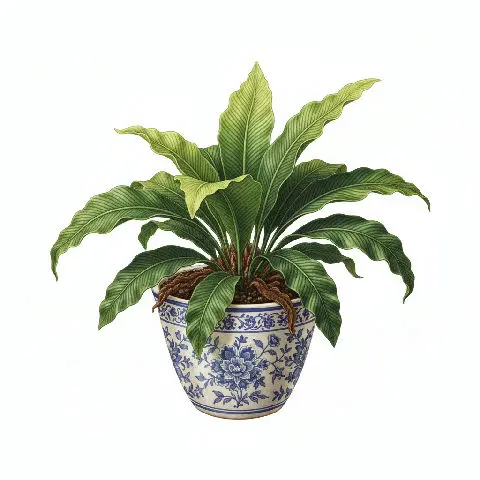
The Bird's Nest Fern, scientifically known as Asplenium nidus, is a striking epiphytic herbaceous perennial belonging to the Aspleniaceae family. This captivating fern is characterized by its dramatic, apple-green, strap-shaped fronds that unfurl from a central, tight rosette, creating a distinctive nest-like appearance. These large, simple, undivided fronds can reach 2 to 4 feet in length and width, featuring a prominent, dark brown or black midrib and often wavy, crisped, or even crested margins depending on the cultivar.
Unlike many fern species with bipinnate or tripinnate fronds, A. nidus exhibits a unique, unlobed lamina. It does not produce flowers or fruits, reproducing instead by spores located in linear sori arranged in herringbone patterns on the underside of mature fronds, parallel to the midrib.
Native to tropical and subtropical regions across Asia, Australia, East Africa, and numerous Pacific islands, Asplenium nidus thrives in the understory of rainforests. Here, it typically grows epiphytically on tree trunks or rocks, using its funnel-shaped rosette to efficiently trap falling leaf litter and other organic detritus.
This accumulated debris creates its own nutrient-rich compost pile, which the fern utilizes for sustenance, highlighting its remarkable adaptability as a litter trapper. While primarily valued for its ornamental beauty in horticulture since the Victorian era, its ecological role in nutrient cycling within its natural habitat is equally significant.
Trusted Scientific References
1. Authoritative external sources for Asplenium nidus
1.1 Wikipedia — Asplenium nidus
1.2 Kew POWO (Plants of the World Online)
1.3 PubMed — peer-reviewed research
1.4 NCBI Taxonomy Browser
1.5 GBIF — Global Biodiversity
1.6Bird Nest Fern should be interpreted through verified botanical identity, practical care, and responsible safety language. This recovery note adds the missing context needed for a complete profile: match light to the plant's habit, use well-drained soil, water according to season, and avoid unsupported medicinal or edible claims. For publishing, the plant can be presented as a source-backed indoor plant with clear care guidance, common problem diagnosis, and conservative safety wording.
1.1.Bird Nest Fern — Key Features
- ✓ <strong>Distinctive Rosette Formation</strong> — Fronds grow in a funnel-shaped cluster resembling a bird's nest.
- ✓ <strong>Large, Undivided Fronds</strong> — Glossy, bright green, strap-shaped leaves that can reach significant sizes.
- ✓ <strong>Epiphytic Growth Habit</strong> — Naturally grows on other plants or rocks for support, not typically in soil.
- ✓ <strong>Prominent Dark Midrib</strong> — A defining characteristic running centrally through each frond.
- ✓ <strong>Spore Reproduction</strong> — Reproduces via linear sori arranged on the underside of mature fronds.
- ✓ <strong>High Humidity Requirement</strong> — Thrives in moist, humid environments, crucial for its health.
- ✓ <strong>Shade Tolerant</strong> — Prefers indirect light conditions, susceptible to scorching from direct sun.
- ✓ <strong>Natural Litter Trapper</strong> — Its rosette collects organic debris, creating its own nutrient source.
- ✓ <strong>Ornamental Appeal</strong> — Highly valued as an indoor houseplant and for tropical landscape design.
- ✓ <strong>Diverse Cultivars</strong> — Many varieties exist with unique frond margins, including wavy, crisped, or crested forms.
1.2.Bird Nest Fern — Quick Summary
- ✓ Ornamental Epiphyte — Prized for its lush, nest-like fronds and natural epiphytic growth habit.
- ✓ Tropical Native — Thrives in warm, humid rainforest understories across Asia, Australia, and the Pacific.
- ✓ Traditional Uses — Folk medicine suggests diuretic, anti-inflammatory, and general wellness benefits.
- ✓ Low Maintenance Houseplant — Adaptable to indoor environments with indirect light and consistent moisture.
- ✓ Unique Frond Structure — Features large, simple, undivided fronds with a prominent dark midrib.
- ✓ Air Purifier — Contributes to improved indoor air quality, making it a valuable home addition.
2.Bird Nest Fern — Scientific Identity
3.Bird Nest Fern — Quick Facts
4.Bird Nest Fern — Appearance & Identification
5.Bird Nest Fern — Native Habitat
6.Bird Nest Fern — Water Requirements
- ✓ Light Requirements — Prefers partial to full shade; direct sunlight can scorch its fronds, leading to yellowing and stunted growth.
- ✓ Soil & Substrate — Thrives in rich, moist, porous, well-draining soil, or as an epiphyte on tree trunks or rocks with minimal growing media.
- ✓ Humidity & Temperature — Requires high humidity (70-80% ideal) and warm temperatures (60-70°F, 15-21°C); protect from temperatures below 40°F (4°C).
- ✓ Watering — Keep soil consistently moist but never waterlogged; allow the top inch to dry slightly between waterings, as it is not drought-tolerant.
- ✓ Fertilization — During periods of active growth (spring and summer), apply a diluted liquid fertilizer monthly, avoiding direct application into the central nest.
- ✓ Repotting — Repot when the plant becomes root-bound, typically in spring, using a well-aerated fern or orchid potting mix.
- ✓ Propagation — Primarily by spores, which can be collected from mature sori, though clump division is possible for very large, established plants.
Reviewed by the Flora Medical Global Botanical Review Panel
Multi-disciplinary editorial group · Botany · Ethnobotany · Herbal-medicine literature
Who reviewed this: This page was checked by the Flora Medical Global Botanical Review Panel — an in-house editorial group of botany graduates, ethnobotany researchers, and horticulture practitioners who collectively maintain our 7,000+ plant encyclopedia. Meet the team.
Our 4-step verification process
1. Taxonomic verification
Scientific names and synonyms cross-checked against Kew POWO, World Flora Online, and The Plant List.
2. Phytochemical & medicinal cross-reference
Active compounds, traditional uses, and reported activities are cross-referenced with PubMed, USDA Dr. Duke's database, and peer-reviewed ethnobotanical literature.
3. Conservation & distribution check
Distribution, ecology, and conservation status confirmed against GBIF occurrence records and the IUCN Red List.
4. Editorial & safety review
Every entry passes an editorial pass for clarity, originality, and safety notices (toxicity, contraindications, dosage caveats) before publication.
Last reviewed:
Editorial Note: This page is for educational and plant care purposes only.
Written by: Flora Medical Global Editorial Team
Reviewed by: Flora Medical Global Botanical Review Panel
Last Updated: June 15, 2026







Bird Nest Fern — Comments & Community Reviews
Rate this plant