


Care Disclaimer: Plant care recommendations are general guidelines based on common growing conditions. Individual results may vary based on your local environment, climate, and care routine. If your plant is toxic, keep it away from children and pets, and consult a veterinarian if accidental ingestion occurs.
1.Bishop Cap Cactus — Overview
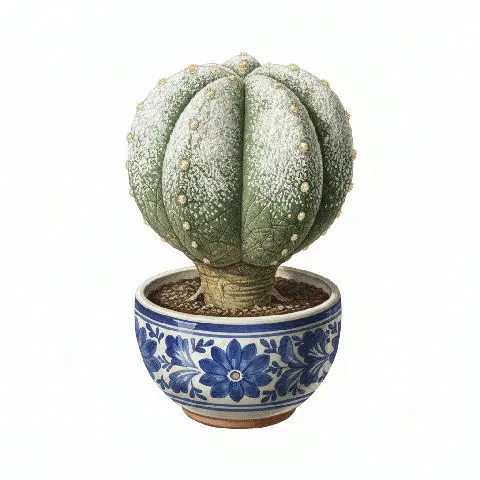
Astrophytum myriostigma, widely recognized as Bishop's Cap Cactus or Bishop's Miter Cactus, is an extraordinary spineless succulent indigenous to the arid Chihuahuan Desert regions of northeastern and central Mexico. Its scientific nomenclature, derived from the Greek 'astro' (star) and 'phyton' (plant), aptly describes its frequently star-shaped, ribbed morphology, while 'myriostigma' refers to the numerous minute white flecks, or trichomes, that adorn its surface, giving it a speckled appearance. This iconic member of the Cactaceae family is highly coveted by botanical collectors for its distinct architectural form and relatively undemanding care requirements. Unlike many cacti species, A. myriostigma characteristically lacks spines, instead presenting a smooth, often heavily mottled, glaucous-green or grey-green epidermis.
It typically exhibits 3 to 8 prominent vertical ribs, with the five-ribbed variant being the most classic and visually resembling a bishop's miter hat, hence its common name. Mature specimens of Bishop's Cap Cactus can attain a height of 10-25 cm and a diameter of 10-20 cm, developing slowly into a solitary, globose to columnar stem over many years. Its deeply lobed, often star-shaped body is covered with fine, fuzzy, white scales (trichomes) which serve several critical ecological functions: reflecting intense desert sunlight, mitigating water loss through transpiration by trapping a layer of insulating air, and potentially deterring herbivory. These trichomes are a key diagnostic feature, aiding in its distinction from other Astrophytum species. The flowering period typically spans late spring to early summer, producing solitary, funnel-shaped, glossy yellow flowers, often with a reddish throat, that emerge from the plant's apex.
These flowers are diurnal, opening during the day and closing at night, and are primarily pollinated by insects. Following successful pollination, small, fuzzy, reddish-green, star-shaped fruits develop, eventually dehiscing to release numerous tiny, dark brown to black seeds. Ecologically, A. myriostigma thrives in arid and semi-arid environments, frequently found inhabiting rocky hillsides, limestone outcrops, and sandy flats.
Trusted Scientific References
1. Authoritative external sources for Astrophytum myriostigma
1.1 Wikipedia — Astrophytum myriostigma
1.2 Kew POWO (Plants of the World Online)
1.3 PubMed — peer-reviewed research
1.4 NCBI Taxonomy Browser
1.5 GBIF — Global Biodiversity
1.1.Bishop Cap Cactus — Key Features
- ✓ <strong>Botanical Name</strong> — Astrophytum myriostigma
- ✓ <strong>Common Names</strong> — Bishop's Cap Cactus, Bishop's Miter Cactus, Star Cactus, Monk's Hood, Deacons Hat.
- ✓ <strong>Family</strong> — Cactaceae
- ✓ <strong>Origin</strong> — Chihuahuan Desert, Mexico.
- ✓ <strong>Appearance</strong> — Spineless, globose to columnar stem, typically 5-ribbed, covered in dense white stellate trichomes.
- ✓ <strong>Flowers</strong> — Solitary, funnel-shaped, glossy yellow, often with a reddish throat, diurnal.
- ✓ <strong>Growth Rate</strong> — Slow-growing.
- ✓ <strong>Care Level</strong> — Easy, low maintenance, highly drought-tolerant.
- ✓ <strong>Toxicity</strong> — Non-toxic to humans and pets.
- ✓ <strong>Primary Use</strong> — Ornamental and horticultural specimen.
1.2.Bishop Cap Cactus — Quick Summary
- ✓ Spineless ornamental cactus, native to Mexico's Chihuahuan Desert.
- ✓ Distinctive star-shaped, ribbed body covered in white, fuzzy flecks (trichomes).
- ✓ Low-maintenance, drought-tolerant, ideal for collectors and xeriscaping.
- ✓ Produces glossy yellow, diurnal flowers in late spring to early summer.
- ✓ Primarily valued for aesthetic appeal; no documented medicinal uses for humans.
- ✓ Non-toxic to humans and pets, but requires careful watering to prevent root rot.
2.Bishop Cap Cactus — Scientific Identity
3.Bishop Cap Cactus — Quick Facts
4.Bishop Cap Cactus — Appearance & Identification
5.Bishop Cap Cactus — Native Habitat
6.Bishop Cap Cactus — Water Requirements
- ✓ Light — Provide bright, indirect sunlight when grown indoors; outdoors, prefer a location with partial shade to full sun (minimum 6 hours), ensuring protection from intense afternoon sun, especially in hot climates.
- ✓ Soil — Plant in well-drained, sandy soil; a specialized cactus potting mix or a homemade blend of equal parts perlite, coarse sand, and a good natural potting soil is ideal.
- ✓ Watering — During the growing season (spring to early fall), water deeply but infrequently, allowing the soil to dry out completely between watering sessions; significantly reduce watering to once a month or less in winter during dormancy.
- ✓ Fertilization — Lightly fertilize once a year in spring during the active growing season using a balanced (5-10-5), water-soluble NPK fertilizer diluted to half strength, and avoid over-fertilizing or fertilizing during dormancy.
- ✓ Temperature — Optimal indoor temperatures range from 70-85°F (21-29°C) during the growing season; avoid exposure to temperatures below 50°F (10°C), and aim for around 60°F (15°C) in winter for dormancy.
- ✓ Hardiness Zones — Suitable for outdoor cultivation in USDA Hardiness Zones 9-11, where it can be grown year-round without special protection from cold.
- ✓ Potting — Always use pots with adequate drainage holes to prevent waterlogging and subsequent root rot, which is a common issue for cacti.
Reviewed by the Flora Medical Global Botanical Review Panel
Multi-disciplinary editorial group · Botany · Ethnobotany · Herbal-medicine literature
Who reviewed this: This page was checked by the Flora Medical Global Botanical Review Panel — an in-house editorial group of botany graduates, ethnobotany researchers, and horticulture practitioners who collectively maintain our 7,000+ plant encyclopedia. Meet the team.
Our 4-step verification process
1. Taxonomic verification
Scientific names and synonyms cross-checked against Kew POWO, World Flora Online, and The Plant List.
2. Phytochemical & medicinal cross-reference
Active compounds, traditional uses, and reported activities are cross-referenced with PubMed, USDA Dr. Duke's database, and peer-reviewed ethnobotanical literature.
3. Conservation & distribution check
Distribution, ecology, and conservation status confirmed against GBIF occurrence records and the IUCN Red List.
4. Editorial & safety review
Every entry passes an editorial pass for clarity, originality, and safety notices (toxicity, contraindications, dosage caveats) before publication.
Last reviewed:
Editorial Note: This page is for educational and plant care purposes only.
Written by: Flora Medical Global Editorial Team
Reviewed by: Flora Medical Global Botanical Review Panel
Last Updated: June 15, 2026







Bishop Cap Cactus — Comments & Community Reviews
Rate this plant