


Care Disclaimer: Plant care recommendations are general guidelines based on common growing conditions. Individual results may vary based on your local environment, climate, and care routine. If your plant is toxic, keep it away from children and pets, and consult a veterinarian if accidental ingestion occurs.
1.Boston Fern — Overview
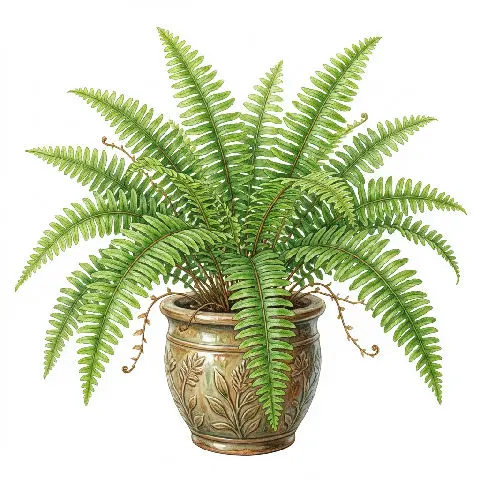
The Boston Fern, scientifically known as Nephrolepis exaltata, and often referred to as Sword Fern, is a highly cherished evergreen plant renowned for its dense, gracefully arching, and feathery fronds. It typically presents a vibrant pale- to medium-green hue, with individual fronds capable of reaching lengths of up to four feet and widths of six inches.
This species is characterized by its broad fronds featuring alternate leaflets, or pinnae, arranged symmetrically along the central midrib. Near the margins on the underside of these pinnae, two rows of round sori—clusters of spore-bearing organs—are visible, indicative of its classification as a seedless vascular plant.
Native to the humid, tropical, and subtropical forests spanning from northern South America through Mexico, Florida, and the West Indies, Nephrolepis exaltata thrives in environments rich in moisture. While the species itself can have more erect fronds, the popular 'Bostoniensis' variant, discovered in 1894, is particularly noted for its distinctive, pendulous foliage. The plant readily sends out long, slender runners, known as stolons, which root upon contact with the ground, facilitating its natural propagation.
Though hardy outdoors only in USDA Zones 9 to 11, the Boston Fern has become a globally popular indoor houseplant, easily adapting to container culture. Its aesthetic appeal, combined with its robust nature, makes it a staple in homes and offices worldwide, often displayed in hanging baskets or on elevated stands to showcase its cascading fronds.
Trusted Scientific References
1. Authoritative external sources for Nephrolepis exaltata
1.1 Wikipedia — Nephrolepis exaltata
1.2 Kew POWO (Plants of the World Online)
1.3 PubMed — peer-reviewed research
1.4 NCBI Taxonomy Browser
1.5 GBIF — Global Biodiversity
1.6Boston Fern should be interpreted through verified botanical identity, practical care, and responsible safety language. This recovery note adds the missing context needed for a complete profile: match light to the plant's habit, use well-drained soil, water according to season, and avoid unsupported medicinal or edible claims. For publishing, the plant can be presented as a source-backed indoor plant with clear care guidance, common problem diagnosis, and conservative safety wording.
1.1.Boston Fern — Key Features
- ✓ <strong>Lush, arching, feathery</strong> — Lush, arching, feathery green fronds creating a dense canopy.
- ✓ <strong>Scientifically recognized for</strong> — Scientifically recognized for superior indoor air purification capabilities (NASA Clean Air Study).
- ✓ <strong>Highly effective at</strong> — Highly effective at removing formaldehyde, xylene, and toluene from the air.
- ✓ <strong>Non</strong> — toxic to both humans and household pets, ensuring peace of mind.
- ✓ <strong>Native to tropical</strong> — Native to tropical and subtropical regions, thriving in high humidity.
- ✓ <strong>Adaptable to container</strong> — Adaptable to container culture, making it an ideal houseplant globally.
- ✓ <strong>Propagates easily via</strong> — Propagates easily via division of rhizomes or rooting of stolons.
- ✓ <strong>Indirectly contributes to</strong> — Indirectly contributes to reducing symptoms of 'sick building syndrome'.
- ✓ <strong>Requires medium</strong> — bright, indirect light and consistently moist, well-draining soil.
- ✓ <strong>Enhances indoor aesthetics</strong> — Enhances indoor aesthetics with its vibrant foliage and graceful form.
1.2.Boston Fern — Quick Summary
- ✓ Popular ornamental houseplant known for lush, arching fronds.
- ✓ Exceptional natural air purifier, removing formaldehyde and other VOCs.
- ✓ Non-toxic to humans and pets, making it a safe household addition.
- ✓ Thrives in humid environments with indirect light and consistent moisture.
- ✓ Contributes to improved indoor air quality and reduced 'sick building syndrome' symptoms.
- ✓ Relatively low-maintenance, ideal for hanging baskets and elevated displays.
2.Boston Fern — Scientific Identity
3.Boston Fern — Quick Facts
4.Boston Fern — Appearance & Identification
5.Boston Fern — Native Habitat
6.Boston Fern — Water Requirements
- ✓ Light — Position in medium bright, indirect light; ideal spots include an east-facing window or behind a sheer curtain in south/west windows.
- ✓ Temperature — Prefers night temperatures around 65°F (18°C) and day temperatures not exceeding 95°F (35°C); protect from temperatures below 40°F (4°C).
- ✓ Soil — Use a well-drained yet moisture-retaining potting medium, such as a mix of peat moss and vermiculite, to ensure consistent moisture without waterlogging.
- ✓ Watering — Keep the potting medium consistently moist but never saturated; Boston Ferns are more drought-tolerant than many other ferns but thrive with regular moisture.
- ✓ Humidity — Requires high humidity; misting regularly, using a pebble tray, or grouping with other plants can help prevent frond tips from browning in dry indoor air.
- ✓ Fertilization — Feed with a balanced liquid or slow-release houseplant fertilizer at half strength every 4-6 weeks during active growth, reducing frequency significantly in winter.
- ✓ Propagation — Easily propagated by dividing the root ball every few years in spring or by rooting the long runners (stolons) that the plant produces.
- ✓ Pest Management — Monitor for common indoor pests like scales and mealybugs; remove affected fronds or treat with horticultural oil or insecticidal soap if necessary.
Reviewed by the Flora Medical Global Botanical Review Panel
Multi-disciplinary editorial group · Botany · Ethnobotany · Herbal-medicine literature
Who reviewed this: This page was checked by the Flora Medical Global Botanical Review Panel — an in-house editorial group of botany graduates, ethnobotany researchers, and horticulture practitioners who collectively maintain our 7,000+ plant encyclopedia. Meet the team.
Our 4-step verification process
1. Taxonomic verification
Scientific names and synonyms cross-checked against Kew POWO, World Flora Online, and The Plant List.
2. Phytochemical & medicinal cross-reference
Active compounds, traditional uses, and reported activities are cross-referenced with PubMed, USDA Dr. Duke's database, and peer-reviewed ethnobotanical literature.
3. Conservation & distribution check
Distribution, ecology, and conservation status confirmed against GBIF occurrence records and the IUCN Red List.
4. Editorial & safety review
Every entry passes an editorial pass for clarity, originality, and safety notices (toxicity, contraindications, dosage caveats) before publication.
Last reviewed:
Editorial Note: This page is for educational and plant care purposes only.
Written by: Flora Medical Global Editorial Team
Reviewed by: Flora Medical Global Botanical Review Panel
Last Updated: June 15, 2026







Boston Fern — Comments & Community Reviews
Rate this plant