


Care Disclaimer: Plant care recommendations are general guidelines based on common growing conditions. Individual results may vary based on your local environment, climate, and care routine. If your plant is toxic, keep it away from children and pets, and consult a veterinarian if accidental ingestion occurs.
1.Bottle Palm — Overview
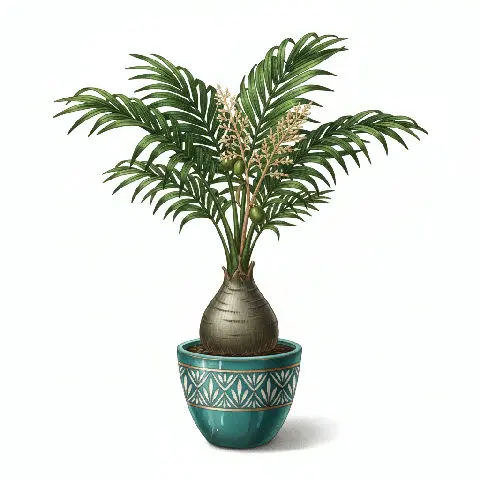
The Bottle Palm, scientifically classified as Hyophorbe lagenicaulis, is a highly distinctive member of the Arecaceae family, celebrated for its unique trunk morphology that strikingly resembles a swollen bottle or flask. This characteristic is most pronounced in younger specimens, gradually becoming more elongated and less bulbous with age.
Native exclusively to Round Island (Île Ronde), a small, uninhabited islet off the coast of Mauritius in the Mascarene Islands, its natural habitat consists of volcanic, well-draining soils and a warm, humid climate. Discovered and formally described in the early 19th century, its unusual form quickly captivated botanists and horticulturists alike.
Botanically, Hyophorbe lagenicaulis is one of only five species within the genus Hyophorbe. Mature Bottle Palms typically reach heights of 10 to 20 feet (3 to 6 meters), though cultivated indoor specimens are often smaller. The iconic trunk, initially bulbous at the base, tapers upwards and is often topped by a relatively small crown of 4-8 pinnate leaves.
These leaves, each growing 6-10 feet (1.8-3 meters) long, are arching and composed of numerous stiff, V-shaped leaflets, imparting a feathery, elegant appearance to the canopy. Contrary to a common misconception, the swollen trunk does not primarily serve as a water storage organ, though the palm exhibits moderate drought tolerance once established. The inflorescence emerges from below the crownshaft, bearing small, creamy-white to yellowish bisexual flowers.
These develop into small, round to oblong fruits, approximately 1 inch (2.5 cm) in diameter, which transition from green to blackish-purple when ripe. Its slow growth rate, combined with its distinctive aesthetic, makes the Bottle Palm a prized ornamental plant for conservatories, tropical gardens, and as a low-maintenance indoor specimen. Critically endangered in its native range due to habitat loss and competition from invasive species, cultivation efforts are vital for its global survival, primarily for its aesthetic contribution to tropical landscapes.
Trusted Scientific References
1. Authoritative external sources for Hyophorbe lagenicaulis
1.1 Wikipedia — Hyophorbe lagenicaulis
1.2 Kew POWO (Plants of the World Online)
1.3 PubMed — peer-reviewed research
1.4 NCBI Taxonomy Browser
1.5 GBIF — Global Biodiversity
1.1.Bottle Palm — Key Features
- ✓ <strong>Distinctive Bottle</strong> — Shaped Trunk — Unique, swollen base tapering upwards, especially prominent in juvenile plants.
- ✓ <strong>Native to Mascarene Islands</strong> — Endemic to Round Island, Mauritius, highlighting its rare and endangered status.
- ✓ <strong>Pinnate Leaves</strong> — Crown of 4-8 arching, feathery leaves with stiff, V-shaped leaflets.
- ✓ <strong>Slow Growth Rate</strong> — Matures slowly, reaching 10-20 feet over many years, making it ideal for smaller spaces and containers.
- ✓ <strong>Cold Sensitive</strong> — Requires warm, tropical to subtropical climates; susceptible to frost damage.
- ✓ <strong>Salt Tolerant</strong> — Adaptable to coastal environments, tolerating saline conditions.
- ✓ <strong>Moderate Drought Tolerance</strong> — Established plants can withstand periodic dry spells, though regular watering is preferred.
- ✓ <strong>Ornamental Value</strong> — Primarily cultivated for its aesthetic appeal in tropical gardens and as an indoor specimen.
- ✓ <strong>Arecaceae Family Member</strong> — Belongs to the palm family, sharing general botanical characteristics with other palms.
1.2.Bottle Palm — Quick Summary
- ✓ Iconic bottle-shaped trunk, highly ornamental.
- ✓ Critically endangered native to Round Island, Mauritius.
- ✓ Slow-growing, moderately drought-tolerant palm.
- ✓ Prefers warm climates (USDA Zones 10B-11) and well-draining soil.
- ✓ Not documented for any traditional or modern medicinal uses.
- ✓ Prized for tropical landscaping and container cultivation.
2.Bottle Palm — Scientific Identity
3.Bottle Palm — Quick Facts
4.Bottle Palm — Appearance & Identification
5.Bottle Palm — Native Habitat
6.Bottle Palm — Water Requirements
- ✓ Soil Requirements — Prefers well-draining soil; sandy or volcanic loam is ideal. Amend heavy soils with sand or perlite to improve drainage.
- ✓ Light Exposure — Thrives in full sun to partial shade. Too much shade can cause the crownshaft to elongate and lean towards light, altering its iconic shape.
- ✓ Watering — Requires regular irrigation during dry spells to maintain optimal appearance; moderately drought-tolerant once established but dislikes overly wet conditions.
- ✓ Fertilization Schedule — Feed with a slow-release granular palm fertilizer three times a year (spring, summer, autumn) to support healthy growth, as it is not a 'hungry' palm.
- ✓ Cold Protection — Highly cold-sensitive; best grown in USDA Zones 10B-11. In Zone 10A, protect from frost by wrapping the crown and trunk during cold snaps.
- ✓ Pruning — Self-cleaning is not typical, but due to slow growth, old fronds rarely need trimming. Remove only completely dead fronds to avoid stressing the palm.
- ✓ Spacing — Can be planted as close as 4-6 feet apart in groups or lines. Allow at least 6 feet from structures for frond spread; multi-trunk specimens require more space.
Reviewed by the Flora Medical Global Botanical Review Panel
Multi-disciplinary editorial group · Botany · Ethnobotany · Herbal-medicine literature
Who reviewed this: This page was checked by the Flora Medical Global Botanical Review Panel — an in-house editorial group of botany graduates, ethnobotany researchers, and horticulture practitioners who collectively maintain our 7,000+ plant encyclopedia. Meet the team.
Our 4-step verification process
1. Taxonomic verification
Scientific names and synonyms cross-checked against Kew POWO, World Flora Online, and The Plant List.
2. Phytochemical & medicinal cross-reference
Active compounds, traditional uses, and reported activities are cross-referenced with PubMed, USDA Dr. Duke's database, and peer-reviewed ethnobotanical literature.
3. Conservation & distribution check
Distribution, ecology, and conservation status confirmed against GBIF occurrence records and the IUCN Red List.
4. Editorial & safety review
Every entry passes an editorial pass for clarity, originality, and safety notices (toxicity, contraindications, dosage caveats) before publication.
Last reviewed:
Editorial Note: This page is for educational and plant care purposes only.
Written by: Flora Medical Global Editorial Team
Reviewed by: Flora Medical Global Botanical Review Panel
Last Updated: June 15, 2026







Bottle Palm — Comments & Community Reviews
Rate this plant