


Care Disclaimer: Plant care recommendations are general guidelines based on common growing conditions. Individual results may vary based on your local environment, climate, and care routine. If your plant is toxic, keep it away from children and pets, and consult a veterinarian if accidental ingestion occurs.
1.Bromeliad — Overview
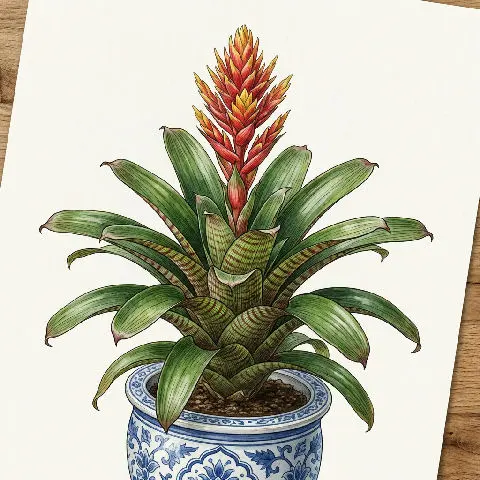
Guzmania lingulata, widely recognized as the Scarlet Star or Tongue Guzmania, is a captivating epiphytic herbaceous perennial belonging to the diverse Bromeliaceae family. Native to the lush tropical rainforests spanning Central and South America, its natural distribution extends from Southern Mexico, through the West Indies, and southward into Brazil and Bolivia. This species is particularly admired for its striking, long-lasting inflorescence, which consists of brightly colored floral bracts, rather than its true flowers, which are comparatively small and less conspicuous. The plant's historical presence in its native habitat suggests indigenous communities would have observed its remarkable resilience and unique ability to collect and store water within its central rosette.
The specific epithet 'lingulata' aptly describes its tongue-shaped leaves, which form a dense, gracefully arching rosette of smooth-margined, vibrant green foliage. The showy bracts, which can display vivid shades of red, orange, yellow, or purple, encircle a cluster of tiny white or yellow true flowers. These brilliant bracts can retain their color for several months, making Guzmania lingulata an exceptionally popular ornamental houseplant globally. Ecologically, this bromeliad plays a vital role in its native ecosystems, creating microhabitats within its water-filled central cup for various small organisms.
Its epiphytic nature means it thrives by growing on other plants, primarily trees, without being parasitic, instead absorbing moisture and nutrients from the air and decaying organic matter that accumulates around its base. While its primary significance has historically been ornamental due to its stunning visual appeal, modern pharmacological research is beginning to explore its phytochemical composition, though direct medicinal applications are not extensively documented in established ethnomedical systems like Ayurveda, TCM, or Unani.
Trusted Scientific References
1. Authoritative external sources for Guzmania lingulata
1.1 Wikipedia — Guzmania lingulata
1.2 Kew POWO (Plants of the World Online)
1.3 PubMed — peer-reviewed research
1.4 NCBI Taxonomy Browser
1.5 GBIF — Global Biodiversity
1.1.Bromeliad — Key Features
- ✓ <strong>Striking Floral Bracts</strong> — Features vivid red, orange, yellow, or purple bracts that are the plant's main attraction, lasting for several months.
- ✓ <strong>Epiphytic Growth Habit</strong> — Naturally grows on trees, absorbing nutrients from air and decaying matter, not soil.
- ✓ <strong>Central Water</strong> — Holding Rosette — Forms a 'tank' with its leaves to collect water and nutrients, a characteristic of many bromeliads.
- ✓ <strong>Low Maintenance Houseplant</strong> — Relatively easy to care for indoors, requiring specific watering and light conditions.
- ✓ <strong>Non</strong> — Toxic — Considered safe for pets (dogs, cats, horses) and humans upon contact.
- ✓ <strong>Tropical Aesthetic</strong> — Adds a vibrant, exotic touch to indoor spaces with its lush green foliage and colorful inflorescence.
- ✓ <strong>Air Purifying Qualities</strong> — Contributes to indoor air quality by producing oxygen and potentially filtering some toxins.
- ✓ <strong>Resilient and Adaptable</strong> — Thrives in controlled indoor environments, adapting well to container culture.
- ✓ <strong>Produces 'Pups' for Propagation</strong> — Easily propagated from offshoots that emerge after the main plant flowers and declines.
1.2.Bromeliad — Quick Summary
- ✓ Scarlet Star (Guzmania lingulata) is an epiphytic bromeliad cherished for its vibrant, long-lasting floral bracts.
- ✓ Native to Central and South American rainforests, it thrives in warm, humid, indirect light conditions.
- ✓ Primarily an ornamental houseplant, it is known for its aesthetic appeal and low maintenance.
- ✓ No extensive traditional medicinal uses are documented; modern research explores its phytochemical potential.
- ✓ Generally non-toxic to humans and pets, making it a safe indoor plant choice.
- ✓ Requires specific care for its central water-holding rosette and well-draining substrate.
2.Bromeliad — Scientific Identity
3.Bromeliad — Quick Facts
4.Bromeliad — Appearance & Identification
5.Bromeliad — Native Habitat
6.Bromeliad — Water Requirements
- ✓ Light — Prefers bright, indirect light; avoid direct sun which can scorch leaves, thriving well under artificial lights indoors.
- ✓ Watering — Keep the central cup (tank) filled with distilled or rainwater; flush regularly to prevent stagnation. Water the potting medium sparingly, allowing it to dry slightly between waterings.
- ✓ Humidity — Requires high humidity, typical of its rainforest origin. Consider using a humidifier or placing the pot on a tray of wet pebbles to increase ambient moisture.
- ✓ Substrate — Use a well-draining, airy mix designed for bromeliads or orchids, such as a blend of bark, peat moss, and perlite, to ensure proper root aeration.
- ✓ Temperature — Thrives in warm temperatures, ideally between 65-80°F (18-27°C); protect from cold drafts and temperatures below 60°F (15°C).
- ✓ Fertilization — Fertilize sparingly during the growing season (spring/summer) with a diluted liquid fertilizer applied to the central cup or sprayed on leaves.
- ✓ Propagation — After flowering, the main plant will decline but typically produces 'pups' (offshoots) at its base, which can be separated and grown into new plants once they reach about one-third the size of the mother plant.
Reviewed by the Flora Medical Global Botanical Review Panel
Multi-disciplinary editorial group · Botany · Ethnobotany · Herbal-medicine literature
Who reviewed this: This page was checked by the Flora Medical Global Botanical Review Panel — an in-house editorial group of botany graduates, ethnobotany researchers, and horticulture practitioners who collectively maintain our 7,000+ plant encyclopedia. Meet the team.
Our 4-step verification process
1. Taxonomic verification
Scientific names and synonyms cross-checked against Kew POWO, World Flora Online, and The Plant List.
2. Phytochemical & medicinal cross-reference
Active compounds, traditional uses, and reported activities are cross-referenced with PubMed, USDA Dr. Duke's database, and peer-reviewed ethnobotanical literature.
3. Conservation & distribution check
Distribution, ecology, and conservation status confirmed against GBIF occurrence records and the IUCN Red List.
4. Editorial & safety review
Every entry passes an editorial pass for clarity, originality, and safety notices (toxicity, contraindications, dosage caveats) before publication.
Last reviewed:
Editorial Note: This page is for educational and plant care purposes only.
Written by: Flora Medical Global Editorial Team
Reviewed by: Flora Medical Global Botanical Review Panel
Last Updated: June 15, 2026







Bromeliad — Comments & Community Reviews
Rate this plant