


Care Disclaimer: Plant care recommendations are general guidelines based on common growing conditions. Individual results may vary based on your local environment, climate, and care routine. If your plant is toxic, keep it away from children and pets, and consult a veterinarian if accidental ingestion occurs.
1.Browallia Speciosa — Overview
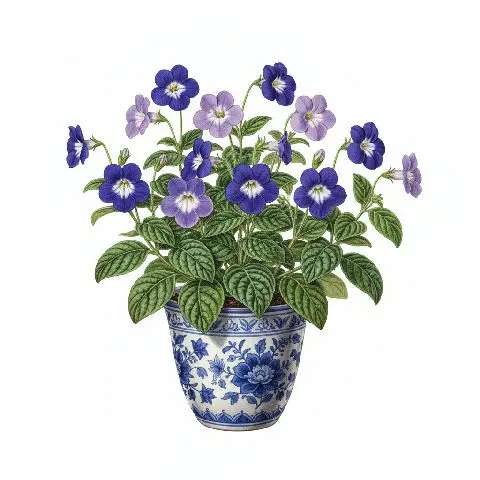
Browallia speciosa, widely recognized as the Sapphire Flower or Bush Violet, is an exquisite flowering herbaceous perennial native to the tropical and subtropical regions of Central and South America, particularly Colombia, Costa Rica, Panama, and Peru. It belongs to the expansive Solanaceae family, a diverse group that also encompasses economically significant plants like tomatoes, potatoes, and various nightshades. This species is celebrated for its striking, trumpet-shaped flowers, which typically display vibrant shades of purplish-blue with distinct white centers, although cultivars with white or lighter blue blooms exist.
Growing as a bushy annual in temperate climates or a short-lived perennial in its native warm zones, Browallia speciosa generally reaches heights and widths of 30 to 60 centimeters (1-2 feet), forming a rounded or cushion-like habit. Its medium-green, ovate to elliptical leaves, measuring 2 to 4 inches long, provide a lush backdrop to the prolific floral display. The genus name 'Browallia' pays homage to Johannes Browallius, an 18th-century Swedish botanist, while 'speciosa' is Latin for 'showy' or 'beautiful,' aptly describing its ornamental allure.
The plant’s abundant blooms typically emerge from late spring through autumn, or nearly year-round in consistently warm environments, making it a favored choice for hanging baskets, containers, and bedding plants globally. While extensive modern pharmacological research specifically on Browallia speciosa is less prevalent compared to other Solanaceae members, general phytochemical screenings suggest the presence of various secondary metabolites characteristic of the family, notably alkaloids, which are known for diverse biological activities.
Trusted Scientific References
1. Authoritative external sources for Browallia speciosa
1.1 Wikipedia — Browallia speciosa
1.2 Kew POWO (Plants of the World Online)
1.3 PubMed — peer-reviewed research
1.4 NCBI Taxonomy Browser
1.5 GBIF — Global Biodiversity
1.6Browallia Speciosa should be interpreted through verified botanical identity, practical care, and responsible safety language. This recovery note adds the missing context needed for a complete profile: match light to the plant's habit, use well-drained soil, water according to season, and avoid unsupported medicinal or edible claims. For publishing, the plant can be presented as a source-backed indoor plant with clear care guidance, common problem diagnosis, and conservative safety wording.
1.1.Browallia Speciosa — Key Features
- ✓ <strong>Botanical Name</strong> — Browallia speciosa, also known as Sapphire Flower or Bush Violet.
- ✓ <strong>Family Affiliation</strong> — Member of the Solanaceae family, the nightshade family.
- ✓ <strong>Native Range</strong> — Indigenous to tropical and subtropical Central and South America.
- ✓ <strong>Striking Blooms</strong> — Produces abundant, showy purplish-blue, trumpet-shaped flowers with white centers.
- ✓ <strong>Growth Habit</strong> — Grows as a bushy annual or short-lived perennial, reaching 1-2 feet in height and width.
- ✓ <strong>Traditional Use</strong> — Historically used by indigenous Colombians for topical toothache relief.
- ✓ <strong>Phytochemical Profile</strong> — Contains alkaloids, flavonoids, and phenolic acids.
- ✓ <strong>Ornamental Value</strong> — Highly valued as an ornamental plant for containers, hanging baskets, and garden beds.
- ✓ <strong>Toxicity Warning</strong> — Considered toxic if ingested, particularly for domestic animals.
- ✓ <strong>Low Maintenance</strong> — Relatively easy to cultivate with moderate growth rate and minimal care requirements.
1.2.Browallia Speciosa — Quick Summary
- ✓ Browallia speciosa is an ornamental flowering plant from the Solanaceae family, native to Central and South America.
- ✓ Known for its vibrant blue/violet trumpet-shaped flowers, it's popular as an annual bedding and container plant.
- ✓ Traditionally, its leaves were used topically in Colombia to relieve toothaches, suggesting local analgesic and antiseptic properties.
- ✓ Phytochemical analysis indicates the presence of alkaloids, flavonoids, and phenolic acids, common to its family.
- ✓ It is toxic if ingested, especially for pets, and internal use is contraindicated for humans.
- ✓ Requires full sun to partial shade, well-drained soil, and consistent moisture for optimal growth.
2.Browallia Speciosa — Scientific Identity
3.Browallia Speciosa — Quick Facts
4.Browallia Speciosa — Appearance & Identification
5.Browallia Speciosa — Native Habitat
6.Browallia Speciosa — Water Requirements
- ✓ Light — Prefers full sun (at least 6 hours direct sunlight) to partial shade (afternoon shade is beneficial in hot climates) for optimal flowering.
- ✓ Soil — Thrives in evenly moist, well-drained soil. Tolerant of various soil textures including sand, loam, and clay, with a preference for slightly acidic to neutral pH.
- ✓ Watering — Requires consistent moisture; avoid both waterlogging and prolonged drought. Over-watering can lead to foliage growth at the expense of blooms.
- ✓ Fertilization — Fertilize sparingly; excessive nutrients can promote leafy growth rather than flower production. A balanced liquid fertilizer every 2-4 weeks during blooming is sufficient.
- ✓ Propagation — Primarily propagated by seeds. Seeds can be sown indoors 6-8 weeks before the last frost or directly outdoors after all danger of frost has passed.
- ✓ Pruning — Pinching back terminal growth encourages a bushier habit and more prolific flowering, enhancing its ornamental appeal.
- ✓ Spacing — Allow 6-8 inches between plants, as Browallia speciosa can spread up to 1-3 feet, ensuring adequate air circulation and growth space.
- ✓ Hardiness — Grown as an annual in most temperate regions, but is a perennial in USDA Hardiness Zones 9-11.
Reviewed by the Flora Medical Global Botanical Review Panel
Multi-disciplinary editorial group · Botany · Ethnobotany · Herbal-medicine literature
Who reviewed this: This page was checked by the Flora Medical Global Botanical Review Panel — an in-house editorial group of botany graduates, ethnobotany researchers, and horticulture practitioners who collectively maintain our 7,000+ plant encyclopedia. Meet the team.
Our 4-step verification process
1. Taxonomic verification
Scientific names and synonyms cross-checked against Kew POWO, World Flora Online, and The Plant List.
2. Phytochemical & medicinal cross-reference
Active compounds, traditional uses, and reported activities are cross-referenced with PubMed, USDA Dr. Duke's database, and peer-reviewed ethnobotanical literature.
3. Conservation & distribution check
Distribution, ecology, and conservation status confirmed against GBIF occurrence records and the IUCN Red List.
4. Editorial & safety review
Every entry passes an editorial pass for clarity, originality, and safety notices (toxicity, contraindications, dosage caveats) before publication.
Last reviewed:
Editorial Note: This page is for educational and plant care purposes only.
Written by: Flora Medical Global Editorial Team
Reviewed by: Flora Medical Global Botanical Review Panel
Last Updated: June 15, 2026







Browallia Speciosa — Comments & Community Reviews
Rate this plant