


Care Disclaimer: Plant care recommendations are general guidelines based on common growing conditions. Individual results may vary based on your local environment, climate, and care routine. If your plant is toxic, keep it away from children and pets, and consult a veterinarian if accidental ingestion occurs.
1.Bulbophyllum Orchid — Overview
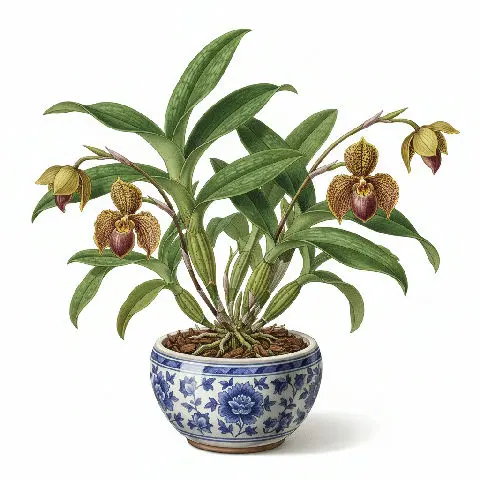
Bulbophyllum lobbii, commonly known as Lobb's Bulbophyllum, stands as a captivating epiphytic orchid species renowned for its remarkably large and often solitary flowers, a distinguishing feature within the vast Bulbophyllum genus. First botanically described by John Lindley in 1847 and named in honor of Thomas Lobb, who collected it in Southeast Asia, this orchid's natural habitat spans across tropical Asia. It thrives in the moist, shaded canopies of ancient rainforests, adhering to tree trunks and branches.
Morphologically, B. lobbii is characterized by its ovoid, distinctly ridged pseudobulbs, each typically supporting a single, leathery, oblong-lanceolate leaf that can reach considerable lengths. The true spectacle lies in its floral display, with individual flowers, rarely in pairs, emerging gracefully from the base of the pseudobulb.
These blossoms are substantial, ranging from 5 to 10 cm across, and exhibit a stunning variability in coloration, typically presenting in shades of yellow, orange, or reddish-brown, often adorned with intricate spotting and delicate veining. A most intriguing botanical trait is the highly mobile, hinged labellum (lip), which 'wobbles' or 'twitches' at the slightest air movement or touch. This dynamic mechanism is believed to play a crucial role in mimicking insect movement, effectively attracting specific pollinators to ensure successful reproduction for this fascinating species.
Trusted Scientific References
1. Authoritative external sources for Bulbophyllum lobbii
1.1 Wikipedia — Bulbophyllum lobbii
1.2 Kew POWO (Plants of the World Online)
1.3 PubMed — peer-reviewed research
1.4 NCBI Taxonomy Browser
1.5 GBIF — Global Biodiversity
1.6Bulbophyllum Orchid should be interpreted through verified botanical identity, practical care, and responsible safety language. This recovery note adds the missing context needed for a complete profile: match light to the plant's habit, use well-drained soil, water according to season, and avoid unsupported medicinal or edible claims. For publishing, the plant can be presented as a source-backed indoor plant with clear care guidance, common problem diagnosis, and conservative safety wording.
1.1.Bulbophyllum Orchid — Key Features
- ✓ <strong>Large, Solitary Flowers</strong> — Bulbophyllum lobbii produces striking, often single flowers that can reach up to 10 cm in diameter.
- ✓ <strong>Mobile Labellum</strong> — A distinctive hinged lip that 'wobbles' or 'twitches,' aiding in pollination.
- ✓ <strong>Epiphytic Growth Habit</strong> — Naturally grows on trees in rainforests, not in soil.
- ✓ <strong>Ovoid, Ridged Pseudobulbs</strong> — Characteristic storage organs that support a single leaf.
- ✓ <strong>Tropical Asian Origin</strong> — Native to the moist, shaded canopies of Southeast Asian rainforests.
- ✓ <strong>Ornamental Value</strong> — Highly prized by orchid collectors for its unique floral display and relative ease of cultivation.
- ✓ <strong>Potential Phytochemical Profile</strong> — Contains alkaloids, flavonoids, and phenanthrenes, indicating medicinal potential within the genus.
- ✓ <strong>Limited Traditional Medicinal Use</strong> — While primarily ornamental, some ethnobotanical accounts suggest localized applications.
- ✓ <strong>Leathery, Oblong</strong> — Lanceolate Leaves — Durable foliage adapted to its epiphytic environment.
- ✓ <strong>Variable Flower Coloration</strong> — Blooms range from yellow to orange or reddish-brown, often with intricate patterns.
1.2.Bulbophyllum Orchid — Quick Summary
- ✓ Bulbophyllum lobbii is an ornamental epiphytic orchid from tropical Asia, known for its large, mobile-lipped flowers.
- ✓ Traditional medicinal uses are limited and localized, primarily for wound healing as a general tonic.
- ✓ Phytochemical research on the broader Bulbophyllum genus reveals promising compounds like alkaloids, flavonoids, and phenanthrenes.
- ✓ These compounds suggest potential anti-inflammatory, antimicrobial, and antioxidant activities, requiring specific research on B. lobbii.
- ✓ Cultivation is popular among orchid enthusiasts, requiring specific light, humidity, and watering conditions.
- ✓ Safety data for human medicinal consumption is critically lacking, advising caution and professional consultation.
2.Bulbophyllum Orchid — Scientific Identity
3.Bulbophyllum Orchid — Quick Facts
4.Bulbophyllum Orchid — Appearance & Identification
5.Bulbophyllum Orchid — Native Habitat
6.Bulbophyllum Orchid — Water Requirements
- ✓ Growing Medium — As an epiphyte, Bulbophyllum lobbii thrives when mounted on bark slabs, cork, or grown in very well-draining orchid media such as coarse fir bark, sphagnum moss, or a mix of both.
- ✓ Light Requirements — Provide bright, indirect light; direct harsh sun can scorch its leaves. Ideal conditions mimic dappled light found under a rainforest canopy.
- ✓ Watering Schedule — Water frequently, ensuring the medium dries slightly between waterings. Epiphytes appreciate moisture but cannot tolerate soggy roots, leading to rot.
- ✓ Humidity Levels — High humidity (70-85%) is crucial for its health and growth, often requiring humidifiers or humidity trays in drier environments.
- ✓ Temperature Range — Maintain warm temperatures, ideally between 20-30°C (68-86°F) during the day and a slight drop at night, typical of its tropical origin.
- ✓ Air Circulation — Good air movement is essential to prevent fungal issues and promote healthy growth, especially in high humidity conditions.
- ✓ Fertilization — Feed regularly during active growth with a balanced orchid fertilizer, typically at half-strength, reducing frequency in cooler, less active periods.
- ✓ Repotting — Repot only when necessary, usually when the medium breaks down or the plant outgrows its container/mount, taking care not to damage delicate roots.
Reviewed by the Flora Medical Global Botanical Review Panel
Multi-disciplinary editorial group · Botany · Ethnobotany · Herbal-medicine literature
Who reviewed this: This page was checked by the Flora Medical Global Botanical Review Panel — an in-house editorial group of botany graduates, ethnobotany researchers, and horticulture practitioners who collectively maintain our 7,000+ plant encyclopedia. Meet the team.
Our 4-step verification process
1. Taxonomic verification
Scientific names and synonyms cross-checked against Kew POWO, World Flora Online, and The Plant List.
2. Phytochemical & medicinal cross-reference
Active compounds, traditional uses, and reported activities are cross-referenced with PubMed, USDA Dr. Duke's database, and peer-reviewed ethnobotanical literature.
3. Conservation & distribution check
Distribution, ecology, and conservation status confirmed against GBIF occurrence records and the IUCN Red List.
4. Editorial & safety review
Every entry passes an editorial pass for clarity, originality, and safety notices (toxicity, contraindications, dosage caveats) before publication.
Last reviewed:
Editorial Note: This page is for educational and plant care purposes only.
Written by: Flora Medical Global Editorial Team
Reviewed by: Flora Medical Global Botanical Review Panel
Last Updated: June 15, 2026







Bulbophyllum Orchid — Comments & Community Reviews
Rate this plant