


Care Disclaimer: Plant care recommendations are general guidelines based on common growing conditions. Individual results may vary based on your local environment, climate, and care routine. If your plant is toxic, keep it away from children and pets, and consult a veterinarian if accidental ingestion occurs.
1.Byblis — Overview
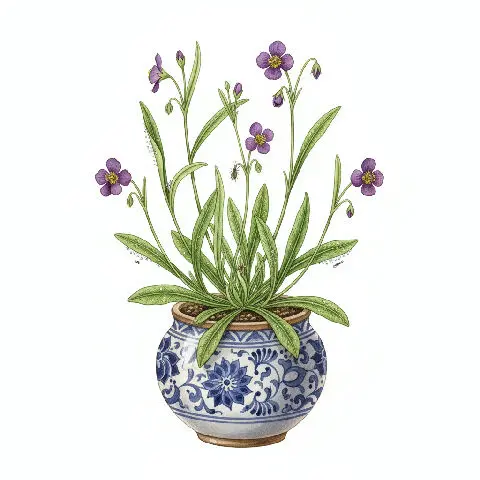
Byblis liniflora, commonly known as the 'Rainbow Plant', is a captivating annual carnivorous species native to the nutrient-poor soils of northern Australia and parts of New Guinea, belonging to the monotypic Byblidaceae family. This delicate plant typically grows upright, supported by a fibrous root system, reaching modest heights. Its slender, linear leaves are a defining feature, densely covered with two types of specialized glandular hairs.
The smaller, sessile glands produce a shimmering, non-elastic, highly viscous mucilage that gives the plant its 'Rainbow Plant' moniker, attracting insects with its glistening appearance. Larger, stalked glands then secrete potent digestive enzymes, primarily proteases and chitinases. Unlike many active carnivorous plants, Byblis liniflora employs a passive 'flypaper' trap mechanism; insects become irreversibly ensnared in the mucilage, leading to their eventual breakdown and nutrient absorption by the plant.
This adaptation is crucial for acquiring essential nutrients like nitrogen and phosphorus, which are scarce in its natural marshy or sandy habitats. Its zygomorphic (bilaterally symmetrical) flowers, typically purple to pinkish-purple, distinguish it taxonomically from superficially similar genera like Drosera, which possess actinomorphic flowers. Byblis liniflora was formally described by Robert Brown in 1810 and is primarily valued in horticulture for its unique biology and ornamental appeal.
Trusted Scientific References
1. Authoritative external sources for Byblis liniflora
1.1 Wikipedia — Byblis liniflora
1.2 Kew POWO (Plants of the World Online)
1.3 PubMed — peer-reviewed research
1.4 NCBI Taxonomy Browser
1.5 GBIF — Global Biodiversity
1.6Byblis should be interpreted through verified botanical identity, practical care, and responsible safety language. This recovery note adds the missing context needed for a complete profile: match light to the plant's habit, use well-drained soil, water according to season, and avoid unsupported medicinal or edible claims. For publishing, the plant can be presented as a source-backed indoor plant with clear care guidance, common problem diagnosis, and conservative safety wording.
1.1.Byblis — Key Features
- ✓ <strong>Passive 'flypaper' carnivorous</strong> — Passive 'flypaper' carnivorous trap mechanism.
- ✓ <strong>Glandular leaves secrete</strong> — Glandular leaves secrete sticky mucilage and digestive enzymes.
- ✓ <strong>Distinctive iridescent appearance,</strong> — Distinctive iridescent appearance, hence 'Rainbow Plant'.
- ✓ <strong>Annual plant native</strong> — Annual plant native to northern Australia and New Guinea.
- ✓ <strong>Zygomorphic (bilaterally symmetrical) purple to pinkish</strong> — purple flowers.
- ✓ <strong>Adaptations for nutrient acquisition in nutrient</strong> — poor environments.
- ✓ <strong>Belongs to the</strong> — Belongs to the monotypic family Byblidaceae, distinct from Droseraceae.
- ✓ <strong>Unique enzymatic profile,</strong> — Unique enzymatic profile, particularly proteases and chitinases.
- ✓ <strong>Cultivated mainly by</strong> — Cultivated mainly by carnivorous plant enthusiasts for ornamental value.
- ✓ <strong>Subject of ongoing</strong> — Subject of ongoing botanical and phytochemical research.
1.2.Byblis — Quick Summary
- ✓ 'Rainbow Plant' from Australia, a passive flypaper carnivorous plant.
- ✓ Leaves covered in glistening mucilage and digestive enzyme-secreting glands.
- ✓ Captures insects for essential nutrients in poor soils.
- ✓ Not traditionally used in medicine; emerging interest in its unique enzymes and phytochemistry.
- ✓ Requires specific cultivation conditions: wet, nutrient-poor soil, bright light.
- ✓ Primarily valued for horticulture and botanical research.
2.Byblis — Scientific Identity
3.Byblis — Quick Facts
4.Byblis — Appearance & Identification
5.Byblis — Native Habitat
6.Byblis — Water Requirements
- ✓ Soil Mix — For Byblis liniflora, use a well-draining yet moisture-retentive substrate, typically a 3/4 peat to 1/4 sand mix, avoiding nutrient-rich soils.
- ✓ Watering — Employ the tray method, keeping pots consistently wet with pure RO or distilled water, as Byblis liniflora tolerates wetter conditions better than other Byblis species.
- ✓ Light Requirements — Provide at least 8-10 hours of direct, bright light daily, either natural sunlight or strong artificial grow lights, to ensure vigorous growth and mucilage production.
- ✓ Temperature & Humidity — Maintain temperatures between 15°C to 30°C (60°F to 85°F) and humidity levels ranging from 50% to 80% for optimal growth.
- ✓ Germination — Seeds benefit from pre-treatment; a 24-hour soak in 10 PPM gibberellic acid solution or smoke treatment can significantly improve germination rates.
- ✓ Fertilization — Avoid traditional fertilizers as the plant obtains nutrients from captured insects; high TDS water or nutrient salts are detrimental.
- ✓ Repotting — Annual repotting is generally recommended for this annual species to refresh the substrate and maintain plant health.
- ✓ Pest Control — Monitor for common greenhouse pests, but avoid chemical pesticides which can harm the plant's delicate glandular structures.
Reviewed by the Flora Medical Global Botanical Review Panel
Multi-disciplinary editorial group · Botany · Ethnobotany · Herbal-medicine literature
Who reviewed this: This page was checked by the Flora Medical Global Botanical Review Panel — an in-house editorial group of botany graduates, ethnobotany researchers, and horticulture practitioners who collectively maintain our 7,000+ plant encyclopedia. Meet the team.
Our 4-step verification process
1. Taxonomic verification
Scientific names and synonyms cross-checked against Kew POWO, World Flora Online, and The Plant List.
2. Phytochemical & medicinal cross-reference
Active compounds, traditional uses, and reported activities are cross-referenced with PubMed, USDA Dr. Duke's database, and peer-reviewed ethnobotanical literature.
3. Conservation & distribution check
Distribution, ecology, and conservation status confirmed against GBIF occurrence records and the IUCN Red List.
4. Editorial & safety review
Every entry passes an editorial pass for clarity, originality, and safety notices (toxicity, contraindications, dosage caveats) before publication.
Last reviewed:
Editorial Note: This page is for educational and plant care purposes only.
Written by: Flora Medical Global Editorial Team
Reviewed by: Flora Medical Global Botanical Review Panel
Last Updated: June 15, 2026







Byblis — Comments & Community Reviews
Rate this plant