


Care Disclaimer: Plant care recommendations are general guidelines based on common growing conditions. Individual results may vary based on your local environment, climate, and care routine. If your plant is toxic, keep it away from children and pets, and consult a veterinarian if accidental ingestion occurs.
1.Cactus Barrel — Overview
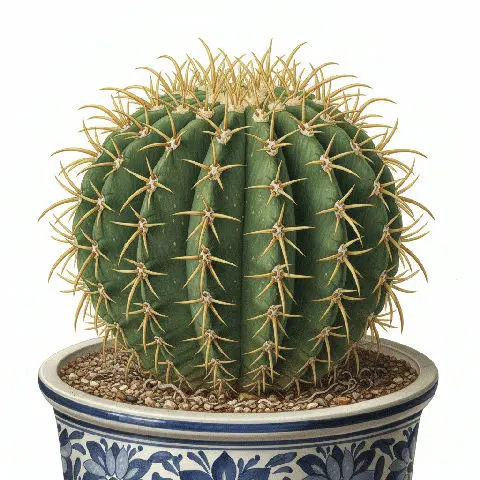
Echinocactus grusonii, widely known as the Golden Barrel Cactus or Golden Ball Cactus, stands as an iconic member of the Cactaceae family, celebrated for its distinctive spherical form and brilliant golden spines. While historically recognized under the genus Echinocactus, contemporary botanical classification, notably by some taxonomists, now places this species in the genus Kroenleinia, referring to it as Kroenleinia grusonii.
This slow-growing succulent is indigenous to the arid and semi-arid regions of east-central Mexico, specifically in the states of Querétaro and Hidalgo, where it thrives in rocky, desert environments. First formally described by German botanist Heinrich Hildmann in 1891 and named in honor of Hermann Gruson, a prominent German industrialist and cactus enthusiast, it has since become a globally cherished ornamental plant.
Regrettably, wild populations of the Golden Barrel Cactus face severe threats, primarily from habitat destruction due to agricultural expansion, quarrying, and urban development. This has led to its classification as endangered in its native range by the IUCN Red List, underscoring its vulnerability and the importance of conservation efforts. Botanically, Echinocactus grusonii is characterized by its unbranched, globose stem, which gradually elongates into a short-cylindrical shape with considerable age, potentially reaching over a meter in both height and diameter.
The stem features 20 to 40 prominent, undulating ribs that become more numerous and less defined as the plant matures. Along these ribs, areoles bear clusters of robust, rigid spines. Typically, 8-10 yellowish-white radial spines encircle 4-10 longer, thicker central spines, which range in color from vivid golden yellow to reddish-brown, giving the plant its characteristic 'golden' appellation.
A dense cap of woolly hairs crowns the apex, particularly noticeable in younger specimens, from which small, bright yellow, bell-shaped flowers emerge diurnally in late spring to early summer.
Trusted Scientific References
1. Authoritative external sources for Echinocactus grusonii
1.1 Wikipedia — Echinocactus grusonii
1.2 Kew POWO (Plants of the World Online)
1.3 PubMed — peer-reviewed research
1.4 NCBI Taxonomy Browser
1.5 GBIF — Global Biodiversity
1.1.Cactus Barrel — Key Features
- ✓ <strong>Iconic globose to short</strong> — cylindrical form.
- ✓ <strong>Prominent, rigid, bright golden</strong> — yellow spines.
- ✓ <strong>Distinctive ribbed stem with 20</strong> — 40 wavy ribs.
- ✓ <strong>Dense woolly apex</strong> — Dense woolly apex where flowers emerge.
- ✓ <strong>Bright yellow, bell</strong> — shaped diurnal flowers.
- ✓ <strong>Exceptionally drought</strong> — tolerant and heat-loving.
- ✓ <strong>Critically endangered in</strong> — Critically endangered in its natural Mexican habitat.
- ✓ <strong>Slow</strong> — growing, long-lived succulent.
- ✓ <strong>Highly valued ornamental</strong> — Highly valued ornamental plant worldwide.
- ✓ <strong>Member of the</strong> — Member of the Cactaceae family.
1.2.Cactus Barrel — Quick Summary
- ✓ Golden Barrel Cactus (Echinocactus grusonii/Kroenleinia grusonii) is an iconic, spherical succulent.
- ✓ Native to east-central Mexico, now critically endangered in the wild.
- ✓ Prized globally as an ornamental plant for its striking golden spines and form.
- ✓ Requires full sun, well-draining soil, and minimal water; highly drought-tolerant.
- ✓ Primarily valued for aesthetic appeal and conservation, with no documented medicinal uses.
- ✓ Handle with extreme care due to its sharp, rigid spines.
2.Cactus Barrel — Scientific Identity
3.Cactus Barrel — Quick Facts
4.Cactus Barrel — Appearance & Identification
5.Cactus Barrel — Native Habitat
6.Cactus Barrel — Water Requirements
- ✓ Sunlight — Requires full sun exposure for optimal growth, tolerating very slight partial shade, especially in extremely hot climates.
- ✓ Soil — Demands exceptionally well-draining soil; a specialized cactus mix with coarse sand, perlite, or pumice is ideal to prevent root rot.
- ✓ Watering — Water sparingly, allowing the soil to dry out completely between waterings; significantly reduce watering during winter dormancy.
- ✓ Temperature — Prefers warm desert-like conditions; protect from frost, as it is not cold-hardy and can be damaged below 20°F (-6°C).
- ✓ Humidity — Thrives in low humidity environments, typical of its native desert habitat.
- ✓ Container Growing — Excellent as a potted plant, especially when young, but requires large, stable containers as it matures due to its size and weight.
- ✓ Propagation — Primarily propagated from seeds, which can be slow and require specific germination conditions; offsets are rare.
- ✓ Fertilization — Fertilize sparingly during the growing season (spring/summer) with a balanced, low-nitrogen fertilizer diluted to half strength.
Reviewed by the Flora Medical Global Botanical Review Panel
Multi-disciplinary editorial group · Botany · Ethnobotany · Herbal-medicine literature
Who reviewed this: This page was checked by the Flora Medical Global Botanical Review Panel — an in-house editorial group of botany graduates, ethnobotany researchers, and horticulture practitioners who collectively maintain our 7,000+ plant encyclopedia. Meet the team.
Our 4-step verification process
1. Taxonomic verification
Scientific names and synonyms cross-checked against Kew POWO, World Flora Online, and The Plant List.
2. Phytochemical & medicinal cross-reference
Active compounds, traditional uses, and reported activities are cross-referenced with PubMed, USDA Dr. Duke's database, and peer-reviewed ethnobotanical literature.
3. Conservation & distribution check
Distribution, ecology, and conservation status confirmed against GBIF occurrence records and the IUCN Red List.
4. Editorial & safety review
Every entry passes an editorial pass for clarity, originality, and safety notices (toxicity, contraindications, dosage caveats) before publication.
Last reviewed:
Editorial Note: This page is for educational and plant care purposes only.
Written by: Flora Medical Global Editorial Team
Reviewed by: Flora Medical Global Botanical Review Panel
Last Updated: June 15, 2026







Cactus Barrel — Comments & Community Reviews
Rate this plant