


Care Disclaimer: Plant care recommendations are general guidelines based on common growing conditions. Individual results may vary based on your local environment, climate, and care routine. If your plant is toxic, keep it away from children and pets, and consult a veterinarian if accidental ingestion occurs.
1.Cactus Brain — Overview
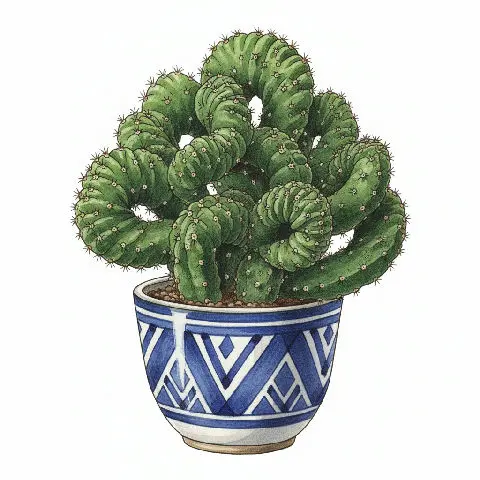
The 'Cactus Brain', scientifically known as Mammillaria elongata cristata, is a highly distinctive and sought-after succulent variety, representing a fascinating mutation of the common 'Ladyfinger Cactus', Mammillaria elongata. This particular crested form arises from an abnormal growth pattern where the apical meristem, instead of developing into a single, cylindrical column, broadens and flattens. This results in a convoluted, fan-like, brain-coral, or wave-like appearance, giving it its popular common name. While the parent species, Mammillaria elongata, is native to arid to semi-arid deserts in Hidalgo and Querétaro in central Mexico, often found nestled among rocky outcrops and sheltered by larger vegetation, the 'cristata' form is predominantly a cultivated horticultural specimen.
Botanically, Mammillaria elongata cristata retains many fundamental characteristics of its parent species but in a dramatically altered morphology. It typically forms a relatively small, clumping cactus, with individual 'ridges' or 'crests' usually growing up to 10-15 cm (4-6 inches) in diameter, though larger, sprawling specimens can be cultivated. The surface is densely adorned with numerous small, conical tubercles (mammillae) arranged in a spiral pattern, from which emerge short, bristle-like spines. These spines are typically golden-yellow to reddish-brown, imparting a somewhat fuzzy or soft appearance despite their inherent sharpness.
Unlike many cacti characterized by prominent ribs, Mammillaria elongata cristata's structure is defined solely by these coalescing tubercles. Flowers, though rarer on crested forms, can appear in spring and early summer, arising from the axils of the tubercles near the apex. They are small, typically pale yellow to cream, about 1 cm in diameter, and bell-shaped. Successful pollination is followed by the development of a small, red berry-like fruit.
Trusted Scientific References
1. Authoritative external sources for Mammillaria elongata cristata
1.1 Wikipedia — Mammillaria elongata cristata
1.2 Kew POWO (Plants of the World Online)
1.3 PubMed — peer-reviewed research
1.4 NCBI Taxonomy Browser
1.5 GBIF — Global Biodiversity
1.1.Cactus Brain — Key Features
- ✓ <strong>Botanical Name</strong> — Mammillaria elongata cristata
- ✓ <strong>Common Name</strong> — Cactus Brain, Brain Cactus
- ✓ <strong>Family</strong> — Cactaceae
- ✓ <strong>Unique Morphology</strong> — Crested, fan-like, or brain-coral growth pattern
- ✓ <strong>Origin</strong> — Central Mexico (Hidalgo, Querétaro) for the parent species
- ✓ <strong>Growth Habit</strong> — Small, clumping succulent groundcover
- ✓ <strong>Spines</strong> — Short, bristle-like, golden-yellow to reddish-brown
- ✓ <strong>Flowers</strong> — Small, pale yellow to cream, bell-shaped (rare on crested forms)
- ✓ <strong>Primary Use</strong> — Ornamental houseplant or xeriscape specimen
- ✓ <strong>Care</strong> — Low maintenance, requiring full sun and minimal water
1.2.Cactus Brain — Quick Summary
- ✓ Unique crested form of Mammillaria elongata known as 'Cactus Brain'.
- ✓ Exhibits a distinctive brain-like morphology due to an apical meristem mutation.
- ✓ Native to arid regions of central Mexico for its parent species, primarily cultivated as an ornamental.
- ✓ Requires bright, direct light, well-draining soil, and infrequent watering for optimal growth.
- ✓ No documented traditional or modern medicinal uses for this specific cultivar.
- ✓ Handle with care due to sharp spines; strictly for external, ornamental display purposes.
2.Cactus Brain — Scientific Identity
3.Cactus Brain — Quick Facts
4.Cactus Brain — Appearance & Identification
5.Cactus Brain — Native Habitat
6.Cactus Brain — Water Requirements
- ✓ Light — Requires several hours of bright, direct sunlight daily; ideally a south-facing window indoors or under a grow light to prevent leggy growth and root rot.
- ✓ Soil — Thrives in sandy, well-draining soil mixes; commercial cactus and succulent mixes or a DIY blend of equal parts potting soil, sand, and perlite are ideal.
- ✓ Watering — Sensitive to overwatering; allow soil to dry out completely between waterings, soaking thoroughly and ensuring excess drainage, reducing frequency in winter.
- ✓ Temperature & Humidity — Prefers warm, dry conditions, making average household temperature and humidity levels ideal; hardy outdoors in USDA zones 10-11, otherwise needs winter protection.
- ✓ Fertilizer — Benefits from a low-nitrogen fertilizer (e.g., 5-10-10 blend) diluted and applied with each watering during its active spring and summer growing seasons.
- ✓ Potting — Repot every couple of years when outgrowing its container, choosing a pot 2-4 inches wider; terracotta planters are popular for their moisture-wicking properties.
- ✓ Propagation — Primarily via stem cuttings, which are often grafted onto a Mammillaria elongata rootstock for the best chance of retaining the 'cristata' form, as offsets may revert to the parent species' straight growth.
Reviewed by the Flora Medical Global Botanical Review Panel
Multi-disciplinary editorial group · Botany · Ethnobotany · Herbal-medicine literature
Who reviewed this: This page was checked by the Flora Medical Global Botanical Review Panel — an in-house editorial group of botany graduates, ethnobotany researchers, and horticulture practitioners who collectively maintain our 7,000+ plant encyclopedia. Meet the team.
Our 4-step verification process
1. Taxonomic verification
Scientific names and synonyms cross-checked against Kew POWO, World Flora Online, and The Plant List.
2. Phytochemical & medicinal cross-reference
Active compounds, traditional uses, and reported activities are cross-referenced with PubMed, USDA Dr. Duke's database, and peer-reviewed ethnobotanical literature.
3. Conservation & distribution check
Distribution, ecology, and conservation status confirmed against GBIF occurrence records and the IUCN Red List.
4. Editorial & safety review
Every entry passes an editorial pass for clarity, originality, and safety notices (toxicity, contraindications, dosage caveats) before publication.
Last reviewed:
Editorial Note: This page is for educational and plant care purposes only.
Written by: Flora Medical Global Editorial Team
Reviewed by: Flora Medical Global Botanical Review Panel
Last Updated: June 15, 2026







Cactus Brain — Comments & Community Reviews
Rate this plant