


Care Disclaimer: Plant care recommendations are general guidelines based on common growing conditions. Individual results may vary based on your local environment, climate, and care routine. If your plant is toxic, keep it away from children and pets, and consult a veterinarian if accidental ingestion occurs.
1.Cactus Bunny Ear — Overview
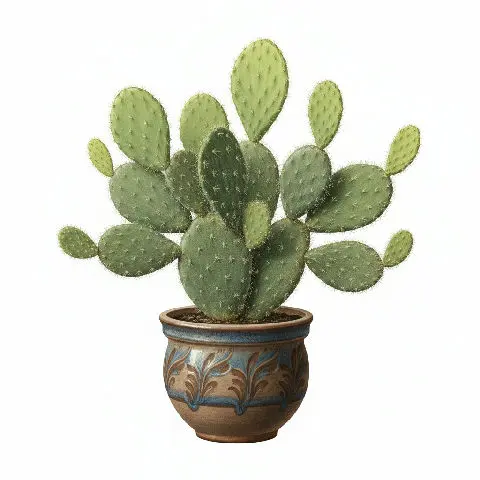
Opuntia microdasys, commonly known as Bunny Ear Cactus, Polka Dot Cactus, or Angel's-wings, is a captivating succulent native to the arid and semi-arid regions of central and northern Mexico, extending into parts of Arizona. This fascinating member of the Cactaceae family forms low, branching clumps, with a habit ranging from creeping to nearly erect, typically reaching 2 to 3 feet in height and spreading 4 to 5 feet as a mature plant. Its most distinctive feature lies in its flattened, segmented stem pads (cladodes), which are obovate to circular and often grow in pairs, strikingly resembling a rabbit's ears, especially when young. Unlike many cacti, O.
microdasys lacks traditional sharp spines; instead, its surface is densely covered with minute, barbed bristles called glochids, which can be golden-yellow, white, or reddish-brown. The species name 'microdasys' is derived from Greek, meaning 'small hairy,' directly referencing these pervasive glochids. While primarily cultivated as an ornamental plant today, the broader Opuntia genus holds significant ethnobotanical history, with species like O. ficus-indica (prickly pear) being vital for indigenous peoples of Mexico as a source of edible fruits (tunas) and pads (nopales), traditionally used for nourishment, wound healing, and anti-inflammatory purposes.
O. microdasys produces small, bright yellow, bowl-shaped flowers, typically 2-3 cm in diameter, in late spring to early summer, which rarely appear in indoor cultivation. These flowers can develop into small, spherical, red to reddish-purple fruits, though these are also uncommon in cultivated settings.
Trusted Scientific References
1. Authoritative external sources for Opuntia microdasys
1.1 Wikipedia — Opuntia microdasys
1.2 Kew POWO (Plants of the World Online)
1.3 PubMed — peer-reviewed research
1.4 NCBI Taxonomy Browser
1.5 GBIF — Global Biodiversity
1.6Cactus Bunny Ear should be interpreted through verified botanical identity, practical care, and responsible safety language. This recovery note adds the missing context needed for a complete profile: match light to the plant's habit, use well-drained soil, water according to season, and avoid unsupported medicinal or edible claims. For publishing, the plant can be presented as a source-backed indoor plant with clear care guidance, common problem diagnosis, and conservative safety wording.
1.1.Cactus Bunny Ear — Key Features
- ✓ <strong>Distinctive "Bunny Ear"</strong> — Distinctive "Bunny Ear" shaped pads (cladodes).
- ✓ <strong>Lacks traditional spines,</strong> — Lacks traditional spines, instead covered in minute, barbed glochids.
- ✓ <strong>Highly drought</strong> — tolerant and a popular low-maintenance ornamental plant.
- ✓ <strong>Native to the arid and semi</strong> — arid regions of central and northern Mexico.
- ✓ <strong>Produces small, bright yellow, bowl</strong> — shaped flowers, though rarely indoors.
- ✓ <strong>Develops small, spherical, red to reddish</strong> — purple fruits, uncommon in cultivation.
- ✓ <strong>Belongs to the</strong> — Belongs to the Cactaceae family, specifically the Opuntia genus.
- ✓ <strong>Easily propagated from</strong> — Easily propagated from detached pad cuttings.
- ✓ <strong>Related Opuntia species</strong> — Related Opuntia species are known for high antioxidant and polysaccharide content.
- ✓ <strong>Not frost tolerant</strong> — Not frost tolerant and requires protection in cooler climates.
1.2.Cactus Bunny Ear — Quick Summary
- ✓ Ornamental succulent known for its distinctive "bunny ear" pads and numerous irritating glochids.
- ✓ Native to arid regions of Mexico, prized for its unique aesthetic and drought tolerance.
- ✓ Not typically consumed due to its glochids; medicinal uses are primarily extrapolated from related, edible Opuntia species.
- ✓ The broader Opuntia genus is rich in antioxidants (betalains, phenolics) and polysaccharides.
- ✓ Requires full sun, fast-draining soil, minimal watering, and strict protection from frost.
- ✓ Primary health hazard is severe skin and eye irritation caused by its barbed glochids.
2.Cactus Bunny Ear — Scientific Identity
3.Cactus Bunny Ear — Quick Facts
4.Cactus Bunny Ear — Appearance & Identification
5.Cactus Bunny Ear — Native Habitat
6.Cactus Bunny Ear — Water Requirements
- ✓ Light — Requires full sun to partial shade for optimal growth; indoors, provide bright, indirect light, ideally from a south-facing window.
- ✓ Soil — Thrives in a fast-draining cactus or succulent potting mix, essential to prevent root rot in its arid-adapted nature.
- ✓ Watering — Allow the soil to completely dry out between waterings; overwatering is the most common cause of plant failure, especially in cooler months.
- ✓ Temperature — Prefers warm temperatures (70-100°F / 21-38°C) during its active growing season and requires a cooler winter dormancy (50-65°F / 10-18°C).
- ✓ Humidity — Prefers dry, low-humidity conditions, mirroring its native desert environment; high humidity can lead to fungal issues.
- ✓ Propagation — Easily propagated by carefully breaking off a mature pad (cladode) in spring, allowing it to callus for several days, then planting in well-drained soil.
- ✓ Frost Tolerance — Not frost tolerant; must be brought indoors or protected in cooler climates to avoid chilling injury or freezing damage.
- ✓ Pests — Monitor regularly for common cactus pests such as mealybugs and scale insects, which can affect pads and flowers.
Reviewed by the Flora Medical Global Botanical Review Panel
Multi-disciplinary editorial group · Botany · Ethnobotany · Herbal-medicine literature
Who reviewed this: This page was checked by the Flora Medical Global Botanical Review Panel — an in-house editorial group of botany graduates, ethnobotany researchers, and horticulture practitioners who collectively maintain our 7,000+ plant encyclopedia. Meet the team.
Our 4-step verification process
1. Taxonomic verification
Scientific names and synonyms cross-checked against Kew POWO, World Flora Online, and The Plant List.
2. Phytochemical & medicinal cross-reference
Active compounds, traditional uses, and reported activities are cross-referenced with PubMed, USDA Dr. Duke's database, and peer-reviewed ethnobotanical literature.
3. Conservation & distribution check
Distribution, ecology, and conservation status confirmed against GBIF occurrence records and the IUCN Red List.
4. Editorial & safety review
Every entry passes an editorial pass for clarity, originality, and safety notices (toxicity, contraindications, dosage caveats) before publication.
Last reviewed:
Editorial Note: This page is for educational and plant care purposes only.
Written by: Flora Medical Global Editorial Team
Reviewed by: Flora Medical Global Botanical Review Panel
Last Updated: June 15, 2026







Cactus Bunny Ear — Comments & Community Reviews
Rate this plant