
Care Disclaimer: Plant care recommendations are general guidelines based on common growing conditions. Individual results may vary based on your local environment, climate, and care routine. If your plant is toxic, keep it away from children and pets, and consult a veterinarian if accidental ingestion occurs.
1.Caladium Pink Beauty — Overview
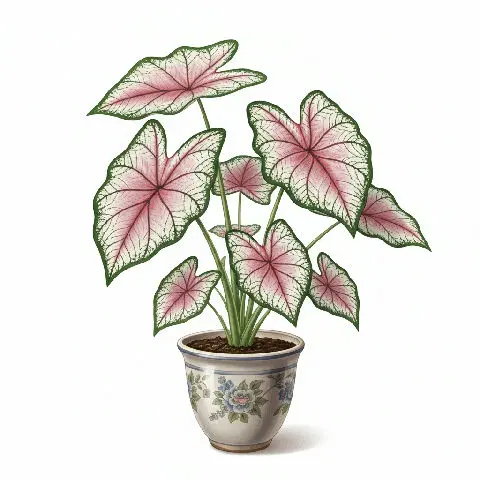
Caladium 'Pink Beauty', botanically known as Caladium bicolor 'Pink Beauty', is a highly prized hybrid tropical perennial originating from the Araceae family. This cultivar, primarily a product of modern horticultural breeding, is celebrated for its exceptionally vibrant and intricate foliage rather than ancient medicinal applications. The genus Caladium is native to the humid, shaded understories of the Amazon rainforests in South America, where its tuberous ancestors thrive in rich, consistently moist soils.
Historically, some indigenous communities in these regions utilized the tubers of certain Caladium species as a food source, but only after extensive and meticulous processing to neutralize their inherent toxicity. 'Pink Beauty' itself is a testament to selective breeding, showcasing large, distinctively heart-shaped to lance-shaped leaves that boast a striking fuchsia pink coloration, dramatically contrasted by dark green veins and margins, often adorned with lighter pink or white speckles. This dramatic aesthetic makes it a highly sought-after indoor plant globally and a popular choice for enhancing shaded garden beds in subtropical and tropical climates (USDA Hardiness Zones 9-11).
As a tuberous plant, Caladium 'Pink Beauty' stores essential nutrients in underground tubers, enabling it to enter a dormant phase during less favorable conditions, typically in cooler, drier months. While Caladiums do produce a characteristic spathe and spadix flower, these are generally inconspicuous and often removed by growers to direct the plant's energy towards its spectacular leaves, which are its primary ornamental feature. Naturalized populations of other Caladium species can be found in various tropical regions worldwide, sometimes becoming invasive, though 'Pink Beauty' is primarily cultivated.
Trusted Scientific References
1. Authoritative external sources for Caladium pink beauty
1.1 Wikipedia — Caladium pink beauty
1.2 Kew POWO (Plants of the World Online)
1.3 PubMed — peer-reviewed research
1.4 NCBI Taxonomy Browser
1.5 GBIF — Global Biodiversity
1.1.Caladium Pink Beauty — Key Features
- ✓ <strong>Botanical Name</strong> — Caladium bicolor 'Pink Beauty' (or Caladium 'Pink Beauty')
- ✓ <strong>Family</strong> — Araceae (Aroid family), known for its toxic members.
- ✓ <strong>Primary Use</strong> — Exclusively ornamental foliage plant, prized for its aesthetic appeal.
- ✓ <strong>Leaf Coloration</strong> — Distinctive fuchsia pink with contrasting dark green veins and margins, often speckled.
- ✓ <strong>Leaf Shape</strong> — Large, showy, typically heart-shaped (cordate) or lanceolate leaves.
- ✓ <strong>Growth Habit</strong> — Tuberous perennial, characterized by a dormant phase during cooler seasons.
- ✓ <strong>Native Region</strong> — The genus Caladium is native to the Amazon rainforests of South America.
- ✓ <strong>Toxicity</strong> — All parts of the plant are highly toxic if ingested, primarily due to calcium oxalate raphides.
- ✓ <strong>Light Preference</strong> — Prefers partial to full shade; direct sun causes leaf burn.
- ✓ <strong>Care Level</strong> — Considered relatively easy to care for when its specific light, water, and humidity requirements are met.
1.2.Caladium Pink Beauty — Quick Summary
- ✓ Ornamental and Toxic — Caladium 'Pink Beauty' is a beautiful foliage plant, but all parts are highly toxic if ingested.
- ✓ Striking Appearance — Celebrated for its vibrant pink, green, and white heart-shaped leaves.
- ✓ Tropical Needs — Thrives in warm, humid, shaded conditions, native to the Amazon rainforest.
- ✓ No Medicinal Use — This cultivar has no known medicinal or safe edible applications.
- ✓ Handling Precautions — Requires careful handling to avoid skin and eye irritation from its sap.
- ✓ Indoor or Shade Garden — Best suited as a houseplant or for shaded outdoor gardens in tropical zones.
2.Caladium Pink Beauty — Scientific Identity
3.Caladium Pink Beauty — Quick Facts
4.Caladium Pink Beauty — Appearance & Identification
5.Caladium Pink Beauty — Native Habitat
6.Caladium Pink Beauty — Water Requirements
- ✓ Light Requirement — Prefers partial to full shade; direct sunlight will scorch and damage the delicate leaves, causing discoloration and burn spots.
- ✓ Soil Preference — Thrives in rich, well-draining, slightly acidic soil with a pH range of 5.5 to 6.2, ideally amended with organic matter like peat moss.
- ✓ Watering Schedule — Keep the soil consistently moist but never waterlogged during the active growing season; reduce watering significantly as the plant enters dormancy in autumn.
- ✓ Temperature Range — Optimal growth occurs between 21°C and 30°C (70°F-85°F); temperatures below 15°C (60°F) can trigger dormancy or cause damage.
- ✓ Humidity Needs — Requires normal to high humidity, mimicking its native tropical environment; consider misting or using a pebble tray for indoor plants.
- ✓ Hardiness Zones — Suitable for outdoor cultivation in USDA Hardiness Zones 9-11; in colder climates, tubers must be dug up and stored indoors over winter.
- ✓ Dormancy Management — Allow foliage to die back naturally in autumn; store tubers in a cool, dry, dark place (e.g., peat moss) until spring for replanting.
- ✓ Fertilization — Feed with a balanced liquid fertilizer every 2-4 weeks during the active growing season to support robust foliage growth.
Reviewed by the Flora Medical Global Botanical Review Panel
Multi-disciplinary editorial group · Botany · Ethnobotany · Herbal-medicine literature
Who reviewed this: This page was checked by the Flora Medical Global Botanical Review Panel — an in-house editorial group of botany graduates, ethnobotany researchers, and horticulture practitioners who collectively maintain our 7,000+ plant encyclopedia. Meet the team.
Our 4-step verification process
1. Taxonomic verification
Scientific names and synonyms cross-checked against Kew POWO, World Flora Online, and The Plant List.
2. Phytochemical & medicinal cross-reference
Active compounds, traditional uses, and reported activities are cross-referenced with PubMed, USDA Dr. Duke's database, and peer-reviewed ethnobotanical literature.
3. Conservation & distribution check
Distribution, ecology, and conservation status confirmed against GBIF occurrence records and the IUCN Red List.
4. Editorial & safety review
Every entry passes an editorial pass for clarity, originality, and safety notices (toxicity, contraindications, dosage caveats) before publication.
Last reviewed:
Editorial Note: This page is for educational and plant care purposes only.
Written by: Flora Medical Global Editorial Team
Reviewed by: Flora Medical Global Botanical Review Panel
Last Updated: June 15, 2026







Caladium Pink Beauty — Comments & Community Reviews
Rate this plant