
Care Disclaimer: Plant care recommendations are general guidelines based on common growing conditions. Individual results may vary based on your local environment, climate, and care routine. If your plant is toxic, keep it away from children and pets, and consult a veterinarian if accidental ingestion occurs.
1.Caladium Red Flash — Overview
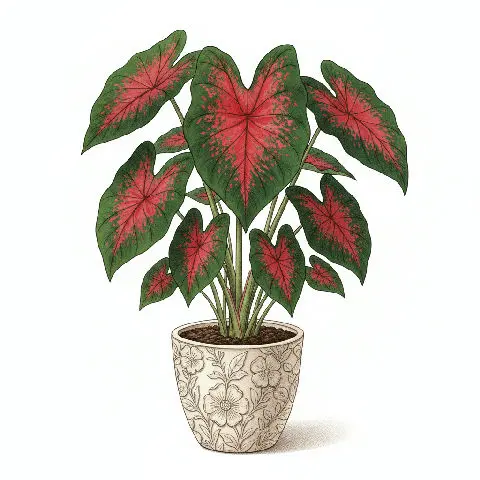
Caladium 'Red Flash', a captivating cultivar of Caladium bicolor, is celebrated for its extraordinary foliage that injects a striking tropical flair into any indoor or shaded outdoor environment. This perennial, tuberous plant belongs to the Araceae family, a diverse group predominantly found in the rainforest understories of South and Central America, particularly the Amazon basin. Morphologically, 'Red Flash' distinguishes itself with large, heart-shaped leaves, often spanning 6 to 14 inches, which emerge directly from subterranean tubers.
The leaf coloration is its most remarkable feature: a brilliant red or deep crimson dominates the center, gradually fading into rich green margins, frequently adorned with lively pink or white speckles. This intricate and dynamic patterning sets 'Red Flash' apart from many other Caladium varieties. While Caladium species have a long history of cultivation, tracing from indigenous communities who sometimes processed their tubers (despite inherent toxicity) to European botanists for ornamental purposes, 'Red Flash' is exclusively valued for its aesthetic contribution.
The plant typically grows to 12-30 inches tall, forming a lush, clumping mound. Although Caladiums produce inconspicuous spathe and spadix flowers, these are often removed in ornamental cultivation to redirect energy to the vibrant leaf growth. The plant enters a dormant phase during cooler, drier conditions, a natural adaptation to its native environment.
Trusted Scientific References
1. Authoritative external sources for Caladium red flash
1.1 Wikipedia — Caladium red flash
1.2 Kew POWO (Plants of the World Online)
1.3 PubMed — peer-reviewed research
1.4 NCBI Taxonomy Browser
1.5 GBIF — Global Biodiversity
1.6Caladium Red Flash should be interpreted through verified botanical identity, practical care, and responsible safety language. This recovery note adds the missing context needed for a complete profile: match light to the plant's habit, use well-drained soil, water according to season, and avoid unsupported medicinal or edible claims. For publishing, the plant can be presented as a source-backed indoor plant with clear care guidance, common problem diagnosis, and conservative safety wording.
1.1.Caladium Red Flash — Key Features
- ✓ <strong>Striking Foliage</strong> — Features large, heart-shaped leaves with prominent red centers, green margins, and often pink/white speckles.
- ✓ <strong>Ornamental Cultivar</strong> — Primarily valued for its aesthetic qualities, making it a popular choice for decorative purposes.
- ✓ <strong>Tuberous Perennial</strong> — Grows from underground tubers, entering dormancy during less favorable conditions.
- ✓ <strong>Tropical Origin</strong> — Native to the humid understories of South and Central American rainforests.
- ✓ <strong>Shade</strong> — Loving Plant — Prefers indirect or filtered light, thriving in shaded garden spots or as an indoor plant.
- ✓ <strong>High Toxicity</strong> — All plant parts are poisonous due to calcium oxalate, causing severe irritation upon ingestion or contact.
- ✓ <strong>Araceae Family Member</strong> — Belongs to the Arum family, sharing characteristics like the spathe and spadix inflorescence (though inconspicuous).
- ✓ <strong>Dormancy Cycle</strong> — Requires a period of dormancy in cooler, drier conditions, during which leaves may die back.
- ✓ <strong>Easy Propagation</strong> — Readily propagated through the division of its tubers.
- ✓ <strong>Versatile Use</strong> — Suitable for container gardening, shade beds, and as an indoor focal point.
1.2.Caladium Red Flash — Quick Summary
- ✓ Caladium 'Red Flash' is a striking ornamental plant known for its vibrant red, green, and pink heart-shaped leaves.
- ✓ It is a cultivar of Caladium bicolor, native to South American rainforests.
- ✓ All parts of the plant are highly toxic due to the presence of calcium oxalate crystals.
- ✓ Primarily cultivated for its aesthetic appeal in shaded gardens and as a popular houseplant.
- ✓ Thrives in warm, humid conditions and requires a dormant period in cooler, drier seasons.
2.Caladium Red Flash — Scientific Identity
3.Caladium Red Flash — Quick Facts
4.Caladium Red Flash — Appearance & Identification
5.Caladium Red Flash — Native Habitat
6.Caladium Red Flash — Water Requirements
- ✓ Light Requirements — Prefers filtered sunlight or partial shade; direct afternoon sun can scorch the delicate leaves, while too little light diminishes color.
- ✓ Soil Conditions — Thrives in rich, well-draining, consistently moist soil with a slightly acidic to neutral pH (6.0-6.5).
- ✓ Temperature & Humidity — Requires warm temperatures, ideally between 65-80°F (18-27°C), and high humidity, mimicking its native tropical environment.
- ✓ Watering — Keep the soil consistently moist during the active growing season, but avoid waterlogging, which can lead to tuber rot; reduce watering significantly as dormancy approaches.
- ✓ Fertilization — Feed with a balanced liquid fertilizer every 2-4 weeks during peak growing periods (spring and summer), diluting to half strength.
- ✓ Dormancy Care — As foliage dies back in fall, reduce water; once dormant, dig up tubers, air dry for a week, and store in a dry, dark place at 55-65°F (13-18°C).
- ✓ Propagation — Primarily propagated by dividing the tubers (often referred to as bulbs) into sections, ensuring each section has at least one 'eye' or growth point.
- ✓ Pest & Disease Management — Generally resistant, but watch for spider mites or mealybugs; ensure good air circulation to prevent fungal issues.
Reviewed by the Flora Medical Global Botanical Review Panel
Multi-disciplinary editorial group · Botany · Ethnobotany · Herbal-medicine literature
Who reviewed this: This page was checked by the Flora Medical Global Botanical Review Panel — an in-house editorial group of botany graduates, ethnobotany researchers, and horticulture practitioners who collectively maintain our 7,000+ plant encyclopedia. Meet the team.
Our 4-step verification process
1. Taxonomic verification
Scientific names and synonyms cross-checked against Kew POWO, World Flora Online, and The Plant List.
2. Phytochemical & medicinal cross-reference
Active compounds, traditional uses, and reported activities are cross-referenced with PubMed, USDA Dr. Duke's database, and peer-reviewed ethnobotanical literature.
3. Conservation & distribution check
Distribution, ecology, and conservation status confirmed against GBIF occurrence records and the IUCN Red List.
4. Editorial & safety review
Every entry passes an editorial pass for clarity, originality, and safety notices (toxicity, contraindications, dosage caveats) before publication.
Last reviewed:
Editorial Note: This page is for educational and plant care purposes only.
Written by: Flora Medical Global Editorial Team
Reviewed by: Flora Medical Global Botanical Review Panel
Last Updated: June 15, 2026







Caladium Red Flash — Comments & Community Reviews
Rate this plant