


Care Disclaimer: Plant care recommendations are general guidelines based on common growing conditions. Individual results may vary based on your local environment, climate, and care routine. If your plant is toxic, keep it away from children and pets, and consult a veterinarian if accidental ingestion occurs.
1.Calathea Dottie — Overview
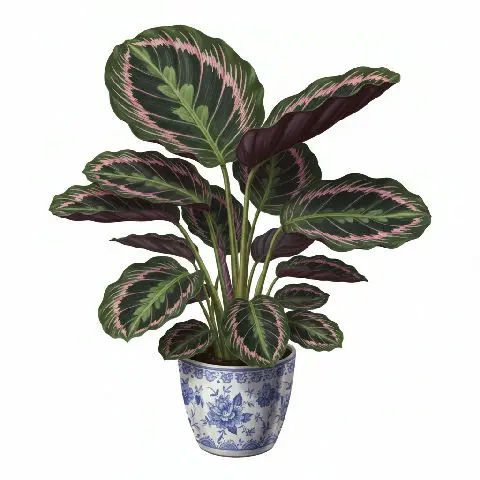
Calathea 'Dottie', scientifically known as Calathea roseopicta 'Dottie', is an exquisite cultivar within the Marantaceae family, celebrated for its dramatically dark foliage and vivid contrasting patterns. This hybrid was meticulously developed to enhance the striking visual appeal inherent in its parent species, Calathea roseopicta, which is native to the humid tropical rainforests of Brazil and Ecuador.
In its natural habitat, the progenitor species thrives in the shaded understory, employing a fascinating diurnal leaf movement called nyctinasty; leaves fold upwards at dusk, mimicking hands in prayer, and unfurl with the morning light to maximize light absorption. 'Dottie' exhibits this characteristic 'prayer plant' behavior with remarkable grace.
The morphological distinction of 'Dottie' lies in its intensely deep, almost black-green leaves, which serve as a dramatic canvas for vibrant, rosy-pink to magenta markings. These striking patterns meticulously trace the leaf veins and margins, creating a painted, almost iridescent effect that sets it apart from other cultivars. The undersides of the leaves often present a rich purple hue, adding another layer of visual complexity.
While the 'Dottie' cultivar itself is a product of modern horticulture and lacks traditional medicinal documentation, its wild relatives in the Calathea genus have historically been utilized by indigenous communities for purposes such as weaving and as biodegradable food wrappers, reflecting the practical value of the broader species. Contemporary research into the genus has revealed a presence of beneficial phytochemicals, including flavonoids and triterpenes, which suggest potential antioxidant and anti-inflammatory properties, though direct studies on 'Dottie' are limited.
Trusted Scientific References
1. Authoritative external sources for Calathea roseopicta Dottie
1.1 Wikipedia — Calathea roseopicta Dottie
1.2 Kew POWO (Plants of the World Online)
1.3 PubMed — peer-reviewed research
1.4 NCBI Taxonomy Browser
1.5 GBIF — Global Biodiversity
1.1.Calathea Dottie — Key Features
- ✓ <strong>Striking Foliage</strong> — Deep, almost black-green leaves with vibrant rosy-pink to magenta patterns.
- ✓ <strong>Nyctinastic Movement</strong> — Leaves fold up at night and unfurl during the day, a 'prayer plant' characteristic.
- ✓ <strong>Non</strong> — Toxic — Safe for households with children and pets.
- ✓ <strong>Air Purifier</strong> — Contributes to improved indoor air quality.
- ✓ <strong>Tropical Origin</strong> — Native to the understory of Brazilian and Ecuadorian rainforests (parent species).
- ✓ <strong>High Humidity Lover</strong> — Thrives in moist, warm environments.
- ✓ <strong>Indirect Light Requirement</strong> — Prefers shaded conditions, susceptible to direct sun scorch.
- ✓ <strong>Ornamental Value</strong> — Highly prized for aesthetic appeal in interior design.
- ✓ <strong>Unique Cultivar</strong> — 'Dottie' is a specifically bred hybrid of Calathea roseopicta.
- ✓ <strong>Marantaceae Family Member</strong> — Part of the 'prayer plant' family, known for decorative foliage.
1.2.Calathea Dottie — Quick Summary
- ✓ Ornamental and Air-Purifying Houseplant — Valued for dramatic foliage and indoor air quality benefits.
- ✓ Non-Toxic to Humans and Pets — A safe choice for family environments.
- ✓ Unique Foliage Patterns & Nyctinasty — Dark leaves with pink markings, exhibiting 'prayer plant' movement.
- ✓ Requires High Humidity & Indirect Light — Mimics its tropical rainforest understory habitat.
- ✓ Limited Direct Medicinal Research — Cultivar lacks traditional medicinal uses, but genus shows phytochemical potential.
- ✓ Potential for Mild Skin Irritation — Sap may affect sensitive individuals.
2.Calathea Dottie — Scientific Identity
3.Calathea Dottie — Quick Facts
4.Calathea Dottie — Appearance & Identification
5.Calathea Dottie — Native Habitat
6.Calathea Dottie — Water Requirements
- ✓ Light — Provide bright, indirect light; direct sunlight can scorch leaves and fade their vibrant patterns.
- ✓ Soil — Use a well-draining, peat-based potting mix, ideally amended with perlite or vermiculite for aeration.
- ✓ Water — Maintain consistently moist soil, but avoid waterlogging; use distilled or filtered water to prevent mineral buildup.
- ✓ Temperature & Humidity — Thrive in temperatures between 18-24°C (65-75°F) and high humidity (above 60%); mist regularly or use a pebble tray.
- ✓ Fertilization — Feed with a diluted, balanced liquid houseplant fertilizer every 2-4 weeks during the active growing season (spring/summer).
- ✓ Pruning — Remove any yellowing, browning, or damaged leaves at the base to encourage new growth and maintain plant vigor.
- ✓ Cleaning — Gently wipe leaves with a damp, soft cloth periodically to remove dust, ensuring efficient photosynthesis.
- ✓ Repotting — Repot every 1-2 years or when root-bound, using a slightly larger pot to accommodate growth.
Reviewed by the Flora Medical Global Botanical Review Panel
Multi-disciplinary editorial group · Botany · Ethnobotany · Herbal-medicine literature
Who reviewed this: This page was checked by the Flora Medical Global Botanical Review Panel — an in-house editorial group of botany graduates, ethnobotany researchers, and horticulture practitioners who collectively maintain our 7,000+ plant encyclopedia. Meet the team.
Our 4-step verification process
1. Taxonomic verification
Scientific names and synonyms cross-checked against Kew POWO, World Flora Online, and The Plant List.
2. Phytochemical & medicinal cross-reference
Active compounds, traditional uses, and reported activities are cross-referenced with PubMed, USDA Dr. Duke's database, and peer-reviewed ethnobotanical literature.
3. Conservation & distribution check
Distribution, ecology, and conservation status confirmed against GBIF occurrence records and the IUCN Red List.
4. Editorial & safety review
Every entry passes an editorial pass for clarity, originality, and safety notices (toxicity, contraindications, dosage caveats) before publication.
Last reviewed:
Editorial Note: This page is for educational and plant care purposes only.
Written by: Flora Medical Global Editorial Team
Reviewed by: Flora Medical Global Botanical Review Panel
Last Updated: June 15, 2026







Calathea Dottie — Comments & Community Reviews
Rate this plant