


Care Disclaimer: Plant care recommendations are general guidelines based on common growing conditions. Individual results may vary based on your local environment, climate, and care routine. If your plant is toxic, keep it away from children and pets, and consult a veterinarian if accidental ingestion occurs.
1.Calathea Louisae — Overview
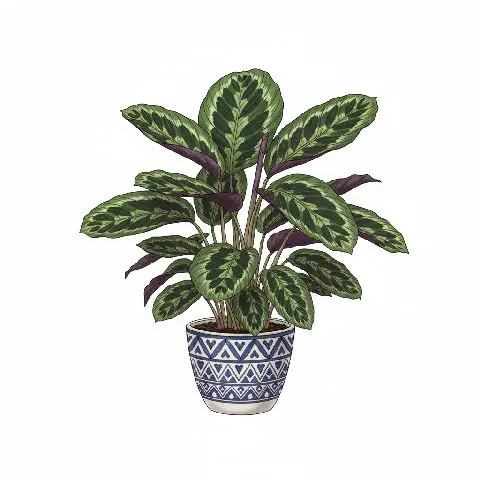
Goeppertia louisae, often still recognized by its former botanical classification Calathea louisae, is a striking tropical perennial native to the lush, humid understory of the Brazilian rainforests, particularly abundant in the southeastern regions. This captivating species, a proud member of the Marantaceae family—commonly known as the prayer plant family—thrives in environments characterized by consistent warmth, high humidity, and filtered, dappled sunlight. Its reclassification from Calathea to Goeppertia reflects advancements in phylogenetic understanding based on molecular studies, refining our botanical comprehension of this diverse genus.
The plant's primary allure lies in its magnificent foliage; its large, ovate to oblong leaves are a vibrant tapestry of dark green, often adorned with lighter green or silvery-green feathering that radiates from the midrib, complemented by a distinctly purplish-red underside. This dramatic contrast creates an exquisite visual spectacle, making it a highly prized ornamental houseplant.
A defining characteristic of the Marantaceae family, and elegantly displayed by Goeppertia louisae, is the phenomenon of nyctinasty. Throughout the day, its leaves spread open to maximize light capture for photosynthesis. As dusk approaches, specialized motor organs called pulvini, located at the base of each leaf stalk, respond to diminishing light intensity.
Through precise changes in turgor pressure within these pulvini, the leaves gracefully fold upwards, evoking the image of hands clasped in prayer. This fascinating circadian rhythm not only optimizes photosynthetic efficiency but may also serve as a defense mechanism against nocturnal herbivores or to minimize water loss. While its ornamental beauty is paramount, documented traditional medicinal applications for Goeppertia louisae are notably scarce in established ethnomedical systems like Ayurveda, TCM, or Unani, which typically focus on pharmacologically active root or leaf compounds.
Modern pharmacological research into this specific species remains limited, primarily due to its prevailing status as an ornamental.
Trusted Scientific References
1. Authoritative external sources for Goeppertia louisae
1.1 Wikipedia — Goeppertia louisae
1.2 Kew POWO (Plants of the World Online)
1.3 PubMed — peer-reviewed research
1.4 NCBI Taxonomy Browser
1.5 GBIF — Global Biodiversity
1.1.Calathea Louisae — Key Features
- ✓ <strong>Botanical Reclassification</strong> — Formerly Calathea louisae, now scientifically known as Goeppertia louisae.
- ✓ <strong>Family Marantaceae</strong> — A prominent member of the 'prayer plant' family.
- ✓ <strong>Brazilian Origin</strong> — Native to the humid understories of southeastern Brazilian rainforests.
- ✓ <strong>Nyctinastic Leaves</strong> — Displays daily rhythmic movement, folding leaves upwards at dusk.
- ✓ <strong>Distinctive Foliage</strong> — Large, ovate leaves with intricate green patterns and a deep purplish-red underside.
- ✓ <strong>Rhizomatous Perennial</strong> — Grows from underground rhizomes, allowing for easy propagation.
- ✓ <strong>Shade/Partial Shade Tolerant</strong> — Prefers dappled light, making it suitable for indoor environments.
- ✓ <strong>High Humidity Lover</strong> — Requires consistent atmospheric moisture to prevent leaf crisping.
- ✓ <strong>Non</strong> — Toxic Plant — Safe for humans and common household pets.
- ✓ <strong>Ornamental Value</strong> — Primarily cultivated for its exceptional aesthetic appeal and decorative qualities.
1.2.Calathea Louisae — Quick Summary
- ✓ Striking Ornamental Foliage — Renowned for its vibrant, intricately patterned leaves with purple undersides.
- ✓ Prayer Plant Movement — Exhibits nyctinasty, gracefully folding its leaves upwards at night.
- ✓ Tropical Rainforest Native — Thrives in warm, humid conditions with indirect light.
- ✓ Non-toxic and Pet-Friendly — Considered safe for households with children and pets upon contact or ingestion.
- ✓ Limited Medicinal Research — Currently lacks specific documented traditional or modern medicinal uses.
- ✓ Air Purifier (General) — Contributes to indoor air quality as a common houseplant.
2.Calathea Louisae — Scientific Identity
3.Calathea Louisae — Quick Facts
4.Calathea Louisae — Appearance & Identification
5.Calathea Louisae — Native Habitat
6.Calathea Louisae — Water Requirements
- ✓ Light — Provide bright, indirect light; direct sunlight can scorch the delicate leaves and fade their vibrant patterns.
- ✓ Watering — Keep the soil consistently moist but not waterlogged; use non-calcareous, room-temperature water like rainwater or filtered water.
- ✓ Humidity — Requires high humidity (60-80%); regularly mist foliage, use a pebble tray, or place near a humidifier.
- ✓ Soil — Plant in a well-draining, humus-rich potting mix, ideally with added perlite or coco coir for aeration and moisture retention.
- ✓ Temperature — Maintain warm temperatures between 18-24°C (65-75°F); avoid cold drafts or sudden temperature fluctuations.
- ✓ Fertilization — Feed sparingly with a diluted liquid green plant fertilizer during the spring and summer growing seasons, typically every 2-4 weeks.
- ✓ Repotting — Repot every 1-2 years in spring into a slightly larger pot, choosing a wide pot to accommodate its rhizomatous growth.
- ✓ Propagation — Primarily propagated by rhizome division during repotting, ensuring each section has roots and at least one leaf.
Reviewed by the Flora Medical Global Botanical Review Panel
Multi-disciplinary editorial group · Botany · Ethnobotany · Herbal-medicine literature
Who reviewed this: This page was checked by the Flora Medical Global Botanical Review Panel — an in-house editorial group of botany graduates, ethnobotany researchers, and horticulture practitioners who collectively maintain our 7,000+ plant encyclopedia. Meet the team.
Our 4-step verification process
1. Taxonomic verification
Scientific names and synonyms cross-checked against Kew POWO, World Flora Online, and The Plant List.
2. Phytochemical & medicinal cross-reference
Active compounds, traditional uses, and reported activities are cross-referenced with PubMed, USDA Dr. Duke's database, and peer-reviewed ethnobotanical literature.
3. Conservation & distribution check
Distribution, ecology, and conservation status confirmed against GBIF occurrence records and the IUCN Red List.
4. Editorial & safety review
Every entry passes an editorial pass for clarity, originality, and safety notices (toxicity, contraindications, dosage caveats) before publication.
Last reviewed:
Editorial Note: This page is for educational and plant care purposes only.
Written by: Flora Medical Global Editorial Team
Reviewed by: Flora Medical Global Botanical Review Panel
Last Updated: June 15, 2026







Calathea Louisae — Comments & Community Reviews
Rate this plant