


Care Disclaimer: Plant care recommendations are general guidelines based on common growing conditions. Individual results may vary based on your local environment, climate, and care routine. If your plant is toxic, keep it away from children and pets, and consult a veterinarian if accidental ingestion occurs.
1.Calathea Makoyana — Overview
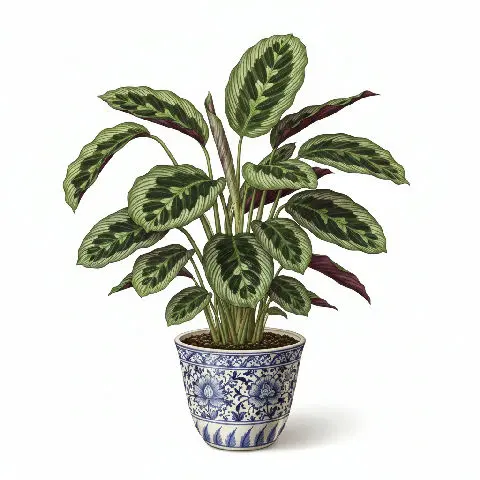
Calathea makoyana, popularly known as the Peacock Plant or Cathedral Windows, is an exquisite evergreen perennial celebrated for its visually arresting foliage and distinctive nyctinastic leaf movements. Native to the humid tropical rainforests of eastern Brazil, specifically within the states of Espirito Santo and Rio de Janeiro, this species thrives under the dense canopy, favoring warm, shaded, and consistently moist environments. Taxonomically, it belongs to the Marantaceae family, often referred to as the 'prayer plant family,' and has recently been reclassified into the genus Goeppertia, now known botanically as Goeppertia makoyana. Its common names perfectly encapsulate its aesthetic appeal: 'Peacock Plant' references the intricate, feather-like patterns on its leaves that vividly mimic the eye-spots of a peacock's tail, while 'Cathedral Windows' describes the translucent light green blotches against a darker green background, which appear illuminated when viewed from beneath, akin to stained glass.
Morphologically, Calathea makoyana features large, ovate leaves borne on long stalks. The upper surface presents a striking mosaic of dark green feathered markings on a silvery-green base, meticulously outlined by fine dark veins. The underside offers a dramatic contrast, displaying a rich, uniform burgundy or purple-red hue. A hallmark of Calathea species is their nyctinastic rhythm, a fascinating circadian movement where leaves fold upwards at dusk, resembling praying hands, and unfurl again with the dawn.
This dynamic response is facilitated by a specialized pulvinus at the leaf base, which reacts to ambient light intensity and humidity fluctuations. While primarily cultivated for its ornamental value in Western horticulture since the Victorian era, some members of the Marantaceae family have traditional ethnobotanical applications, such as the use of rhizomes in digestive remedies by indigenous tribes. Calathea makoyana itself is recognized for its significant role in enhancing indoor air quality.
Trusted Scientific References
1. Authoritative external sources for Calathea makoyana
1.1 Wikipedia — Calathea makoyana
1.2 Kew POWO (Plants of the World Online)
1.3 PubMed — peer-reviewed research
1.4 NCBI Taxonomy Browser
1.5 GBIF — Global Biodiversity
1.1.Calathea Makoyana — Key Features
- ✓ <strong>Striking Foliage</strong> — Features intricate, feather-like patterns of dark and light green on the upper leaf surface.
- ✓ <strong>Purple Undersides</strong> — The reverse side of each leaf displays a dramatic, rich burgundy or purple-red coloration.
- ✓ <strong>Nyctinastic Movement</strong> — Leaves fold upwards at night and unfurl during the day, a characteristic 'prayer-like' motion.
- ✓ <strong>Air Purifying Qualities</strong> — Effectively filters indoor air pollutants, contributing to a healthier environment.
- ✓ <strong>Non</strong> — Toxic — Safe for households with children and pets, as it poses no known toxicity risks.
- ✓ <strong>Tropical Origin</strong> — Native to the rainforests of Brazil, thriving in warm, humid, and shaded conditions.
- ✓ <strong>Award of Garden Merit</strong> — Recognized by the Royal Horticultural Society for its ornamental excellence.
- ✓ <strong>Clump</strong> — Forming Evergreen — Grows as a compact, bushy perennial with leaves emerging from a central rosette.
- ✓ <strong>High Humidity Lover</strong> — Requires consistently high humidity levels to prevent leaf browning and maintain vigor.
- ✓ <strong>Aesthetic Appeal</strong> — Highly prized for its decorative value in interior spaces, resembling stained-glass windows.
1.2.Calathea Makoyana — Quick Summary
- ✓ Calathea makoyana, or Peacock Plant, is famed for its striking, patterned foliage and unique nyctinastic movement.
- ✓ It is a tropical perennial, native to Brazil, belonging to the Marantaceae family.
- ✓ Primarily an ornamental houseplant, it is non-toxic to pets and humans.
- ✓ Recognized for its ability to improve indoor air quality and boost humidity.
- ✓ Requires consistent care with indirect light, high humidity, and moist soil.
- ✓ Offers biophilic benefits, reducing stress and enhancing aesthetic appeal.
2.Calathea Makoyana — Scientific Identity
3.Calathea Makoyana — Quick Facts
4.Calathea Makoyana — Appearance & Identification
5.Calathea Makoyana — Native Habitat
6.Calathea Makoyana — Water Requirements
- ✓ Light — Prefers bright, indirect sunlight; direct sun can scorch leaves and fade patterns.
- ✓ Soil — Requires a well-draining, peat-based potting mix, often amended with perlite or vermiculite.
- ✓ Water — Keep soil consistently moist but never waterlogged; use distilled, rainwater, or filtered water to prevent leaf tip browning.
- ✓ Temperature and Humidity — Thrives in temperatures between 18°C to 24°C (65°F to 75°F) with high humidity, ideally above 60%.
- ✓ Fertilization — Feed with a diluted, balanced liquid houseplant fertilizer every 4 weeks during spring and summer; withhold during winter.
- ✓ Pruning — Trim away yellow or brown leaves at the base to maintain plant health and aesthetic appeal.
- ✓ Cleaning — Regularly wipe leaves with a damp cloth to remove dust, ensuring efficient photosynthesis.
- ✓ Repotting — Repot every 2-3 years, or when root-bound, into a slightly larger pot with fresh potting mix.
Reviewed by the Flora Medical Global Botanical Review Panel
Multi-disciplinary editorial group · Botany · Ethnobotany · Herbal-medicine literature
Who reviewed this: This page was checked by the Flora Medical Global Botanical Review Panel — an in-house editorial group of botany graduates, ethnobotany researchers, and horticulture practitioners who collectively maintain our 7,000+ plant encyclopedia. Meet the team.
Our 4-step verification process
1. Taxonomic verification
Scientific names and synonyms cross-checked against Kew POWO, World Flora Online, and The Plant List.
2. Phytochemical & medicinal cross-reference
Active compounds, traditional uses, and reported activities are cross-referenced with PubMed, USDA Dr. Duke's database, and peer-reviewed ethnobotanical literature.
3. Conservation & distribution check
Distribution, ecology, and conservation status confirmed against GBIF occurrence records and the IUCN Red List.
4. Editorial & safety review
Every entry passes an editorial pass for clarity, originality, and safety notices (toxicity, contraindications, dosage caveats) before publication.
Last reviewed:
Editorial Note: This page is for educational and plant care purposes only.
Written by: Flora Medical Global Editorial Team
Reviewed by: Flora Medical Global Botanical Review Panel
Last Updated: June 15, 2026







Calathea Makoyana — Comments & Community Reviews
Rate this plant