


Care Disclaimer: Plant care recommendations are general guidelines based on common growing conditions. Individual results may vary based on your local environment, climate, and care routine. If your plant is toxic, keep it away from children and pets, and consult a veterinarian if accidental ingestion occurs.
1.Calathea Medallion — Overview
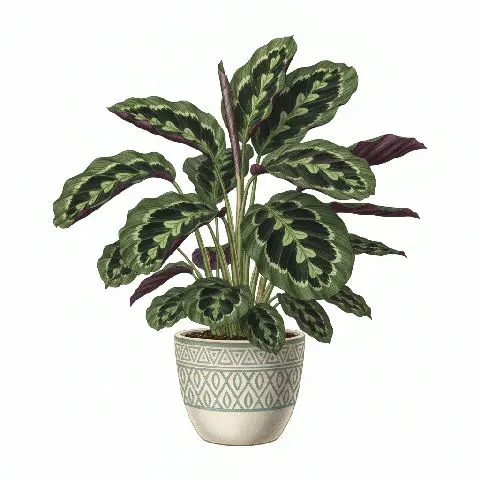
The Calathea Medallion, scientifically recognized as Goeppertia veitchiana 'Medallion' (and formerly classified under Calathea and Maranta), is a highly esteemed cultivar within the Marantaceae family. This striking herbaceous perennial originates from the humid, shaded understories of the Amazon rainforests, specifically in regions of Ecuador. It is celebrated for its dramatically ornate foliage, which presents a complex tapestry of colors and patterns.
The 'Medallion' cultivar earned its name from its large, broadly elliptic to sub-orbicular leaves, which are often 20-30 cm in length, resembling ancient shields or medallions. The upper surface of these leaves features a deep green background adorned with a distinctive lime green and creamy white feathered brushstroke pattern, radiating from the central midrib. In stark contrast, the undersides boast a rich, deep burgundy hue, contributing to its visual allure.
Unlike many other members of the 'prayer plant' family, Goeppertia veitchiana 'Medallion' does not typically exhibit the prominent nyctinastic (leaf-folding) movements. Its history in cultivation dates back to the 19th century, with its specific epithet 'veitchiana' honoring Sir Harry Veitch, a renowned English horticulturist. This plant's evolution in dappled light and high humidity conditions makes it perfectly adapted for indoor environments that mimic its native tropical habitat, establishing it as a prime choice for houseplant enthusiasts and collectors seeking a touch of exotic elegance.
Trusted Scientific References
1. Authoritative external sources for Goeppertia veitchiana Medallion
1.1 Wikipedia — Goeppertia veitchiana Medallion
1.2 Kew POWO (Plants of the World Online)
1.3 PubMed — peer-reviewed research
1.4 NCBI Taxonomy Browser
1.5 GBIF — Global Biodiversity
1.6Calathea Medallion should be interpreted through verified botanical identity, practical care, and responsible safety language. This recovery note adds the missing context needed for a complete profile: match light to the plant's habit, use well-drained soil, water according to season, and avoid unsupported medicinal or edible claims. For publishing, the plant can be presented as a source-backed indoor plant with clear care guidance, common problem diagnosis, and conservative safety wording.
1.1.Calathea Medallion — Key Features
- ✓ <strong>Vibrant, ornamental foliage</strong> — Vibrant, ornamental foliage with unique 'Medallion' patterns.
- ✓ <strong>Deep green upper</strong> — Deep green upper leaves with distinctive lime green and creamy white brushstrokes.
- ✓ <strong>Rich, contrasting deep</strong> — Rich, contrasting deep burgundy undersides of the leaves.
- ✓ <strong>Non</strong> — toxic to both household pets (dogs, cats) and humans.
- ✓ <strong>Requires consistently high</strong> — Requires consistently high humidity, mimicking its tropical rainforest origin.
- ✓ <strong>Prefers bright, indirect</strong> — Prefers bright, indirect light, avoiding direct sun to prevent leaf scorch.
- ✓ <strong>Exhibits a slow</strong> — growing, clumping, and upright growth habit.
- ✓ <strong>Features a rhizomatous</strong> — Features a rhizomatous root system, typical of the Marantaceae family.
- ✓ <strong>Excellent choice as</strong> — Excellent choice as an accent plant for interior decor in homes and offices.
- ✓ <strong>Contributes to a</strong> — Contributes to a tropical ambiance and improved indoor aesthetics.
1.2.Calathea Medallion — Quick Summary
- ✓ Striking ornamental foliage with 'Medallion' patterns.
- ✓ Native to Amazon rainforests, thrives in high humidity and indirect light.
- ✓ Non-toxic and pet-friendly, ideal for household environments.
- ✓ Requires specific care: distilled water, consistent moisture, and warm temperatures.
- ✓ Known for its vibrant green upper leaves with lime/silver variegation and deep burgundy undersides.
- ✓ Excellent accent plant, enhancing indoor aesthetics and well-being.
2.Calathea Medallion — Scientific Identity
3.Calathea Medallion — Quick Facts
4.Calathea Medallion — Appearance & Identification
5.Calathea Medallion — Native Habitat
6.Calathea Medallion — Water Requirements
- ✓ Light — Provide bright, indirect light or partial shade; direct sunlight will scorch the delicate leaves of Calathea Medallion.
- ✓ Water — Keep soil consistently moist but never soggy; use distilled, rainwater, or filtered tap water to avoid fluoride-induced leaf browning.
- ✓ Humidity — Maintain high humidity levels, ideally above 60%; consider using a humidifier, pebble tray, or grouping plants.
- ✓ Temperature — Ensure a stable room temperature between 65-85°F (18-29°C); avoid sudden temperature fluctuations and cold drafts.
- ✓ Soil — Plant in a well-draining, moisture-retentive potting mix, typically an aroid blend with peat moss, perlite, and orchid bark.
- ✓ Fertilization — Feed monthly with a balanced liquid fertilizer diluted to half strength during the active growing season (spring and summer).
- ✓ Maintenance — Regularly wipe dust from the large leaves with a damp cloth to ensure efficient photosynthesis and maintain aesthetic appeal.
- ✓ Propagation — The most effective method for propagating Goeppertia veitchiana 'Medallion' is through division of its rhizomatous root system during repotting.
Reviewed by the Flora Medical Global Botanical Review Panel
Multi-disciplinary editorial group · Botany · Ethnobotany · Herbal-medicine literature
Who reviewed this: This page was checked by the Flora Medical Global Botanical Review Panel — an in-house editorial group of botany graduates, ethnobotany researchers, and horticulture practitioners who collectively maintain our 7,000+ plant encyclopedia. Meet the team.
Our 4-step verification process
1. Taxonomic verification
Scientific names and synonyms cross-checked against Kew POWO, World Flora Online, and The Plant List.
2. Phytochemical & medicinal cross-reference
Active compounds, traditional uses, and reported activities are cross-referenced with PubMed, USDA Dr. Duke's database, and peer-reviewed ethnobotanical literature.
3. Conservation & distribution check
Distribution, ecology, and conservation status confirmed against GBIF occurrence records and the IUCN Red List.
4. Editorial & safety review
Every entry passes an editorial pass for clarity, originality, and safety notices (toxicity, contraindications, dosage caveats) before publication.
Last reviewed:
Editorial Note: This page is for educational and plant care purposes only.
Written by: Flora Medical Global Editorial Team
Reviewed by: Flora Medical Global Botanical Review Panel
Last Updated: June 15, 2026







Calathea Medallion — Comments & Community Reviews
Rate this plant