


Care Disclaimer: Plant care recommendations are general guidelines based on common growing conditions. Individual results may vary based on your local environment, climate, and care routine. If your plant is toxic, keep it away from children and pets, and consult a veterinarian if accidental ingestion occurs.
1.Calathea Musaica — Overview
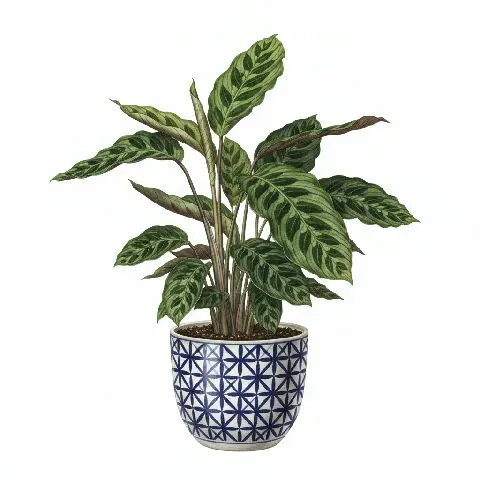
Calathea musaica, widely recognized as 'Network Calathea' or 'Calathea Network', is a captivating evergreen perennial renowned for its extraordinarily intricate foliage. Its common name aptly describes the unique pattern on its leaves, which resembles a finely etched, almost digital mosaic or network of lines.
Unlike many of its Calathea relatives, C. musaica exhibits delicate, geometric venation, creating a stark contrast of dark green lines against a lighter green background on its glossy, heart-shaped leaves.
Native to the humid, shaded understory of the Brazilian rainforests, particularly in regions such as Espírito Santo, this species thrives in conditions mimicking its tropical origin. It belongs to the Marantaceae family, commonly known as the 'prayer plant' family, due to the characteristic nyctinastic movements where leaves fold upwards at night and unfurl in the morning, though this movement is less pronounced in C.
musaica.
Botanically, C. musaica has recently undergone reclassification and is now often referred to as Goeppertia kegeljanii. This taxonomic update reflects ongoing phylogenetic research within the Marantaceae family.
Despite its reclassification, 'Calathea musaica' remains its most recognized and widely used name in horticulture and botanical circles. Its primary significance throughout history and in contemporary use is ornamental, prized for its aesthetic appeal in indoor environments. While specific traditional medicinal uses for C.
musaica are not extensively documented in historical texts from systems like Ayurveda, TCM, or Unani, modern scientific inquiry into the broader Calathea genus suggests the presence of various phytochemicals, including flavonoids and terpenes, which are known for their antioxidant and anti-inflammatory properties, hinting at potential, albeit unresearched, bioactivities.
Trusted Scientific References
1. Authoritative external sources for Calathea musaica
1.1 Wikipedia — Calathea musaica
1.2 Kew POWO (Plants of the World Online)
1.3 PubMed — peer-reviewed research
1.4 NCBI Taxonomy Browser
1.5 GBIF — Global Biodiversity
1.1.Calathea Musaica — Key Features
- ✓ <strong>Unique Mosaic Leaf Pattern</strong> — Intricate dark green venation on light green leaves.
- ✓ <strong>Evergreen Perennial</strong> — Provides year-round foliage and beauty.
- ✓ <strong>Nyctinastic Movement</strong> — Leaves subtly fold upwards at night.
- ✓ <strong>Tropical Origin</strong> — Thrives in warm, humid environments.
- ✓ <strong>Non</strong> — Toxic — Safe for homes with children and pets.
- ✓ <strong>Indoor Air Purifier</strong> — Helps filter common indoor pollutants.
- ✓ <strong>Moderate Size</strong> — Typically grows up to 2 feet tall and wide, suitable for indoor spaces.
- ✓ <strong>Low Maintenance (with proper humidity)</strong> — Relatively easy to care for once environmental needs are met.
- ✓ <strong>Aesthetic Appeal</strong> — Highly valued for its decorative foliage in interior design.
- ✓ <strong>Reclassified Genus</strong> — Now recognized scientifically as Goeppertia kegeljanii.
1.2.Calathea Musaica — Quick Summary
- ✓ Distinctive ornamental plant with mosaic-like leaf patterns.
- ✓ Native to Brazilian rainforests, thrives in high humidity.
- ✓ Recently reclassified as Goeppertia kegeljanii.
- ✓ Non-toxic to pets and humans, popular as a houseplant.
- ✓ Contributes to indoor air quality and aesthetic well-being.
- ✓ Requires consistent moisture, indirect light, and high humidity.
2.Calathea Musaica — Scientific Identity
3.Calathea Musaica — Quick Facts
4.Calathea Musaica — Appearance & Identification
5.Calathea Musaica — Native Habitat
6.Calathea Musaica — Water Requirements
- ✓ Light — Prefers bright, indirect light; direct sun can scorch leaves, while too little light diminishes vibrancy.
- ✓ Soil — Requires a well-draining, peat-based potting mix, often amended with perlite or vermiculite for aeration.
- ✓ Water — Keep soil consistently moist but never waterlogged; use distilled, rainwater, or filtered tap water to prevent mineral buildup.
- ✓ Temperature — Thrives in warm conditions, ideally between 65°F (18°C) to 75°F (24°C); avoid cold drafts and sudden drops.
- ✓ Humidity — Demands high humidity, preferably above 60%; consider humidifiers, pebble trays, or grouping plants.
- ✓ Fertilization — Feed every 4 weeks during spring and summer with a diluted, balanced liquid houseplant fertilizer.
- ✓ Pruning — Trim yellow or brown leaves at the base to maintain tidiness and encourage healthy new growth.
- ✓ Repotting — Repot every 2-3 years in spring, or when the plant becomes root-bound, to refresh soil and provide space.
Reviewed by the Flora Medical Global Botanical Review Panel
Multi-disciplinary editorial group · Botany · Ethnobotany · Herbal-medicine literature
Who reviewed this: This page was checked by the Flora Medical Global Botanical Review Panel — an in-house editorial group of botany graduates, ethnobotany researchers, and horticulture practitioners who collectively maintain our 7,000+ plant encyclopedia. Meet the team.
Our 4-step verification process
1. Taxonomic verification
Scientific names and synonyms cross-checked against Kew POWO, World Flora Online, and The Plant List.
2. Phytochemical & medicinal cross-reference
Active compounds, traditional uses, and reported activities are cross-referenced with PubMed, USDA Dr. Duke's database, and peer-reviewed ethnobotanical literature.
3. Conservation & distribution check
Distribution, ecology, and conservation status confirmed against GBIF occurrence records and the IUCN Red List.
4. Editorial & safety review
Every entry passes an editorial pass for clarity, originality, and safety notices (toxicity, contraindications, dosage caveats) before publication.
Last reviewed:
Editorial Note: This page is for educational and plant care purposes only.
Written by: Flora Medical Global Editorial Team
Reviewed by: Flora Medical Global Botanical Review Panel
Last Updated: June 15, 2026







Calathea Musaica — Comments & Community Reviews
Rate this plant