


Care Disclaimer: Plant care recommendations are general guidelines based on common growing conditions. Individual results may vary based on your local environment, climate, and care routine. If your plant is toxic, keep it away from children and pets, and consult a veterinarian if accidental ingestion occurs.
1.Calathea Network — Overview
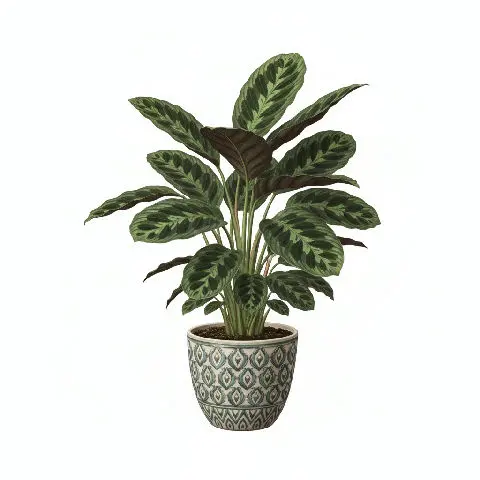
The Calathea Network, formally known as Goeppertia kegeljanii, and previously classified under Calathea kegeljanii, is a highly prized tropical perennial celebrated for its remarkably intricate foliage. Native to the warm, humid understories of the Brazilian rainforests, this species thrives in environments that replicate its natural tropical habitat.
Its common name, 'Network Prayer Plant' or 'Mosaic Calathea,' precisely describes its distinctive leaves, which feature a vibrant mosaic of deep green, almost pixelated veins set against a lighter green background. The undersides of the leaves often display a rich reddish-purple hue, a characteristic shared by many members of the Marantaceae family.
Morphologically, Goeppertia kegeljanii exhibits a clumping habit, growing from a rhizomatous root system to reach heights and widths of 1 to 2 feet. Its leaves are thick, waxy, glossy, and heart-shaped with undulate margins, emerging from long stalks. A fascinating physiological trait is its nyctinastic movement, where the leaves fold upwards at night, resembling praying hands, and unfurl again at sunrise in response to light and temperature changes.
While the plant can produce small, inconspicuous flowers, its primary ornamental appeal lies in its striking leaf patterns. The species epithet 'kegeljanii' honors Ferdinand Kegeljan, a prominent Belgian horticulturalist and philanthropist, underscoring its historical significance in botanical cultivation.
Trusted Scientific References
1. Authoritative external sources for Goeppertia kegeljanii
1.1 Wikipedia — Goeppertia kegeljanii
1.2 Kew POWO (Plants of the World Online)
1.3 PubMed — peer-reviewed research
1.4 NCBI Taxonomy Browser
1.5 GBIF — Global Biodiversity
1.6Calathea Network should be interpreted through verified botanical identity, practical care, and responsible safety language. This recovery note adds the missing context needed for a complete profile: match light to the plant's habit, use well-drained soil, water according to season, and avoid unsupported medicinal or edible claims. For publishing, the plant can be presented as a source-backed indoor plant with clear care guidance, common problem diagnosis, and conservative safety wording.
1.1.Calathea Network — Key Features
- ✓ <strong>Distinctive Mosaic Leaf Pattern</strong> — Intricate network of deep green veins on lighter green leaves.
- ✓ <strong>Nyctinastic Movement</strong> — Leaves fold upwards at night, resembling praying hands.
- ✓ <strong>Tropical Perennial</strong> — Evergreen plant thriving in warm, humid environments.
- ✓ <strong>Popular Houseplant</strong> — Highly sought after for its unique ornamental value.
- ✓ <strong>Non</strong> — Toxic to Pets & Humans — Safe for households with animals and children (ingestion-wise).
- ✓ <strong>High Humidity Requirement</strong> — Needs consistent moisture in the air to prevent leaf crisping.
- ✓ <strong>Rhizomatous Growth Habit</strong> — Grows from underground stems, forming clumps.
- ✓ <strong>Partial Shade Tolerant</strong> — Prefers indirect light, avoiding harsh direct sun.
- ✓ <strong>Reddish</strong> — Purple Undersides — Characteristic of many Marantaceae members, adding visual depth.
- ✓ <strong>General Air Purification</strong> — Contributes to cleaner indoor air like many houseplants.
1.2.Calathea Network — Quick Summary
- ✓ Goeppertia kegeljanii is a tropical ornamental plant known for its striking mosaic leaf patterns.
- ✓ Exhibits nyctinastic movement, with leaves folding at night.
- ✓ Requires high humidity, partial shade, and consistent moisture with fluoride-free water.
- ✓ Non-toxic to pets and humans upon ingestion, but sap can cause skin irritation.
- ✓ Primarily valued for its aesthetic appeal and limited direct medicinal uses are documented.
- ✓ Native to Brazilian rainforests, thriving in warm, humid conditions.
2.Calathea Network — Scientific Identity
3.Calathea Network — Quick Facts
4.Calathea Network — Appearance & Identification
5.Calathea Network — Native Habitat
6.Calathea Network — Water Requirements
- ✓ Light Requirement — Provide partial shade; direct sunlight can scorch the leaves, leading to leaf burn and discoloration.
- ✓ Watering Protocol — Water regularly with distilled or rainwater, as fluoride in tap water can cause brown leaf edges and tips. Keep the potting mix consistently moist but not waterlogged.
- ✓ Humidity Needs — Maintain high humidity levels, ideally above 60%; use a pebble tray with water or a humidifier to create a tropical microclimate.
- ✓ Temperature Stability — Keep temperatures between 60-80°F (15-27°C) and avoid sudden temperature fluctuations or cold drafts.
- ✓ Soil Composition — Use a moist, well-drained potting mix with an acidic to neutral pH, incorporating perlite or vermiculite for optimal drainage.
- ✓ Fertilization Schedule — Fertilize monthly during the active growing season (spring and summer) with a balanced houseplant fertilizer, reducing frequency in winter.
- ✓ Leaf Maintenance — Regularly wipe dust from the leaves with a clean, damp cloth to ensure efficient photosynthesis and maintain their glossy appearance.
- ✓ Propagation Method — Propagate primarily through division of the rhizomatous root system during repotting, ensuring each section has roots and a few leaves.
Reviewed by the Flora Medical Global Botanical Review Panel
Multi-disciplinary editorial group · Botany · Ethnobotany · Herbal-medicine literature
Who reviewed this: This page was checked by the Flora Medical Global Botanical Review Panel — an in-house editorial group of botany graduates, ethnobotany researchers, and horticulture practitioners who collectively maintain our 7,000+ plant encyclopedia. Meet the team.
Our 4-step verification process
1. Taxonomic verification
Scientific names and synonyms cross-checked against Kew POWO, World Flora Online, and The Plant List.
2. Phytochemical & medicinal cross-reference
Active compounds, traditional uses, and reported activities are cross-referenced with PubMed, USDA Dr. Duke's database, and peer-reviewed ethnobotanical literature.
3. Conservation & distribution check
Distribution, ecology, and conservation status confirmed against GBIF occurrence records and the IUCN Red List.
4. Editorial & safety review
Every entry passes an editorial pass for clarity, originality, and safety notices (toxicity, contraindications, dosage caveats) before publication.
Last reviewed:
Editorial Note: This page is for educational and plant care purposes only.
Written by: Flora Medical Global Editorial Team
Reviewed by: Flora Medical Global Botanical Review Panel
Last Updated: June 15, 2026







Calathea Network — Comments & Community Reviews
Rate this plant