


Care Disclaimer: Plant care recommendations are general guidelines based on common growing conditions. Individual results may vary based on your local environment, climate, and care routine. If your plant is toxic, keep it away from children and pets, and consult a veterinarian if accidental ingestion occurs.
1.Calathea Rufibarba — Overview
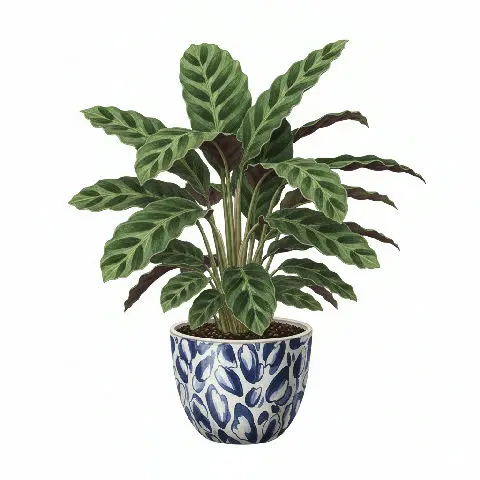
Calathea rufibarba, widely known as the 'Fuzzy Feather' or 'Velvet Calathea,' is an exquisite tropical perennial within the Marantaceae family, celebrated for its unique foliage and characteristic nyctinastic movements. Indigenous to the lush, humid understories of the Brazilian rainforests, particularly in regions like Espírito Santo and Bahia, this species flourishes beneath the dense canopy, where it receives dappled, indirect light. Its common name, 'rufibarba,' is derived from Latin, combining 'rufus' (reddish) and 'barba' (beard), a fitting descriptor for the fine, soft, reddish-brown hairs that densely cover the undersides of its elongated, spear-shaped leaves and petioles.
These velvety undersides strikingly contrast with the vibrant, often slightly ruffled or corrugated, dark green upper surfaces. Botanically, Calathea rufibarba is a rhizomatous plant, meaning it grows from underground stems, enabling it to form dense clumps and regrow effectively. Its upright growth habit can reach heights of 60-90 cm, creating a captivating bushy appearance.
A hallmark of the Marantaceae family, Calathea rufibarba exhibits 'prayer plant' movements, where its leaves fold upwards at dusk and unfurl with the dawn, a photoperiodic response thought to conserve moisture and protect its delicate foliage from nocturnal elements in its native habitat. While primarily cultivated for its striking foliage, the plant does produce small, inconspicuous yellow-orange flowers on short spikes, typically nestled at the base of the plant, though these are rarely observed in indoor cultivation. Though often referred to as Calathea, modern molecular phylogenetic studies have reclassified this species, along with many others, into the genus Goeppertia, reflecting a deeper understanding of its evolutionary relationships within the arrowroot family.
Trusted Scientific References
1. Authoritative external sources for Calathea rufibarba
1.1 Wikipedia — Calathea rufibarba
1.2 Kew POWO (Plants of the World Online)
1.3 PubMed — peer-reviewed research
1.4 NCBI Taxonomy Browser
1.5 GBIF — Global Biodiversity
1.1.Calathea Rufibarba — Key Features
- ✓ <strong>Unique Foliage</strong> — Long, wavy, dark green leaves with a distinctive velvety, reddish-brown underside.
- ✓ <strong>Nyctinastic Movement</strong> — Leaves fold upwards at night and unfurl during the day, a captivating 'prayer plant' behavior.
- ✓ <strong>Pet</strong> — Friendly — Non-toxic to cats and dogs, making it a safe indoor plant choice.
- ✓ <strong>Air Purifier</strong> — Contributes to improving indoor air quality by filtering common pollutants.
- ✓ <strong>Humidity Lover</strong> — Thrives in high humidity, making it suitable for bathrooms or grouped with other plants.
- ✓ <strong>Tropical Aesthetic</strong> — Adds a lush, exotic, and vibrant touch to any indoor space.
- ✓ <strong>Rhizomatous Perennial</strong> — Grows from underground stems, allowing for robust growth and easy propagation by division.
- ✓ <strong>Low</strong> — Maintenance (with proper conditions) — Relatively easy to care for once its specific light and humidity needs are met.
- ✓ <strong>Award</strong> — Winning — Recipient of the Royal Horticultural Society's Award of Garden Merit (AGM).
1.2.Calathea Rufibarba — Quick Summary
- ✓ 'Fuzzy Feather' Calathea, native to Brazilian rainforests.
- ✓ Distinctive velvety, reddish-brown leaf undersides and green upper surfaces.
- ✓ Exhibits nyctinastic 'prayer plant' movements at night.
- ✓ Primarily an ornamental houseplant, non-toxic to pets and humans.
- ✓ Excellent for air purification and increasing indoor humidity.
- ✓ Requires bright, indirect light, consistent moisture, and high humidity.
2.Calathea Rufibarba — Scientific Identity
3.Calathea Rufibarba — Quick Facts
4.Calathea Rufibarba — Appearance & Identification
5.Calathea Rufibarba — Native Habitat
6.Calathea Rufibarba — Water Requirements
- ✓ Light — Prefers bright, indirect light; direct sunlight can scorch its delicate leaves, while insufficient light may diminish leaf vibrancy.
- ✓ Soil — Requires a well-draining, peat-based potting mix, often enriched with perlite or vermiculite to ensure adequate aeration and moisture retention.
- ✓ Water — Maintain consistently moist soil, allowing the top inch to dry slightly between waterings; use distilled, rainwater, or filtered tap water to prevent brown leaf tips.
- ✓ Temperature and Humidity — Thrives in warm temperatures between 18-24°C (65-75°F) and high humidity levels, ideally above 60%, mimicking its native rainforest habitat.
- ✓ Fertilization — Fertilize monthly during the active growing seasons of spring and summer with a diluted, balanced liquid houseplant fertilizer; reduce or cease feeding in fall and winter.
- ✓ Pruning — Remove yellowed, brown, or damaged leaves at the base to encourage new growth and maintain the plant's tidy appearance.
- ✓ Repotting — Repot every 2-3 years, or when the plant becomes root-bound, ideally in spring to accommodate its growth.
Reviewed by the Flora Medical Global Botanical Review Panel
Multi-disciplinary editorial group · Botany · Ethnobotany · Herbal-medicine literature
Who reviewed this: This page was checked by the Flora Medical Global Botanical Review Panel — an in-house editorial group of botany graduates, ethnobotany researchers, and horticulture practitioners who collectively maintain our 7,000+ plant encyclopedia. Meet the team.
Our 4-step verification process
1. Taxonomic verification
Scientific names and synonyms cross-checked against Kew POWO, World Flora Online, and The Plant List.
2. Phytochemical & medicinal cross-reference
Active compounds, traditional uses, and reported activities are cross-referenced with PubMed, USDA Dr. Duke's database, and peer-reviewed ethnobotanical literature.
3. Conservation & distribution check
Distribution, ecology, and conservation status confirmed against GBIF occurrence records and the IUCN Red List.
4. Editorial & safety review
Every entry passes an editorial pass for clarity, originality, and safety notices (toxicity, contraindications, dosage caveats) before publication.
Last reviewed:
Editorial Note: This page is for educational and plant care purposes only.
Written by: Flora Medical Global Editorial Team
Reviewed by: Flora Medical Global Botanical Review Panel
Last Updated: June 15, 2026







Calathea Rufibarba — Comments & Community Reviews
Rate this plant