
Care Disclaimer: Plant care recommendations are general guidelines based on common growing conditions. Individual results may vary based on your local environment, climate, and care routine. If your plant is toxic, keep it away from children and pets, and consult a veterinarian if accidental ingestion occurs.
1.Calathea Setosa — Overview
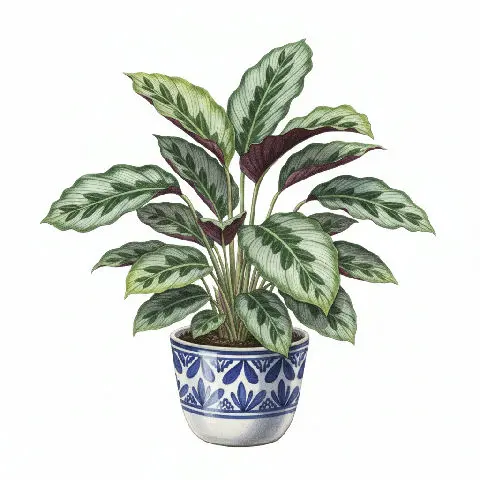
Goeppertia setosa, previously recognized under the genus Calathea, is an exquisite perennial rhizomatous herb belonging to the Marantaceae family, widely known as the 'prayer plant' family. This botanical reclassification highlights its distinct lineage while retaining its characteristic features.
Native to the lush, humid rainforests of eastern Brazil, particularly in regions such as Bahia and Espírito Santo, this species thrives in the shaded understory, benefiting from dappled sunlight and consistently high atmospheric moisture. Its common name, sometimes confused with 'Zebra Plant' (which more accurately refers to Calathea zebrina), points to its striking foliage.
The plant is distinguished by its uniquely textured, elongated, lance-shaped leaves, which present a rich, dark green hue on the upper surface. These leaves are adorned with delicate, velvety, hair-like structures known as setae, imparting a soft, tactile feel and a subtle shimmering appearance. In stark contrast, the undersides of the leaves exhibit a vibrant, rich burgundy or purplish-red coloration, adding to its visual appeal.
Individual leaves can attain lengths of 30 to 45 cm and are held erect on relatively short petioles. A hallmark feature of many Marantaceae, including Goeppertia setosa, is the presence of a pulvinus at the base of each leaf. This specialized motor organ facilitates nyctinastic movements, causing the leaves to fold upwards at night, resembling praying hands, and to flatten during daylight hours to optimize light absorption.
This fascinating photoperiodic adaptation is crucial for reducing water loss and protecting against nocturnal herbivores in its natural rainforest habitat. Indoors, the plant typically achieves a height of 60 to 90 cm, with a similar spread, making it a prominent ornamental specimen.
Trusted Scientific References
1. Authoritative external sources for Goeppertia setosa
1.1 Wikipedia — Goeppertia setosa
1.2 Kew POWO (Plants of the World Online)
1.3 PubMed — peer-reviewed research
1.4 NCBI Taxonomy Browser
1.5 GBIF — Global Biodiversity
1.1.Calathea Setosa — Key Features
- ✓ <strong>Distinctive velvety, dark green, lance</strong> — shaped leaves.
- ✓ <strong>Undersides of leaves</strong> — Undersides of leaves are a contrasting rich burgundy or purplish-red.
- ✓ <strong>Exhibits prominent nyctinastic</strong> — Exhibits prominent nyctinastic leaf movements, folding upwards at night.
- ✓ <strong>Belongs to the</strong> — Belongs to the Marantaceae (prayer plant) family.
- ✓ <strong>Native to the</strong> — Native to the humid rainforests of eastern Brazil.
- ✓ <strong>Thrives in conditions</strong> — Thrives in conditions of high humidity and indirect light.
- ✓ <strong>Considered non</strong> — toxic to both pets and humans.
- ✓ <strong>Excellent choice for</strong> — Excellent choice for adding a tropical aesthetic to indoor spaces.
- ✓ <strong>Rhizomatous perennial growth</strong> — Rhizomatous perennial growth habit.
- ✓ <strong>Contributes to indoor</strong> — Contributes to indoor air quality and psychological well-being.
1.2.Calathea Setosa — Quick Summary
- ✓ Goeppertia setosa, formerly Calathea setosa, is a striking tropical plant.
- ✓ Known for its velvety, lance-shaped leaves with burgundy undersides.
- ✓ Exhibits 'prayer plant' nyctinastic leaf movements, folding at night.
- ✓ Requires high humidity and bright, indirect light to thrive indoors.
- ✓ Generally considered non-toxic and safe for homes with pets and children.
- ✓ Primarily valued for its aesthetic appeal and potential air-purifying qualities.
2.Calathea Setosa — Scientific Identity
3.Calathea Setosa — Quick Facts
4.Calathea Setosa — Appearance & Identification
5.Calathea Setosa — Native Habitat
6.Calathea Setosa — Water Requirements
- ✓ Light — Provide bright, indirect light; direct sunlight will scorch the leaves, leading to crispy, brown edges.
- ✓ Water — Keep soil consistently moist but never waterlogged; allow the top 2 inches of soil to dry out slightly between waterings.
- ✓ Humidity — Requires high humidity (above 60%); mist regularly, use a pebble tray with water, or place near a humidifier.
- ✓ Soil — Use a well-draining, aerated potting mix rich in organic matter, such as a blend of peat moss, perlite, and indoor potting soil.
- ✓ Temperature — Maintain warm, consistent temperatures between 18-27°C (65-80°F); avoid sudden drops or drafts.
- ✓ Fertilization — Fertilize monthly during the growing season (spring and summer) with a diluted, balanced liquid fertilizer.
- ✓ Repotting — Repot every one to two years, or when the plant becomes root-bound, preferably in spring.
- ✓ Pests — Monitor for common houseplant pests like spider mites, mealybugs, and thrips, especially under dry conditions.
Reviewed by the Flora Medical Global Botanical Review Panel
Multi-disciplinary editorial group · Botany · Ethnobotany · Herbal-medicine literature
Who reviewed this: This page was checked by the Flora Medical Global Botanical Review Panel — an in-house editorial group of botany graduates, ethnobotany researchers, and horticulture practitioners who collectively maintain our 7,000+ plant encyclopedia. Meet the team.
Our 4-step verification process
1. Taxonomic verification
Scientific names and synonyms cross-checked against Kew POWO, World Flora Online, and The Plant List.
2. Phytochemical & medicinal cross-reference
Active compounds, traditional uses, and reported activities are cross-referenced with PubMed, USDA Dr. Duke's database, and peer-reviewed ethnobotanical literature.
3. Conservation & distribution check
Distribution, ecology, and conservation status confirmed against GBIF occurrence records and the IUCN Red List.
4. Editorial & safety review
Every entry passes an editorial pass for clarity, originality, and safety notices (toxicity, contraindications, dosage caveats) before publication.
Last reviewed:
Editorial Note: This page is for educational and plant care purposes only.
Written by: Flora Medical Global Editorial Team
Reviewed by: Flora Medical Global Botanical Review Panel
Last Updated: June 15, 2026







Calathea Setosa — Comments & Community Reviews
Rate this plant