
Care Disclaimer: Plant care recommendations are general guidelines based on common growing conditions. Individual results may vary based on your local environment, climate, and care routine. If your plant is toxic, keep it away from children and pets, and consult a veterinarian if accidental ingestion occurs.
1.Calathea Vittata — Overview
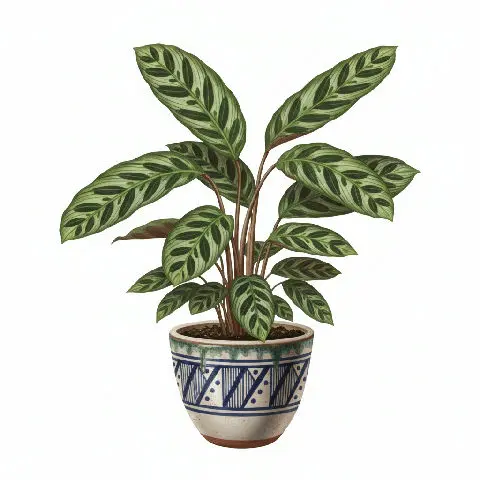
Goeppertia elliptica 'Vittata', commonly known as Calathea Vittata, is a highly sought-after ornamental perennial belonging to the Marantaceae family, often referred to as the prayer plant family. Native to the lush, humid tropical rainforests of Brazil, this cultivar is celebrated for its exceptionally striking foliage. Its elliptical, deep green leaves are distinctively adorned with numerous parallel, light green to white linear stripes that elegantly radiate from the central midrib towards the margins, creating a captivating visual pattern. This unique variegation is the primary reason for its widespread appeal among houseplant enthusiasts.
A hallmark physiological trait of Goeppertia elliptica 'Vittata' is nyctinasty, the rhythmic diurnal movement of its leaves. During daylight hours, the leaves unfurl and flatten to maximize light absorption, while at night, they fold upwards, resembling hands clasped in prayer. This fascinating movement is orchestrated by a specialized joint-like structure called a pulvinus, located at the base of the leaf petiole, which responds to changes in light intensity and internal turgor pressure. While many species within the broader Calathea genus have traditional uses, such as for wrapping food or crafting baskets by indigenous cultures, specific ethnobotanical or medicinal applications for Goeppertia elliptica 'Vittata' are notably sparse.
Its primary significance remains its aesthetic contribution to indoor environments, thriving in conditions that mimic its native understory habitat: consistent warmth, high humidity, and filtered light. Modern research largely focuses on its horticultural aspects, yet the genus as a whole is known to contain potentially bioactive compounds like flavonoids and terpenes.
Trusted Scientific References
1. Authoritative external sources for Goeppertia elliptica
1.1 Wikipedia — Goeppertia elliptica
1.2 Kew POWO (Plants of the World Online)
1.3 PubMed — peer-reviewed research
1.4 NCBI Taxonomy Browser
1.5 GBIF — Global Biodiversity
1.1.Calathea Vittata — Key Features
- ✓ <strong>Botanical Name</strong> — Goeppertia elliptica 'Vittata'
- ✓ <strong>Common Name</strong> — Calathea Vittata, Prayer Plant
- ✓ <strong>Family</strong> — Marantaceae (Arrowroot Family)
- ✓ <strong>Native Region</strong> — Tropical rainforests of Brazil
- ✓ <strong>Foliage</strong> — Deep green elliptical leaves with distinctive white linear stripes
- ✓ <strong>Nyctinasty</strong> — Exhibits diurnal leaf movements, folding upwards at night
- ✓ <strong>Toxicity</strong> — Non-toxic to humans and common household pets
- ✓ <strong>Air Purification</strong> — Known to contribute to improved indoor air quality
- ✓ <strong>Growth Habit</strong> — Evergreen perennial, forming an upright, clumping structure
- ✓ <strong>Environmental Needs</strong> — Thrives in high humidity, consistent moisture, and indirect light
1.2.Calathea Vittata — Quick Summary
- ✓ Ornamental 'Praying Plant' with striking deep green leaves and white linear stripes.
- ✓ Non-toxic to humans, cats, and dogs, making it a safe choice for any household.
- ✓ Actively improves indoor air quality by filtering pollutants and enhancing humidity.
- ✓ Requires consistent moisture, high humidity, and bright, indirect light to thrive.
- ✓ Primary value is aesthetic and environmental, with limited traditional medicinal applications.
- ✓ Exhibits fascinating nyctinasty, where leaves fold up at night and unfurl by day.
2.Calathea Vittata — Scientific Identity
3.Calathea Vittata — Quick Facts
4.Calathea Vittata — Appearance & Identification
5.Calathea Vittata — Native Habitat
6.Calathea Vittata — Water Requirements
- ✓ Light — Prefers bright, indirect light; direct sunlight can lead to leaf scorching, while insufficient light may cause its distinctive patterns to fade.
- ✓ Soil — Thrives in a well-draining, peat-based potting mix, ideally amended with perlite or vermiculite to ensure proper aeration and prevent compaction.
- ✓ Water — Keep the soil consistently moist but never waterlogged; allow the top inch of soil to dry slightly between waterings, using distilled or filtered water to avoid mineral buildup and brown leaf tips.
- ✓ Temperature & Humidity — Optimal temperatures range from 18-24°C (65-75°F); requires high humidity, ideally above 60%, to prevent leaf crisping and browning.
- ✓ Fertilization — Fertilize every 4 weeks during the active growing season (spring and summer) with a diluted, balanced liquid houseplant fertilizer; reduce or cease feeding in fall and winter.
- ✓ Pruning — Trim away any yellowed, browned, or damaged leaves at their base to maintain the plant's tidy appearance and encourage new, healthy growth.
- ✓ Repotting — Repot every 2-3 years in spring, or when the plant becomes root-bound, to refresh the potting medium and provide adequate space for root expansion.
- ✓ Cleaning — Gently wipe the leaves periodically with a soft, damp cloth to remove dust, which helps maintain the plant's aesthetic appeal and supports efficient photosynthesis.
Reviewed by the Flora Medical Global Botanical Review Panel
Multi-disciplinary editorial group · Botany · Ethnobotany · Herbal-medicine literature
Who reviewed this: This page was checked by the Flora Medical Global Botanical Review Panel — an in-house editorial group of botany graduates, ethnobotany researchers, and horticulture practitioners who collectively maintain our 7,000+ plant encyclopedia. Meet the team.
Our 4-step verification process
1. Taxonomic verification
Scientific names and synonyms cross-checked against Kew POWO, World Flora Online, and The Plant List.
2. Phytochemical & medicinal cross-reference
Active compounds, traditional uses, and reported activities are cross-referenced with PubMed, USDA Dr. Duke's database, and peer-reviewed ethnobotanical literature.
3. Conservation & distribution check
Distribution, ecology, and conservation status confirmed against GBIF occurrence records and the IUCN Red List.
4. Editorial & safety review
Every entry passes an editorial pass for clarity, originality, and safety notices (toxicity, contraindications, dosage caveats) before publication.
Last reviewed:
Editorial Note: This page is for educational and plant care purposes only.
Written by: Flora Medical Global Editorial Team
Reviewed by: Flora Medical Global Botanical Review Panel
Last Updated: June 15, 2026







Calathea Vittata — Comments & Community Reviews
Rate this plant