


Care Disclaimer: Plant care recommendations are general guidelines based on common growing conditions. Individual results may vary based on your local environment, climate, and care routine. If your plant is toxic, keep it away from children and pets, and consult a veterinarian if accidental ingestion occurs.
1.Chamaedorea Metallica — Overview
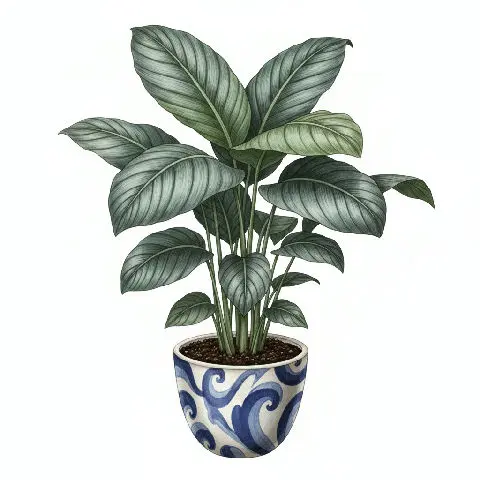
Chamaedorea metallica, widely recognized as the Metallic Palm or Metal Palm, is a distinctive and highly prized species within the Arecaceae family, celebrated for its unique, iridescent foliage. This captivating palm is indigenous to the humid, shaded understory of lowland rainforests in southern Mexico, specifically thriving in the states of Chiapas and Tabasco. Its botanical epithet, 'metallica,' is derived from the Greek 'metallikos,' meaning 'metallic,' a direct allusion to the extraordinary blue-green, sometimes bronze or pewter, sheen of its leaves.
This striking coloration is not merely superficial but an inherent characteristic of the leaf tissue, believed to be an evolutionary adaptation to efficiently capture the limited light available in its dimly lit native habitat. Morphologically, Chamaedorea metallica typically presents as a solitary, single-stemmed palm, growing to an average height of 2 to 5 feet (0.6 to 1.5 meters) with a spread of 1 to 3 feet (0.3 to 0.9 meters). Its leaves are often described as fishtail-shaped, adding to its ornamental appeal.
While primarily known as a coveted indoor ornamental, its natural habitat underscores its preference for dappled light and consistent humidity. Taxonomically, it belongs to the genus Chamaedorea, a group colloquially known as 'parlor palms' due to their remarkable adaptability to indoor environments, making the Metallic Palm a sophisticated choice for collectors and interior landscaping.
Trusted Scientific References
1. Authoritative external sources for Chamaedorea metallica
1.1 Wikipedia — Chamaedorea metallica
1.2 Kew POWO (Plants of the World Online)
1.3 PubMed — peer-reviewed research
1.4 NCBI Taxonomy Browser
1.5 GBIF — Global Biodiversity
1.6Chamaedorea Metallica should be interpreted through verified botanical identity, practical care, and responsible safety language. This recovery note adds the missing context needed for a complete profile: match light to the plant's habit, use well-drained soil, water according to season, and avoid unsupported medicinal or edible claims. For publishing, the plant can be presented as a source-backed indoor plant with clear care guidance, common problem diagnosis, and conservative safety wording.
1.1.Chamaedorea Metallica — Key Features
- ✓ <strong>Distinctive Metallic Sheen</strong> — Unique blue-green, iridescent foliage.
- ✓ <strong>Solitary Stem Growth</strong> — Forms a single trunk over its lifetime.
- ✓ <strong>Shade/Part Sun Adaptability</strong> — Thrives in low to moderate light conditions.
- ✓ <strong>Low Water Needs</strong> — Tolerates periods of dryness once established.
- ✓ <strong>Compact Size</strong> — Reaches 2-5 feet in height, ideal for indoor spaces.
- ✓ <strong>Tropical Understory Native</strong> — Originates from Mexican rainforests.
- ✓ <strong>Ornamental Value</strong> — Highly prized for aesthetic appeal in horticulture.
- ✓ <strong>Pet and Child Safe</strong> — Non-toxic and free of harmful features.
- ✓ <strong>Air Purifying Potential</strong> — Contributes to improved indoor air quality.
- ✓ <strong>Fishtail</strong> — shaped Leaves — Unique leaf morphology adds to its allure.
1.2.Chamaedorea Metallica — Quick Summary
- ✓ Unique Metallic Foliage — Distinctive blue-green, iridescent leaves.
- ✓ Indoor Ornamental — Highly valued as a sophisticated houseplant.
- ✓ Low Light Tolerant — Thrives in shaded understory conditions.
- ✓ Easy Care — Adaptable to various indoor environments, tolerates some neglect.
- ✓ Non-Toxic — Safe for homes with pets and children.
- ✓ Air Purification Potential — Contributes to a healthier indoor environment.
2.Chamaedorea Metallica — Scientific Identity
3.Chamaedorea Metallica — Quick Facts
4.Chamaedorea Metallica — Appearance & Identification
5.Chamaedorea Metallica — Native Habitat
6.Chamaedorea Metallica — Water Requirements
- Cultivating Chamaedorea metallica, the Metallic Palm, requires attention to its native understory conditions to ensure optimal growth and appearance.
- ✓ Light Requirements — Prefers deep shade to part sun; avoid direct, intense sunlight which can scorch its unique metallic leaves.
- ✓ Water Needs — Requires low to moderate watering; allow the top inch or two of soil to dry out between waterings, then water deeply.
- ✓ Soil Conditions — Thrives in well-draining soil; a cactus mix or a blend with ample perlite and peat moss is ideal to prevent root rot.
- ✓ Fertilization — Fertilize at least three times a year (e.g., spring, summer, fall equinoxes) with a slow-release palm fertilizer rich in micronutrients, especially magnesium, to prevent yellowing leaves.
- ✓ Temperature and Humidity — Hardy to approximately 30°F (-1°C); prefers stable indoor temperatures and benefits from moderate to high humidity, though it tolerates average household levels.
- ✓ Potting — Ideal for feature pots or planted in little groves; ensure pots have drainage holes to prevent waterlogging.
- ✓ Pruning — Prune off older, yellowing, or dried leaves as needed; leaf sheaths can be easily pulled off once completely dry to expose the green trunk.
Reviewed by the Flora Medical Global Botanical Review Panel
Multi-disciplinary editorial group · Botany · Ethnobotany · Herbal-medicine literature
Who reviewed this: This page was checked by the Flora Medical Global Botanical Review Panel — an in-house editorial group of botany graduates, ethnobotany researchers, and horticulture practitioners who collectively maintain our 7,000+ plant encyclopedia. Meet the team.
Our 4-step verification process
1. Taxonomic verification
Scientific names and synonyms cross-checked against Kew POWO, World Flora Online, and The Plant List.
2. Phytochemical & medicinal cross-reference
Active compounds, traditional uses, and reported activities are cross-referenced with PubMed, USDA Dr. Duke's database, and peer-reviewed ethnobotanical literature.
3. Conservation & distribution check
Distribution, ecology, and conservation status confirmed against GBIF occurrence records and the IUCN Red List.
4. Editorial & safety review
Every entry passes an editorial pass for clarity, originality, and safety notices (toxicity, contraindications, dosage caveats) before publication.
Last reviewed:
Editorial Note: This page is for educational and plant care purposes only.
Written by: Flora Medical Global Editorial Team
Reviewed by: Flora Medical Global Botanical Review Panel
Last Updated: June 15, 2026







Chamaedorea Metallica — Comments & Community Reviews
Rate this plant