


Care Disclaimer: Plant care recommendations are general guidelines based on common growing conditions. Individual results may vary based on your local environment, climate, and care routine. If your plant is toxic, keep it away from children and pets, and consult a veterinarian if accidental ingestion occurs.
1.Chirita — Overview
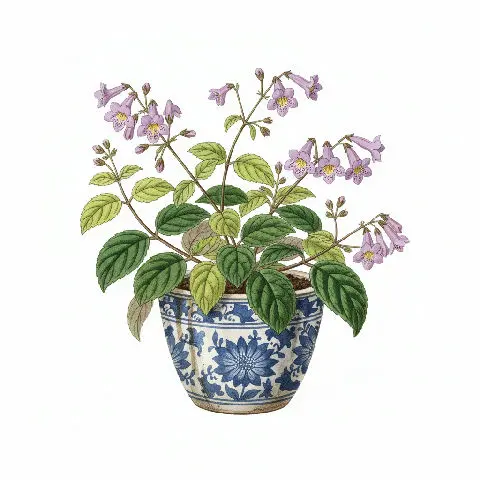
Chirita lavandulacea, commonly known as Lavender-flowered Chirita, is an enchanting tropical perennial herb belonging to the diverse Gesneriaceae family, which notably includes the popular African Violets. This species is indigenous to the humid, shady undergrowth of subtropical and tropical Asia, with its natural distribution spanning forests in Vietnam, southern China, and Thailand, where it often flourishes on limestone rocks or shady embankments. Its botanical designation, 'Chirita,' originates from a local Nepalese term, while the specific epithet 'lavandulacea' directly references the plant's distinctive lavender-hued flowers.
Beyond its ecological role, Chirita lavandulacea has garnered considerable acclaim as an indoor ornamental plant, cherished for its attractive foliage and propensity for abundant blooming. The plant forms a striking rosette of soft, velvety leaves, frequently displaying subtle hints of red or purple on their undersides, offering aesthetic appeal throughout the year. Its tubular, often bi-lipped flowers, typically ranging from lavender to purple and adorned with contrasting markings, add to its visual charm.
While not historically integrated into major traditional medicine systems like Ayurveda or Traditional Chinese Medicine, various Chirita species, including C. lavandulacea, have been employed in Southeast Asian folk medicine for minor ailments, primarily valuing their anti-inflammatory and antiseptic properties when applied externally. Contemporary pharmacological investigations into Chirita species are expanding, with a particular focus on their rich profile of secondary metabolites, especially chalcones and other flavonoids, which have demonstrated promising antioxidant, anti-inflammatory, and antimicrobial activities in controlled in-vitro studies.
Trusted Scientific References
1. Authoritative external sources for Chirita lavandulacea
1.1 Wikipedia — Chirita lavandulacea
1.2 Kew POWO (Plants of the World Online)
1.3 PubMed — peer-reviewed research
1.4 NCBI Taxonomy Browser
1.5 GBIF — Global Biodiversity
1.1.Chirita — Key Features
- ✓ <strong>Captivating Ornamental Plant</strong> — Highly prized for its beauty in indoor gardens.
- ✓ <strong>Tropical Perennial Herb</strong> — Thrives in warm, humid environments.
- ✓ <strong>Native to Southeast Asia</strong> — Found naturally in forests of Vietnam, China, and Thailand.
- ✓ <strong>Member of Gesneriaceae Family</strong> — Related to African Violets.
- ✓ <strong>Distinctive Lavender Flowers</strong> — Features bi-lipped, tubular blooms.
- ✓ <strong>Velvety Rosette Leaves</strong> — Often with reddish-purple undersides.
- ✓ <strong>Folk Medicinal Uses</strong> — Traditionally applied externally for minor ailments.
- ✓ <strong>Rich in Flavonoids & Chalcones</strong> — Key secondary metabolites.
- ✓ <strong>Demonstrated In</strong> — vitro Antioxidant Activity — Shows promise in cell studies.
- ✓ <strong>Exhibited In</strong> — vitro Antimicrobial Effects — Against certain pathogens in lab settings.
1.2.Chirita — Quick Summary
- ✓ Lavender-flowered Chirita is a tropical ornamental herb from Asia.
- ✓ Valued for its attractive foliage and lavender blooms.
- ✓ Folk medicine uses include external anti-inflammatory and antiseptic applications.
- ✓ Modern research highlights its antioxidant and antimicrobial properties in vitro.
- ✓ Rich in chalcones and other flavonoids, key bioactive compounds.
- ✓ Internal use is not recommended due to insufficient safety data.
2.Chirita — Scientific Identity
3.Chirita — Quick Facts
4.Chirita — Appearance & Identification
5.Chirita — Native Habitat
6.Chirita — Water Requirements
- ✓ Light — Prefers bright, indirect light; avoid direct sun which can scorch leaves.
- ✓ Humidity — Requires high humidity, ideally 60-80%, best achieved with pebble trays or humidifiers.
- ✓ Soil — Use a well-draining, airy potting mix, such as an orchid mix or African violet blend.
- ✓ Watering — Keep soil consistently moist but not waterlogged; allow the top inch to dry out slightly between waterings.
- ✓ Temperature — Thrives in warm temperatures, typically 65-75°F (18-24°C); protect from cold drafts.
- ✓ Propagation — Easily propagated by leaf cuttings, stem cuttings, or seeds, rooting readily in moist medium.
- ✓ Fertilization — Feed with a balanced liquid fertilizer diluted to half strength every 2-4 weeks during the growing season.
- ✓ Pests & Diseases — Generally robust, but watch for common houseplant pests like spider mites or mealybugs, and root rot from overwatering.
Reviewed by the Flora Medical Global Botanical Review Panel
Multi-disciplinary editorial group · Botany · Ethnobotany · Herbal-medicine literature
Who reviewed this: This page was checked by the Flora Medical Global Botanical Review Panel — an in-house editorial group of botany graduates, ethnobotany researchers, and horticulture practitioners who collectively maintain our 7,000+ plant encyclopedia. Meet the team.
Our 4-step verification process
1. Taxonomic verification
Scientific names and synonyms cross-checked against Kew POWO, World Flora Online, and The Plant List.
2. Phytochemical & medicinal cross-reference
Active compounds, traditional uses, and reported activities are cross-referenced with PubMed, USDA Dr. Duke's database, and peer-reviewed ethnobotanical literature.
3. Conservation & distribution check
Distribution, ecology, and conservation status confirmed against GBIF occurrence records and the IUCN Red List.
4. Editorial & safety review
Every entry passes an editorial pass for clarity, originality, and safety notices (toxicity, contraindications, dosage caveats) before publication.
Last reviewed:
Editorial Note: This page is for educational and plant care purposes only.
Written by: Flora Medical Global Editorial Team
Reviewed by: Flora Medical Global Botanical Review Panel
Last Updated: June 15, 2026







Chirita — Comments & Community Reviews
Rate this plant