

Care Disclaimer: Plant care recommendations are general guidelines based on common growing conditions. Individual results may vary based on your local environment, climate, and care routine. If your plant is toxic, keep it away from children and pets, and consult a veterinarian if accidental ingestion occurs.
1.Chlorophytum Bonnie — Overview
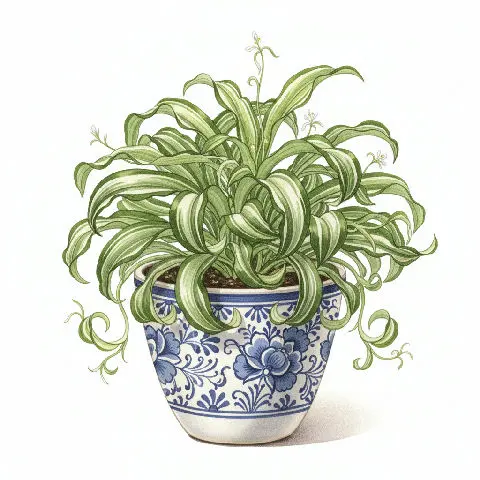
Chlorophytum comosum 'Bonnie', widely recognized as the Curly Spider Plant or Bonnie Spider Plant, is a captivating cultivar of the well-known spider plant, Chlorophytum comosum. Its defining characteristic is its uniquely curled, variegated foliage, which distinctly sets it apart from its straight-leaved counterparts and the parent species. 'Bonnie' emerged through horticultural selection, likely in the mid to late 20th century, specifically cultivated for its exceptional ornamental appeal rather than being a wild discovery.
The broader species, Chlorophytum comosum, is indigenous to the tropical and southern regions of Africa, where it thrives in evergreen and deciduous forests, typically growing as an understory plant or a lithophyte on rocky outcrops, favoring humid and partially shaded conditions. The 'Bonnie' cultivar retains the remarkable resilience and adaptability of its wild ancestors, making it an extraordinarily popular indoor houseplant globally. Botanically, it features relatively short, arching leaves that form a dense rosette.
In contrast to the straight or gently wavy leaves of other cultivars such as 'Vittatum' or 'Variegatum', 'Bonnie' displays a pronounced curl or spiral, contributing to its more compact and bushy aesthetic. The leaves typically showcase a vibrant green margin encircling a creamy white to pale yellow central stripe, though the intensity of variegation can vary.
Trusted Scientific References
1. Authoritative external sources for Chlorophytum comosum bonnie
1.1 Wikipedia — Chlorophytum comosum bonnie
1.2 Kew POWO (Plants of the World Online)
1.3 PubMed — peer-reviewed research
1.4 NCBI Taxonomy Browser
1.5 GBIF — Global Biodiversity
1.6Chlorophytum Bonnie should be interpreted through verified botanical identity, practical care, and responsible safety language. This recovery note adds the missing context needed for a complete profile: match light to the plant's habit, use well-drained soil, water according to season, and avoid unsupported medicinal or edible claims. For publishing, the plant can be presented as a source-backed indoor plant with clear care guidance, common problem diagnosis, and conservative safety wording.
1.1.Chlorophytum Bonnie — Key Features
- ✓ <strong>Unique Curled Foliage</strong> — Distinctive spiraled leaves set 'Bonnie' apart from other spider plant cultivars.
- ✓ <strong>Variegated Leaves</strong> — Features vibrant green margins with a creamy white to pale yellow central stripe.
- ✓ <strong>Air Purifier</strong> — The parent species is recognized by NASA for its effectiveness in cleaning indoor air.
- ✓ <strong>Produces Plantlets</strong> — Easily propagates from the 'spiderettes' that grow on its stolons, allowing for new plants.
- ✓ <strong>Adaptable Houseplant</strong> — Thrives in a wide range of indoor conditions, making it highly versatile.
- ✓ <strong>Non</strong> — Toxic — Safe for households with children and pets, offering peace of mind.
- ✓ <strong>Low Maintenance</strong> — Requires minimal care, making it an excellent choice for novice plant enthusiasts.
- ✓ <strong>Compact Growth Habit</strong> — Exhibits a bushier and more contained appearance compared to straight-leaved varieties.
- ✓ <strong>Ornamental Value</strong> — Highly aesthetic, adding a touch of elegance and natural beauty to interior spaces.
- ✓ <strong>Drought Tolerant</strong> — Possesses a degree of resilience to infrequent watering, forgiving occasional neglect.
1.2.Chlorophytum Bonnie — Quick Summary
- ✓ Chlorophytum 'Bonnie' — A distinctive ornamental cultivar known for its uniquely curled, variegated leaves.
- ✓ Parent Species *C. comosum* — Native to tropical Africa, celebrated for its resilience and adaptability.
- ✓ Air Purification — The species is widely recognized by NASA for its ability to remove indoor air toxins like formaldehyde.
- ✓ Traditional Uses — While limited for the 'Bonnie' cultivar, the parent species has anecdotal uses in African folk medicine.
- ✓ Non-Toxic — Generally considered safe for humans and pets, making it an ideal houseplant.
- ✓ Easy Care — A popular, low-maintenance indoor plant, suitable for beginners and experienced growers alike.
2.Chlorophytum Bonnie — Scientific Identity
3.Chlorophytum Bonnie — Quick Facts
4.Chlorophytum Bonnie — Appearance & Identification
5.Chlorophytum Bonnie — Native Habitat
6.Chlorophytum Bonnie — Water Requirements
- ✓ Light — Provide bright, indirect light; direct sunlight can scorch the delicate leaves of Chlorophytum Bonnie.
- ✓ Watering — Keep the soil consistently moist but never waterlogged; allow the top inch of soil to dry out between waterings.
- ✓ Soil — Use a well-draining, rich potting mix that retains some moisture, ideally with organic matter.
- ✓ Humidity — Prefers moderate to high humidity; misting regularly or placing the pot on a pebble tray can be beneficial.
- ✓ Temperature — Thrives in average room temperatures between 65-80°F (18-27°C); avoid sudden temperature fluctuations.
- ✓ Propagation — Easily propagated from the plantlets (spiderettes) that grow on long stolons; simply snip and root in water or moist soil.
- ✓ Fertilizing — Feed monthly during the active growing season (spring and summer) with a balanced liquid fertilizer diluted to half strength.
- ✓ Pests — Generally resistant, but occasionally susceptible to spider mites, mealybugs, and scale insects; inspect regularly.
Reviewed by the Flora Medical Global Botanical Review Panel
Multi-disciplinary editorial group · Botany · Ethnobotany · Herbal-medicine literature
Who reviewed this: This page was checked by the Flora Medical Global Botanical Review Panel — an in-house editorial group of botany graduates, ethnobotany researchers, and horticulture practitioners who collectively maintain our 7,000+ plant encyclopedia. Meet the team.
Our 4-step verification process
1. Taxonomic verification
Scientific names and synonyms cross-checked against Kew POWO, World Flora Online, and The Plant List.
2. Phytochemical & medicinal cross-reference
Active compounds, traditional uses, and reported activities are cross-referenced with PubMed, USDA Dr. Duke's database, and peer-reviewed ethnobotanical literature.
3. Conservation & distribution check
Distribution, ecology, and conservation status confirmed against GBIF occurrence records and the IUCN Red List.
4. Editorial & safety review
Every entry passes an editorial pass for clarity, originality, and safety notices (toxicity, contraindications, dosage caveats) before publication.
Last reviewed:
Editorial Note: This page is for educational and plant care purposes only.
Written by: Flora Medical Global Editorial Team
Reviewed by: Flora Medical Global Botanical Review Panel
Last Updated: June 15, 2026







Chlorophytum Bonnie — Comments & Community Reviews
Rate this plant