


Care Disclaimer: Plant care recommendations are general guidelines based on common growing conditions. Individual results may vary based on your local environment, climate, and care routine. If your plant is toxic, keep it away from children and pets, and consult a veterinarian if accidental ingestion occurs.
1.Chlorophytum Cape — Overview
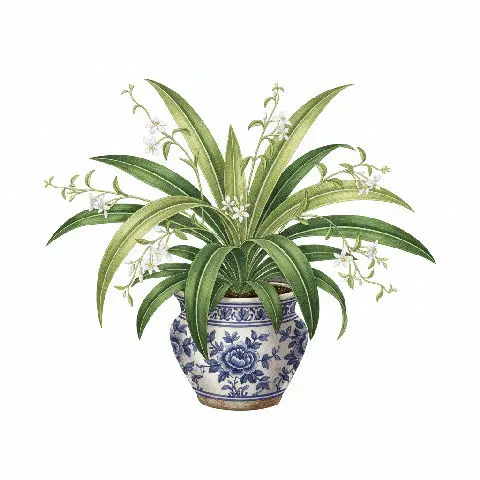
Chlorophytum capense, widely known as the Cape Chlorophytum or Green Spider Plant, is an evergreen herbaceous perennial within the Asparagaceae family. Native to South Africa, particularly the Eastern Cape Province, it thrives in dry, shady vegetation near river banks and coastal areas, demonstrating remarkable adaptability. This resilient species is distinguished by its solid green, strap-like leaves, which are linear to lanceolate, growing up to 45 cm long and 2-3 cm wide, forming an elegant arching rosette. Unlike its more famous relative, Chlorophytum comosum, C.
capense typically does not produce plantlets (spiderettes) on its flower stalks, a key botanical differentiator. The plant features fascicled, fleshy roots that serve as vital storage organs for water and nutrients, contributing to its notable drought tolerance. During summer months (October to April in its native habitat), C. capense produces delicate, star-shaped white flowers on slender, branched racemes that can reach up to 1 meter in height, extending above the foliage.
These flowers have six stamens with white filaments and yellow anthers, culminating in a capsule fruit containing black seeds. Historically, its robust growth and ease of cultivation likely made it a readily available resource, though specific ancient medicinal documentation for C. capense is less prevalent compared to other Chlorophytum species. Its conservation status is 'Least Concern' according to the Red List of South African Plants.
Trusted Scientific References
1. Authoritative external sources for Chlorophytum capense
1.1 Wikipedia — Chlorophytum capense
1.2 Kew POWO (Plants of the World Online)
1.3 PubMed — peer-reviewed research
1.4 NCBI Taxonomy Browser
1.5 GBIF — Global Biodiversity
1.6Chlorophytum Cape should be interpreted through verified botanical identity, practical care, and responsible safety language. This recovery note adds the missing context needed for a complete profile: match light to the plant's habit, use well-drained soil, water according to season, and avoid unsupported medicinal or edible claims. For publishing, the plant can be presented as a source-backed indoor plant with clear care guidance, common problem diagnosis, and conservative safety wording.
1.1.Chlorophytum Cape — Key Features
- ✓ <strong>Evergreen Herbaceous Perennial</strong> — Maintains foliage year-round, growing from a persistent base.
- ✓ <strong>Solid Green Leaves</strong> — Distinctive strap-like, linear to lanceolate leaves without variegation.
- ✓ <strong>Fleshy, Fascicled Roots</strong> — Specialized underground organs for water and nutrient storage, aiding drought tolerance.
- ✓ <strong>Non</strong> — Plantlet Producing — A key differentiator from Chlorophytum comosum, it does not form spiderettes on flower stalks.
- ✓ <strong>Star</strong> — shaped White Flowers — Delicate blooms borne on tall, branched racemes during summer.
- ✓ <strong>Adaptable and Resilient</strong> — Thrives in various light conditions from semi-shade to full sun and is semi-hardy to frost.
- ✓ <strong>Native to South Africa</strong> — Indigenous to the Eastern Cape Province, growing in dry, shady riverine and coastal habitats.
- ✓ <strong>Ornamental Value</strong> — Highly valued as a landscape plant, groundcover, edging plant, and popular indoor pot plant.
- ✓ <strong>Low Maintenance</strong> — Requires moderate water and is relatively easy to cultivate, making it suitable for beginners.
- ✓ <strong>Conservation Status 'Least Concern'</strong> — Not threatened in its natural habitat, indicating stable populations.
1.2.Chlorophytum Cape — Quick Summary
- ✓ Chlorophytum capense is the Green Spider Plant, native to South Africa, thriving in diverse conditions.
- ✓ Characterized by solid green, strap-like leaves and fleshy roots, without producing plantlets like C. comosum.
- ✓ While primarily ornamental, the Chlorophytum genus is known for antioxidant, anti-inflammatory, and immunomodulatory properties.
- ✓ Traditionally, related species are used for rejuvenation, energy, bronchitis, fractures, and burns.
- ✓ Key chemical constituents include saponins and flavonoids.
- ✓ Easily propagated by division, it's a popular, low-maintenance ornamental for shade to full sun.
2.Chlorophytum Cape — Scientific Identity
3.Chlorophytum Cape — Quick Facts
4.Chlorophytum Cape — Appearance & Identification
5.Chlorophytum Cape — Native Habitat
6.Chlorophytum Cape — Water Requirements
- ✓ Propagation by Division — The most common and effective method involves lifting mature clumps and dividing them into smaller sections, each with roots and foliage.
- ✓ Seed Sowing — Seeds can be sown in warmer months, ideally in a well-draining, composted soil mix for optimal germination and growth.
- ✓ Soil Requirements — Prefers a rich, well-drained soil, with a recommended mixture of 70% topsoil and 30% compost for robust growth.
- ✓ Light Conditions — Thrives in a range from semi-shade to full sun, demonstrating its adaptability to various light environments.
- ✓ Watering — Requires moderate watering; allow the topsoil to dry slightly between waterings, as its fleshy roots store moisture.
- ✓ Fertilization — Benefits from the addition of a balanced fertilizer before the main growing season, typically in late winter or early spring (August in the Southern Hemisphere).
- ✓ Frost Tolerance — Considered semi-hardy to frost, suggesting it can tolerate light freezes but may require protection in colder climates.
- ✓ Container Growing — An excellent choice for containers and indoor cultivation due to its aesthetic appeal and relatively compact growth habit.
Reviewed by the Flora Medical Global Botanical Review Panel
Multi-disciplinary editorial group · Botany · Ethnobotany · Herbal-medicine literature
Who reviewed this: This page was checked by the Flora Medical Global Botanical Review Panel — an in-house editorial group of botany graduates, ethnobotany researchers, and horticulture practitioners who collectively maintain our 7,000+ plant encyclopedia. Meet the team.
Our 4-step verification process
1. Taxonomic verification
Scientific names and synonyms cross-checked against Kew POWO, World Flora Online, and The Plant List.
2. Phytochemical & medicinal cross-reference
Active compounds, traditional uses, and reported activities are cross-referenced with PubMed, USDA Dr. Duke's database, and peer-reviewed ethnobotanical literature.
3. Conservation & distribution check
Distribution, ecology, and conservation status confirmed against GBIF occurrence records and the IUCN Red List.
4. Editorial & safety review
Every entry passes an editorial pass for clarity, originality, and safety notices (toxicity, contraindications, dosage caveats) before publication.
Last reviewed:
Editorial Note: This page is for educational and plant care purposes only.
Written by: Flora Medical Global Editorial Team
Reviewed by: Flora Medical Global Botanical Review Panel
Last Updated: June 15, 2026







Chlorophytum Cape — Comments & Community Reviews
Rate this plant