


Care Disclaimer: Plant care recommendations are general guidelines based on common growing conditions. Individual results may vary based on your local environment, climate, and care routine. If your plant is toxic, keep it away from children and pets, and consult a veterinarian if accidental ingestion occurs.
1.Chlorophytum Orange — Overview
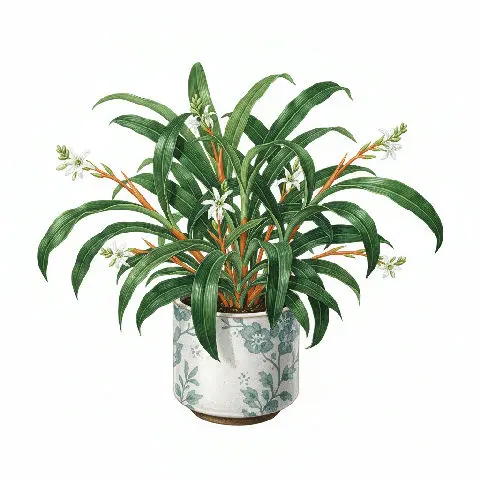
Chlorophytum orchidastrum, widely recognized by its captivating common names such as ‘Orange Spider Plant’, ‘Fire Flash’, ‘Mandarin Plant’, and ‘Sierra Leone Lily’, is a distinguished member of the Asparagaceae family. This evergreen, herbaceous perennial is native to the seasonally dry tropical regions spanning West Tropical Africa to Zambia, encompassing countries like Benin, Cameroon, Ghana, and Zambia. Unlike its more common relative, Chlorophytum comosum, C.
orchidastrum is celebrated for its unique and striking morphological features. The plant forms a beautiful rosette of broad, lance-shaped leaves, typically growing 20-40 cm tall and 40-60 cm wide, giving it an elegant, clumping, and erect habit. Its most distinctive characteristic is the vibrant, iridescent deep orange petioles and midribs that provide a stark and beautiful contrast against the glossy, dark green leaf blades, which can reach up to 30 cm in length with gently undulate margins.
This coloration is particularly pronounced in younger foliage, justifying its fiery common names.
Botanically, Chlorophytum orchidastrum thrives in the dappled light and consistent humidity characteristic of its native understory habitats. It produces small, star-shaped, creamy-white flowers that emerge on an erect shaft from the center of the plant during the summer months, typically from July to August. These inconspicuous blooms are followed by green, triangular seed pods that mature to brown before releasing their seeds.
Propagation primarily occurs through rhizome division, as C. orchidastrum rarely develops the characteristic 'spiderettes' or plantlets on stolons seen in C. comosum.
Its adaptability to indoor environments, coupled with its relatively low maintenance requirements and stunning visual appeal, has solidified its status as a popular ornamental houseplant, contributing aesthetic value to various indoor and patio settings. While closely related to species with significant traditional medicinal uses, such as Chlorophytum borivilianum, C. orchidastrum itself does not have documented historical medicinal applications within traditional healing systems due to its specific geographic origin and limited historical use beyond its native ornamental appeal.
Trusted Scientific References
1. Authoritative external sources for Chlorophytum orchidastrum
1.1 Wikipedia — Chlorophytum orchidastrum
1.2 Kew POWO (Plants of the World Online)
1.3 PubMed — peer-reviewed research
1.4 NCBI Taxonomy Browser
1.5 GBIF — Global Biodiversity
1.1.Chlorophytum Orange — Key Features
- ✓ <strong>Striking Orange Petioles</strong> — The most distinctive feature, providing a vibrant contrast to the green foliage.
- ✓ <strong>Glossy Dark Green Leaves</strong> — Broad, lance-shaped leaves with undulate margins, enhancing its ornamental value.
- ✓ <strong>Clumping, Erect Habit</strong> — Forms a compact rosette, growing 20-40 cm tall and 40-60 cm wide.
- ✓ <strong>Non</strong> — Toxic to Pets — Safe for households with dogs and cats, a major advantage for a houseplant.
- ✓ <strong>Low Maintenance</strong> — Easy to care for, suitable for beginners and busy individuals.
- ✓ <strong>Air Purification Potential</strong> — Contributes to cleaner indoor air, though specific research for this species is limited.
- ✓ <strong>Rhizome Propagation</strong> — Reproduces via underground rhizomes, unlike the stolons of common spider plants.
- ✓ <strong>Partial Shade Tolerant</strong> — Thrives in indirect light, making it ideal for many indoor settings.
- ✓ <strong>Tropical Origin</strong> — Native to West Tropical Africa, preferring warm, humid conditions.
- ✓ <strong>Evergreen Perennial</strong> — Provides year-round foliage and aesthetic appeal.
1.2.Chlorophytum Orange — Quick Summary
- ✓ Vibrant 'Fire Flash' foliage with orange petioles and dark green leaves.
- ✓ Native to West Tropical Africa, an evergreen herbaceous perennial.
- ✓ Primarily an ornamental houseplant, valued for aesthetic appeal and ease of care.
- ✓ Believed to offer air purification benefits, similar to other Chlorophytum species.
- ✓ Non-toxic to humans and pets, making it a safe choice for indoor environments.
- ✓ Propagated by rhizome division, distinct from C. comosum which produces spiderettes.
2.Chlorophytum Orange — Scientific Identity
3.Chlorophytum Orange — Quick Facts
4.Chlorophytum Orange — Appearance & Identification
5.Chlorophytum Orange — Native Habitat
6.Chlorophytum Orange — Water Requirements
- ✓ Light Requirements — Provide bright, indirect light; direct sunlight can scorch leaves, while insufficient light may diminish the vibrant orange color of petioles.
- ✓ Soil and Drainage — Use a well-drained, loamy potting mix, ideally amended with perlite and sand to prevent waterlogging and root rot.
- ✓ Watering Schedule — Water when the top 1 inch (2.5 cm) of soil feels dry to the touch; avoid overwatering, as this plant is susceptible to root rot.
- ✓ Humidity and Temperature — Maintain moderate temperatures above 60°F (15°C) and a humid environment (50-60% relative humidity), mimicking its tropical native habitat.
- ✓ Fertilization — Feed sparingly with a balanced liquid fertilizer during the growing season (spring and summer), typically once a month, reducing frequency in winter.
- ✓ Repotting — Repot every 1-2 years in spring, or when the plant becomes root-bound, to refresh the soil and provide adequate space for growth.
- ✓ Propagation — Primarily propagated through rhizome division; carefully separate sections of the rhizome with attached leaves and roots during repotting.
- ✓ Pest and Disease Management — Generally resilient, but monitor for common houseplant pests like spider mites, mealybugs, and aphids; ensure good air circulation to prevent fungal leaf spots.
Reviewed by the Flora Medical Global Botanical Review Panel
Multi-disciplinary editorial group · Botany · Ethnobotany · Herbal-medicine literature
Who reviewed this: This page was checked by the Flora Medical Global Botanical Review Panel — an in-house editorial group of botany graduates, ethnobotany researchers, and horticulture practitioners who collectively maintain our 7,000+ plant encyclopedia. Meet the team.
Our 4-step verification process
1. Taxonomic verification
Scientific names and synonyms cross-checked against Kew POWO, World Flora Online, and The Plant List.
2. Phytochemical & medicinal cross-reference
Active compounds, traditional uses, and reported activities are cross-referenced with PubMed, USDA Dr. Duke's database, and peer-reviewed ethnobotanical literature.
3. Conservation & distribution check
Distribution, ecology, and conservation status confirmed against GBIF occurrence records and the IUCN Red List.
4. Editorial & safety review
Every entry passes an editorial pass for clarity, originality, and safety notices (toxicity, contraindications, dosage caveats) before publication.
Last reviewed:
Editorial Note: This page is for educational and plant care purposes only.
Written by: Flora Medical Global Editorial Team
Reviewed by: Flora Medical Global Botanical Review Panel
Last Updated: June 15, 2026







Chlorophytum Orange — Comments & Community Reviews
Rate this plant