
Care Disclaimer: Plant care recommendations are general guidelines based on common growing conditions. Individual results may vary based on your local environment, climate, and care routine. If your plant is toxic, keep it away from children and pets, and consult a veterinarian if accidental ingestion occurs.
1.Clerodendrum Thomsoniae — Overview
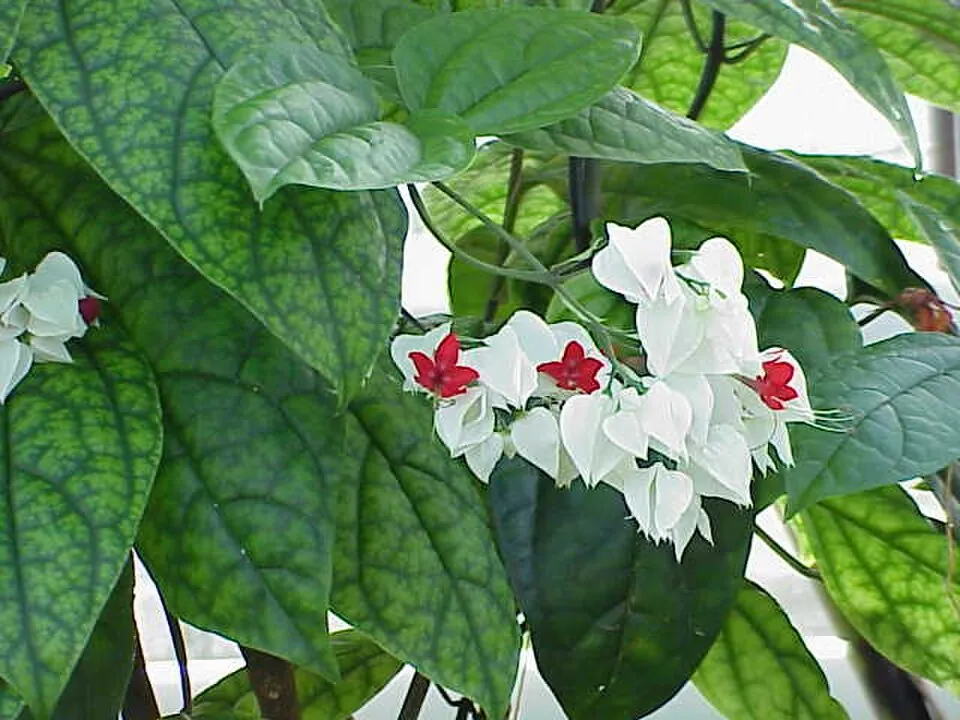
Clerodendrum thomsoniae, widely recognized as the Bleeding Heart Vine or Bagflower, is a captivating ornamental vining plant primarily native to the tropical rainforests of West Africa, spanning regions from Cameroon to Senegal. This striking species, first botanically described in 1861 by George Thomson, belongs to the Lamiaceae family, though it was historically classified under Verbenaceae. It is a vigorous, twining climber, capable of reaching lengths of up to 4 meters (approximately 13 feet) in its natural habitat or under optimal cultivation conditions. Its most distinctive feature is its profusion of unique, bicolored flowers, which emerge in cymes.
Each bloom consists of a pristine, balloon-like white calyx that dramatically encases and then reveals a vibrant, five-lobed crimson corolla, creating a stark and beautiful contrast. This dramatic appearance has earned it evocative common names such as 'Glory Bower' and 'Lady's Eardrops.' While primarily celebrated for its aesthetic appeal in conservatories, hanging baskets, and trellises across tropical and subtropical zones globally, its genus, Clerodendrum, has a long history in various traditional medicine systems. Although C. thomsoniae itself has less documented specific use in formal Ayurvedic, Traditional Chinese Medicine (TCM), or Unani texts compared to some of its congeners, modern scientific inquiry is beginning to unravel its phytochemical richness.
Initial studies have identified significant concentrations of flavonoids, triterpenoids, and phenolic acids, which are known for their diverse biological activities. These compounds suggest a potential for medicinal applications, aligning with the broader therapeutic recognition of the Clerodendrum genus. The plant thrives in warm, humid environments, requiring specific care when cultivated indoors in cooler climates, yet its robust growth habit generally makes it a relatively low-maintenance option for exotic flowering plant enthusiasts.
Trusted Scientific References
1. Authoritative external sources for Clerodendrum thomsoniae
1.1 Wikipedia — Clerodendrum thomsoniae
1.2 Kew POWO (Plants of the World Online)
1.3 PubMed — peer-reviewed research
1.4 NCBI Taxonomy Browser
1.5 GBIF — Global Biodiversity
1.1.Clerodendrum Thomsoniae — Key Features
- ✓ <strong>Botanical Name</strong> — Clerodendrum thomsoniae.
- ✓ <strong>Common Names</strong> — Bleeding Heart Vine, Bagflower, Glory Bower, Lady's Eardrops.
- ✓ <strong>Plant Family</strong> — Lamiaceae (formerly Verbenaceae).
- ✓ <strong>Native Region</strong> — Tropical West Africa (Cameroon to Senegal).
- ✓ <strong>Distinctive Flowers</strong> — Features a prominent white calyx surrounding a vibrant crimson corolla.
- ✓ <strong>Growth Habit</strong> — A vigorous, twining woody climber, capable of reaching significant lengths.
- ✓ <strong>Key Phytochemicals</strong> — Rich in flavonoids, triterpenoids, and phenolic acids.
- ✓ <strong>Preliminary Medicinal Potential</strong> — Explored for antioxidant, anti-inflammatory, and antimicrobial activities.
- ✓ <strong>Primary Use</strong> — Highly valued globally as an ornamental plant for its exquisite blooms.
- ✓ <strong>Cultivation Requirements</strong> — Thrives in warm, humid environments with bright, indirect light.
1.2.Clerodendrum Thomsoniae — Quick Summary
- ✓ Striking ornamental vine, Clerodendrum thomsoniae, known as Bleeding Heart Vine.
- ✓ Native to tropical West Africa, cultivated worldwide for its unique white and crimson flowers.
- ✓ Contains significant levels of flavonoids, triterpenoids, and phenolic acids.
- ✓ Emerging scientific research suggests potential antioxidant, anti-inflammatory, and antimicrobial properties.
- ✓ Limited documented traditional medicinal use for this specific species compared to congeners.
- ✓ Safety for internal human consumption is not established; primarily an ornamental plant.
2.Clerodendrum Thomsoniae — Scientific Identity
3.Clerodendrum Thomsoniae — Quick Facts
4.Clerodendrum Thomsoniae — Appearance & Identification
5.Clerodendrum Thomsoniae — Native Habitat
6.Clerodendrum Thomsoniae — Water Requirements
- ✓ Light — Clerodendrum thomsoniae thrives in bright, indirect light; direct afternoon sun can scorch its leaves, while insufficient light significantly reduces flowering.
- ✓ Soil — Prefers a rich, well-draining potting mix that retains some moisture, ideally with a slightly acidic to neutral pH, enriched with organic compost.
- ✓ Watering — Requires consistent moisture during its active growing season; water thoroughly when the top inch of soil feels dry, reducing frequency in cooler months.
- ✓ Humidity — High humidity is critical for optimal growth and abundant flowering, especially when grown indoors; regular misting or placement on a pebble tray is beneficial.
- ✓ Temperature — Ideal temperatures range between 18-29°C (65-85°F); it is sensitive to cold temperatures and will suffer damage or die if exposed to frost.
- ✓ Fertilization — Feed regularly every 2-4 weeks during the spring and summer growing period with a balanced liquid fertilizer diluted to half strength.
- ✓ Pruning — Prune after the main flush of blooms to maintain a manageable shape, encourage bushier growth, and stimulate the production of more flowers.
- ✓ Propagation — Easily propagated from semi-hardwood stem cuttings taken in spring or early summer, which can root readily in water or a moist, sterile potting medium.
Reviewed by the Flora Medical Global Botanical Review Panel
Multi-disciplinary editorial group · Botany · Ethnobotany · Herbal-medicine literature
Who reviewed this: This page was checked by the Flora Medical Global Botanical Review Panel — an in-house editorial group of botany graduates, ethnobotany researchers, and horticulture practitioners who collectively maintain our 7,000+ plant encyclopedia. Meet the team.
Our 4-step verification process
1. Taxonomic verification
Scientific names and synonyms cross-checked against Kew POWO, World Flora Online, and The Plant List.
2. Phytochemical & medicinal cross-reference
Active compounds, traditional uses, and reported activities are cross-referenced with PubMed, USDA Dr. Duke's database, and peer-reviewed ethnobotanical literature.
3. Conservation & distribution check
Distribution, ecology, and conservation status confirmed against GBIF occurrence records and the IUCN Red List.
4. Editorial & safety review
Every entry passes an editorial pass for clarity, originality, and safety notices (toxicity, contraindications, dosage caveats) before publication.
Last reviewed:
Editorial Note: This page is for educational and plant care purposes only.
Written by: Flora Medical Global Editorial Team
Reviewed by: Flora Medical Global Botanical Review Panel
Last Updated: June 15, 2026







Clerodendrum Thomsoniae — Comments & Community Reviews
Rate this plant