
Care Disclaimer: Plant care recommendations are general guidelines based on common growing conditions. Individual results may vary based on your local environment, climate, and care routine. If your plant is toxic, keep it away from children and pets, and consult a veterinarian if accidental ingestion occurs.
1.Cocoa Plant — Overview
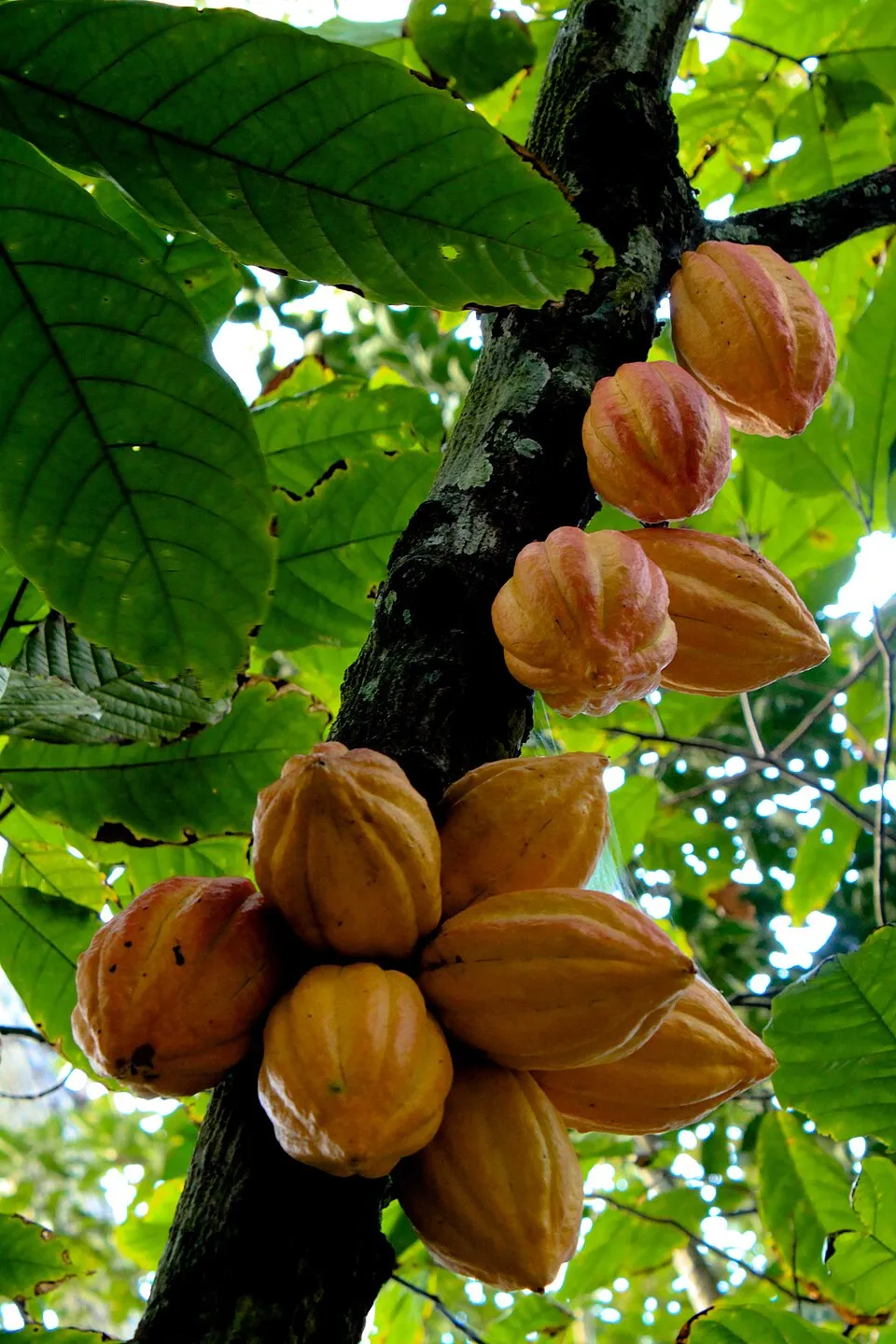
The Cocoa Plant, scientifically known as Theobroma cacao, is a small, evergreen tree revered as the 'food of the gods,' a name bestowed upon it by Carl Linnaeus. Native to the humid tropical understory of the Amazon basin, its cultivation by ancient Olmec, Maya, and Aztec civilizations dates back over 3,000 years, where its beans were brewed into a bitter, spiced beverage and even used as currency. Botanically, T.
cacao is characterized by its unique growth habit, featuring an orthotropic stem and plagiotropic branches that form a tiered canopy. Its large, simple, entire leaves emerge with a reddish hue before maturing to a glossy dark green. The most distinctive feature is cauliflory, where small, waxy, reddish-pink to whitish flowers bloom directly from the trunk and older branches.
These delicate flowers are pollinated by tiny midges, developing into football-shaped pods that ripen to shades of yellow, orange, or reddish-brown. Each pod encases 20-60 cocoa beans, surrounded by a sweet, mucilaginous pulp. These beans are the primary economic product, undergoing a crucial post-harvest process of fermentation, drying, roasting, and grinding to yield cocoa liquor, cocoa butter, and cocoa powder, which form the basis of chocolate and numerous other products globally.
Trusted Scientific References
1. Authoritative external sources for Theobroma cacao
1.1 Wikipedia — Theobroma cacao
1.2 Kew POWO (Plants of the World Online)
1.3 PubMed — peer-reviewed research
1.4 NCBI Taxonomy Browser
1.5 GBIF — Global Biodiversity
1.6Cocoa Plant should be interpreted through verified botanical identity, practical care, and responsible safety language. This recovery note adds the missing context needed for a complete profile: match light to the plant's habit, use well-drained soil, water according to season, and avoid unsupported medicinal or edible claims. For publishing, the plant can be presented as a source-backed indoor plant with clear care guidance, common problem diagnosis, and conservative safety wording.
1.1.Cocoa Plant — Key Features
- ✓ <strong>Ancient Mesoamerican origins</strong> — Ancient Mesoamerican origins and 'food of the gods' moniker.
- ✓ <strong>Unique cauliflorous flowering</strong> — Unique cauliflorous flowering directly on trunk and branches.
- ✓ <strong>Rich source of</strong> — Rich source of powerful antioxidants, especially flavonoids and polyphenols.
- ✓ <strong>Contains methylxanthines (theobromine,</strong> — Contains methylxanthines (theobromine, caffeine) for gentle stimulation.
- ✓ <strong>Supports cardiovascular health</strong> — Supports cardiovascular health by improving blood flow and reducing blood pressure.
- ✓ <strong>Known for mood</strong> — enhancing and cognitive benefits.
- ✓ <strong>Economically significant crop,</strong> — Economically significant crop, foundation of the global chocolate industry.
- ✓ <strong>Thrives in tropical,</strong> — Thrives in tropical, humid understory environments.
- ✓ <strong>Beans undergo crucial</strong> — Beans undergo crucial fermentation for flavor development.
- ✓ <strong>Versatile uses from</strong> — Versatile uses from food and beverage to cosmetics and herbal medicine.
1.2.Cocoa Plant — Quick Summary
- ✓ Theobroma cacao, the 'food of the gods,' originates from Central and South American rainforests.
- ✓ Valued for its beans, which are processed into cocoa and chocolate, rich in bioactive compounds.
- ✓ Offers significant cardiovascular, cognitive, and mood-enhancing benefits due to flavonoids and methylxanthines.
- ✓ Known for its potent antioxidant and anti-inflammatory properties, supporting overall cellular health.
- ✓ Requires careful consumption due to caffeine content, potential heavy metals, and specific contraindications.
- ✓ A culturally significant plant with a rich history, now a global dietary staple and medicinal ingredient.
2.Cocoa Plant — Scientific Identity
3.Cocoa Plant — Quick Facts
4.Cocoa Plant — Appearance & Identification
5.Cocoa Plant — Native Habitat
6.Cocoa Plant — Water Requirements
- ✓ Climate — Requires a hot, humid tropical climate with consistent rainfall (1500-2500 mm annually) and temperatures between 21-32°C.
- ✓ Shade Requirement — Traditionally grown in the understory of larger trees, requiring 25-50% shade, especially during early growth stages, to protect from direct sun and maintain humidity.
- ✓ Soil — Thrives in deep, well-drained, fertile soils with a pH between 6.0-7.0, rich in organic matter.
- ✓ Propagation — Primarily propagated from seeds (for genetic diversity) or vegetatively through cuttings or budding (for clonal uniformity and faster maturation).
- ✓ Pest and Disease Management — Susceptible to various fungal diseases (e.g., Black Pod, Witches' Broom, Frosty Pod Rot) and pests (e.g., mirids, cocoa pod borer), requiring integrated pest management strategies.
- ✓ Harvesting — Pods are hand-harvested when fully ripe, typically indicated by a change in color, and removed carefully to avoid damaging the cauliflorous cushions.
- ✓ Post-Harvest Processing — Beans are extracted from pods, fermented for 2-8 days (crucial for flavor development), dried to reduce moisture, and then roasted.
Reviewed by the Flora Medical Global Botanical Review Panel
Multi-disciplinary editorial group · Botany · Ethnobotany · Herbal-medicine literature
Who reviewed this: This page was checked by the Flora Medical Global Botanical Review Panel — an in-house editorial group of botany graduates, ethnobotany researchers, and horticulture practitioners who collectively maintain our 7,000+ plant encyclopedia. Meet the team.
Our 4-step verification process
1. Taxonomic verification
Scientific names and synonyms cross-checked against Kew POWO, World Flora Online, and The Plant List.
2. Phytochemical & medicinal cross-reference
Active compounds, traditional uses, and reported activities are cross-referenced with PubMed, USDA Dr. Duke's database, and peer-reviewed ethnobotanical literature.
3. Conservation & distribution check
Distribution, ecology, and conservation status confirmed against GBIF occurrence records and the IUCN Red List.
4. Editorial & safety review
Every entry passes an editorial pass for clarity, originality, and safety notices (toxicity, contraindications, dosage caveats) before publication.
Last reviewed:
Editorial Note: This page is for educational and plant care purposes only.
Written by: Flora Medical Global Editorial Team
Reviewed by: Flora Medical Global Botanical Review Panel
Last Updated: June 15, 2026







Cocoa Plant — Comments & Community Reviews
Rate this plant