


Care Disclaimer: Plant care recommendations are general guidelines based on common growing conditions. Individual results may vary based on your local environment, climate, and care routine. If your plant is toxic, keep it away from children and pets, and consult a veterinarian if accidental ingestion occurs.
1.Codonanthe — Overview
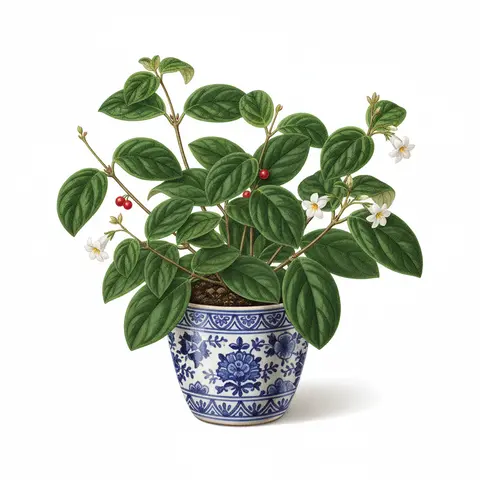
Codonanthe gracilis, a captivating perennial herb, is a distinguished member of the Gesneriaceae family, renowned for its ornamental species. This plant thrives as an epiphyte, growing on tree trunks, or as a lithophyte, anchoring itself to rocks, primarily within the humid tropical forests of Central and South America, particularly Brazil's Atlantic Forest. Its natural habitat, characterized by dappled sunlight and consistent moisture, dictates its cultivation needs, making it an excellent choice for indoor collections, especially in hanging baskets or terrariums. Botanically, Codonanthe gracilis features small, succulent-like, ovate to elliptic leaves, typically a vibrant dark green, which can develop attractive reddish or purplish hues under brighter light conditions.
These leaves are arranged oppositely along trailing or pendulous woody stems, forming a dense and appealing foliage display that can reach up to 2 meters in length. The plant's aesthetic highlight is its delicate and prolific bloom: small, tubular to bell-shaped flowers, predominantly white, sometimes adorned with a faint pink or purple blush, and often exhibiting subtle reddish-brown spotting or striping within the throat. These charming blossoms emerge from the leaf axils, creating a striking contrast against the verdant foliage. Post-pollination, Codonanthe gracilis produces small, spherical, berry-like fruits that mature to a bright orange or red.
These colorful berries are a distinguishing feature, significantly enhancing the plant's ornamental value and playing a crucial role in its native ecosystem by attracting seed-dispersing ants (myrmecochory) through specialized lipid-rich appendages known as elaiosomes, forming a fascinating symbiotic relationship. Synonyms for Codonanthe gracilis include Codonanthe picta Lem., Codonanthe ventricosa (Vell.) Hoehne, Columnea gracilis (Mart.) Kuntze, and Hypocyrta gracilis Mart.
Trusted Scientific References
1. Authoritative external sources for Codonanthe gracilis
1.1 Wikipedia — Codonanthe gracilis
1.2 Kew POWO (Plants of the World Online)
1.3 PubMed — peer-reviewed research
1.4 NCBI Taxonomy Browser
1.5 GBIF — Global Biodiversity
1.1.Codonanthe — Key Features
- ✓ <strong>Epiphytic/Lithophytic Growth</strong> — Naturally grows on trees or rocks in its native humid tropical environments.
- ✓ <strong>Trailing/Pendulous Stems</strong> — Develops long, woody stems that cascade gracefully, ideal for hanging displays.
- ✓ <strong>Succulent</strong> — like Leaves — Small, ovate to elliptic, vibrant green leaves often developing attractive reddish undertones.
- ✓ <strong>Delicate White Flowers</strong> — Produces numerous small, tubular to bell-shaped white flowers, sometimes with pink/purple blushes and spotting.
- ✓ <strong>Bright Orange/Red Berries</strong> — Forms highly ornamental, spherical, berry-like fruits that mature to striking orange or red.
- ✓ <strong>Myrmecochorous Seed Dispersal</strong> — Engages in a unique symbiotic relationship with ants for seed dispersal via elaiosomes.
- ✓ <strong>Indoor Plant Suitability</strong> — Thrives as a houseplant, adapting well to controlled indoor environments with proper care.
- ✓ <strong>Low Maintenance Ornamental</strong> — Relatively easy to cultivate once its specific light, water, and humidity needs are met.
- ✓ <strong>Member of Gesneriaceae Family</strong> — Related to other popular ornamental plants like African Violets and Gloxinias.
- ✓ <strong>Native to Tropical America</strong> — Originates from the humid understory forests of Brazil and surrounding regions.
1.2.Codonanthe — Quick Summary
- ✓ Epiphytic or lithophytic perennial herb native to tropical Central and South America.
- ✓ Prized primarily for its ornamental value, featuring a trailing habit, delicate white flowers, and vibrant orange-red berries.
- ✓ Belongs to the Gesneriaceae family, often cultivated as an attractive indoor plant, especially in hanging baskets.
- ✓ Requires semi-shade, moderate water, high humidity, and well-drained, airy soil for optimal growth.
- ✓ No significant traditional medicinal uses are documented; its value is predominantly aesthetic and ecological.
- ✓ Propagated easily by stem cuttings, making it accessible for home growers.
2.Codonanthe — Scientific Identity
3.Codonanthe — Quick Facts
4.Codonanthe — Appearance & Identification
5.Codonanthe — Native Habitat
6.Codonanthe — Water Requirements
- ✓ Light Preference — Provide semi-shade or bright, indirect sunlight; direct harsh sunlight can cause leaf scorch, while insufficient light may hinder flowering and lead to leggy growth.
- ✓ Soil Requirements — Use a well-drained, airy, and fertile potting mix, ideally formulated for epiphytes, mimicking its natural habitat on tree trunks or rocks, such as an orchid mix or a blend of peat, perlite, and bark.
- ✓ Watering Schedule — Maintain moderate watering, ensuring the soil remains consistently moist but never waterlogged; allow the top inch of soil to dry slightly between waterings to prevent root rot.
- ✓ Humidity and Misting — Requires high ambient humidity, making it an excellent candidate for terrariums or regular misting, especially in dry indoor environments, to replicate its tropical forest origins.
- ✓ Temperature Range — Prefers cooler growing conditions, ideally between 18°C and 28°C (65-82°F); it can adapt well to air-conditioned indoor areas if humidity levels are maintained.
- ✓ Container Choice — Best suited for hanging baskets or elevated containers where its trailing woody stems and ornamental flowers and fruits can cascade freely and be admired.
- ✓ Propagation Method — Easily propagated through stem cuttings; take healthy, non-flowering stem sections and root them in a moist, well-aerated medium like perlite or sphagnum moss.
- ✓ Fertilization — Feed sparingly during the growing season (spring and summer) with a balanced liquid fertilizer diluted to half strength, reducing frequency in fall and winter.
Reviewed by the Flora Medical Global Botanical Review Panel
Multi-disciplinary editorial group · Botany · Ethnobotany · Herbal-medicine literature
Who reviewed this: This page was checked by the Flora Medical Global Botanical Review Panel — an in-house editorial group of botany graduates, ethnobotany researchers, and horticulture practitioners who collectively maintain our 7,000+ plant encyclopedia. Meet the team.
Our 4-step verification process
1. Taxonomic verification
Scientific names and synonyms cross-checked against Kew POWO, World Flora Online, and The Plant List.
2. Phytochemical & medicinal cross-reference
Active compounds, traditional uses, and reported activities are cross-referenced with PubMed, USDA Dr. Duke's database, and peer-reviewed ethnobotanical literature.
3. Conservation & distribution check
Distribution, ecology, and conservation status confirmed against GBIF occurrence records and the IUCN Red List.
4. Editorial & safety review
Every entry passes an editorial pass for clarity, originality, and safety notices (toxicity, contraindications, dosage caveats) before publication.
Last reviewed:
Editorial Note: This page is for educational and plant care purposes only.
Written by: Flora Medical Global Editorial Team
Reviewed by: Flora Medical Global Botanical Review Panel
Last Updated: June 15, 2026







Codonanthe — Comments & Community Reviews
Rate this plant