


Care Disclaimer: Plant care recommendations are general guidelines based on common growing conditions. Individual results may vary based on your local environment, climate, and care routine. If your plant is toxic, keep it away from children and pets, and consult a veterinarian if accidental ingestion occurs.
1.Cordyline Red Sister — Overview
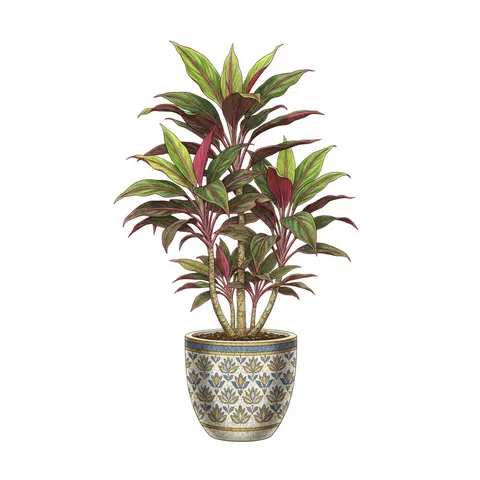
Cordyline Red Sister, scientifically known as Cordyline fruticosa 'Red', is a visually stunning evergreen shrub primarily admired for its vibrant foliage. This striking cultivar of the Ti plant is characterized by its elongated, lanceolate leaves, which can reach lengths of up to 60 cm (24 inches) and widths of 4-5 cm (1.5-2 inches). The leaves exhibit a glossy texture and a captivating blend of deep red with brilliant pink and green streaks, creating a dramatic aesthetic that enhances its ornamental value in both home and office settings.
Mature plants typically achieve a height of 1 to 2 meters (3 to 6 feet), featuring a slender, upright stem that contributes to its graceful architectural form. Native to the tropical regions of Southeast Asia and the Pacific Islands, Cordyline fruticosa thrives in humid environments with well-drained, fertile soil and bright, filtered light, though it can tolerate partial shade. Taxonomically, it belongs to the Asparagaceae family, which encompasses a diverse array of ornamental species, sometimes leading to confusion with Dracaena due to similar appearances.
While primarily cultivated for its leaves, 'Red Sister' can produce small, tubular flowers in creamy-white to pale pink clusters on stalks, though this is a rare occurrence in indoor conditions. Beyond its beauty, Cordyline Red Sister also contributes to indoor air quality by aiding in the filtration of common airborne pollutants.
Trusted Scientific References
1. Authoritative external sources for Cordyline fruticosa Red
1.1 Wikipedia — Cordyline fruticosa Red
1.2 Kew POWO (Plants of the World Online)
1.3 PubMed — peer-reviewed research
1.4 NCBI Taxonomy Browser
1.5 GBIF — Global Biodiversity
1.6Cordyline Red Sister should be interpreted through verified botanical identity, practical care, and responsible safety language. This recovery note adds the missing context needed for a complete profile: match light to the plant's habit, use well-drained soil, water according to season, and avoid unsupported medicinal or edible claims. For publishing, the plant can be presented as a source-backed indoor plant with clear care guidance, common problem diagnosis, and conservative safety wording.
1.1.Cordyline Red Sister — Key Features
- ✓ <strong>Vibrant Red and Pink Foliage</strong> — Distinctive, eye-catching coloration that makes it a popular ornamental plant.
- ✓ <strong>Lanceolate, Glossy Leaves</strong> — Elongated, pointed leaves with a smooth, shiny surface.
- ✓ <strong>Tropical Evergreen Shrub</strong> — Maintains its foliage year-round in warm climates.
- ✓ <strong>Air Purifying Qualities</strong> — Known to help filter indoor air pollutants, enhancing environmental quality.
- ✓ <strong>Traditional Medicinal Uses</strong> — Historically employed in folk medicine for various ailments, including digestive and inflammatory issues.
- ✓ <strong>Low Maintenance Indoor Plant</strong> — Relatively easy to care for when provided with suitable light, water, and humidity.
- ✓ <strong>Cultural 'Good Luck' Symbol</strong> — Revered in some cultures, particularly Hawaiian, for bringing prosperity and protection.
- ✓ <strong>Adaptable to Bright, Indirect Light</strong> — Thrives in well-lit conditions without direct sun exposure.
- ✓ <strong>Rhizomatous Root System</strong> — Features underground stems that aid in nutrient storage and propagation.
- ✓ <strong>Member of Asparagaceae Family</strong> — Belonging to a diverse family that includes many popular ornamental and edible plants.
1.2.Cordyline Red Sister — Quick Summary
- ✓ Cordyline Red Sister is a visually striking tropical evergreen shrub known for its vibrant red and pink variegated foliage.
- ✓ Native to Southeast Asia and the Pacific Islands, it thrives in warm, humid conditions with bright, indirect light.
- ✓ Traditionally, Cordyline fruticosa has been used for digestive issues, wound healing, reducing inflammation, and fever.
- ✓ The plant contains beneficial phytochemicals such as anthocyanins, flavonoids, and saponins, contributing to its antioxidant properties.
- ✓ While low in toxicity for humans, it can cause mild gastrointestinal upset if ingested and is toxic to pets; handle with gloves.
- ✓ Valued culturally as a 'Good Luck Plant' and appreciated for its air-purifying qualities as an indoor ornamental.
2.Cordyline Red Sister — Scientific Identity
3.Cordyline Red Sister — Quick Facts
4.Cordyline Red Sister — Appearance & Identification
5.Cordyline Red Sister — Native Habitat
6.Cordyline Red Sister — Water Requirements
- ✓ Light Requirements — Provide bright, indirect light to maintain the vibrant coloration of the Cordyline Red Sister's foliage; direct sun can scorch leaves.
- ✓ Soil Preference — Plant in a well-draining, fertile, peat-based potting mix or loamy soil with a slightly acidic to neutral pH.
- ✓ Watering Schedule — Water regularly, allowing the top inch or two of soil to dry out between waterings. Reduce watering frequency during the cooler fall and winter months.
- ✓ Humidity Levels — This tropical plant thrives in high humidity; consider using a humidifier or placing the pot on a pebble tray with water, especially indoors.
- ✓ Temperature Range — Maintain temperatures between 65-95°F (18-35°C); avoid temperatures below 50°F (10°C) to prevent cold damage.
- ✓ Fertilization — Fertilize several times a year during the growing season (spring and summer) with a balanced liquid fertilizer to support vigorous growth and color.
- ✓ Propagation Techniques — Easily propagated by dividing the rhizomatous root system or by rooting stem sections (often called 'Ti logs') in water or moist soil.
- ✓ Pest and Disease Management — Monitor for common indoor pests like spider mites, mealybugs, and scale insects; ensure good air circulation to prevent fungal issues like leaf spot.
Reviewed by the Flora Medical Global Botanical Review Panel
Multi-disciplinary editorial group · Botany · Ethnobotany · Herbal-medicine literature
Who reviewed this: This page was checked by the Flora Medical Global Botanical Review Panel — an in-house editorial group of botany graduates, ethnobotany researchers, and horticulture practitioners who collectively maintain our 7,000+ plant encyclopedia. Meet the team.
Our 4-step verification process
1. Taxonomic verification
Scientific names and synonyms cross-checked against Kew POWO, World Flora Online, and The Plant List.
2. Phytochemical & medicinal cross-reference
Active compounds, traditional uses, and reported activities are cross-referenced with PubMed, USDA Dr. Duke's database, and peer-reviewed ethnobotanical literature.
3. Conservation & distribution check
Distribution, ecology, and conservation status confirmed against GBIF occurrence records and the IUCN Red List.
4. Editorial & safety review
Every entry passes an editorial pass for clarity, originality, and safety notices (toxicity, contraindications, dosage caveats) before publication.
Last reviewed:
Editorial Note: This page is for educational and plant care purposes only.
Written by: Flora Medical Global Editorial Team
Reviewed by: Flora Medical Global Botanical Review Panel
Last Updated: June 15, 2026







Cordyline Red Sister — Comments & Community Reviews
Rate this plant