
Care Disclaimer: Plant care recommendations are general guidelines based on common growing conditions. Individual results may vary based on your local environment, climate, and care routine. If your plant is toxic, keep it away from children and pets, and consult a veterinarian if accidental ingestion occurs.
1.Cotyledon Orbiculata — Overview
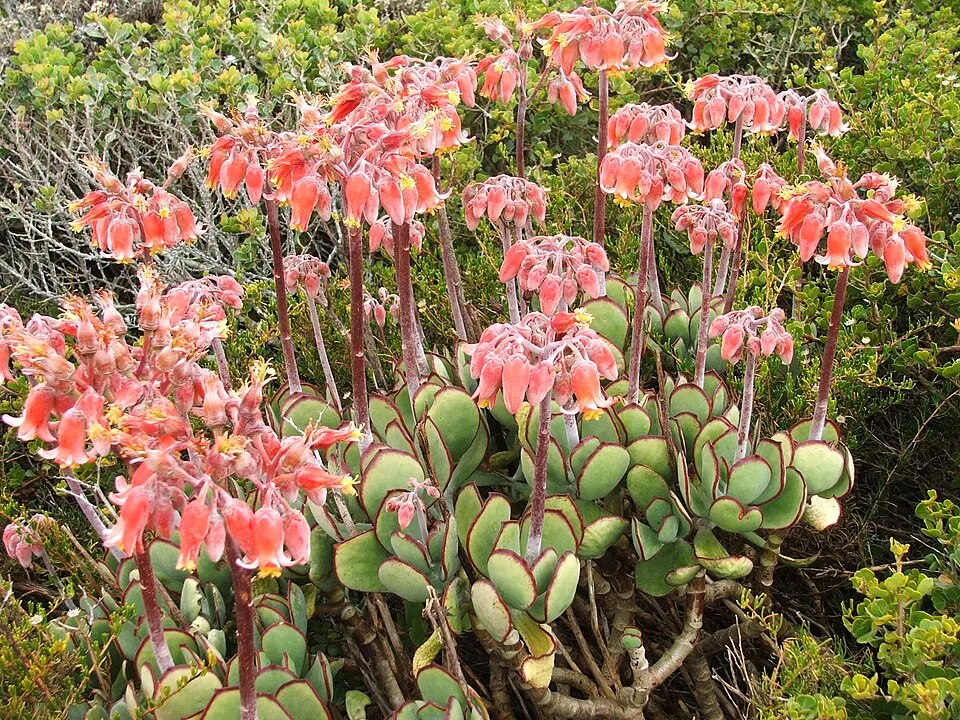
Cotyledon orbiculata, commonly known as Pig’s Ear or Round-leaf Cotyledon, is a remarkably resilient and ornamental succulent shrublet belonging to the Crassulaceae family. Native to South Africa, its name 'Cotyledon' originates from the Greek 'kotyle' (cup), referencing its seedling leaves, while 'orbiculata' is Latin for 'round,' aptly describing its characteristic foliage.
This robust plant thrives in arid and semi-arid environments, frequently found on rocky slopes, sandy flats, and in open vegetation across the Western Cape, Eastern Cape, Northern Cape, Free State, KwaZulu-Natal, Mpumalanga, Limpopo, Swaziland, Lesotho, and Mozambique. It exhibits significant morphological variability, with five recognized varieties differing in leaf arrangement, shape, and flower characteristics.
The plant typically grows up to 1 meter in height, especially when in flower, and is distinguished by its thick, fleshy, obovate to narrowly linear leaves. These leaves often display a glaucous-grey to bluish-green hue, attributed to a fine, powdery waxy bloom (pruina) that conserves water and reflects intense sunlight. Many populations feature a deep red, often undulate, cuticularized margin.
During late winter to early summer (September to January), Cotyledon orbiculata produces tall, stout peduncles (20-80 cm long) bearing cymose inflorescences of pendulous, bell-shaped flowers. These pentamerous blooms, typically 8-30 mm long, range in color from vibrant orange-red to pink, sometimes yellow, and are a magnet for sunbirds, enhancing its ecological value.
Trusted Scientific References
1. Authoritative external sources for Cotyledon orbiculata
1.1 Wikipedia — Cotyledon orbiculata
1.2 Kew POWO (Plants of the World Online)
1.3 PubMed — peer-reviewed research
1.4 NCBI Taxonomy Browser
1.5 GBIF — Global Biodiversity
1.6Cotyledon Orbiculata should be interpreted through verified botanical identity, practical care, and responsible safety language. This recovery note adds the missing context needed for a complete profile: match light to the plant's habit, use well-drained soil, water according to season, and avoid unsupported medicinal or edible claims. For publishing, the plant can be presented as a source-backed indoor plant with clear care guidance, common problem diagnosis, and conservative safety wording.
1.1.Cotyledon Orbiculata — Key Features
- ✓ <strong>Crassulaceae family succulent,</strong> — Crassulaceae family succulent, native to South Africa.
- ✓ <strong>Characterized by thick,</strong> — Characterized by thick, fleshy, orbicular to obovate leaves with a waxy bloom.
- ✓ <strong>Produces tall stalks of pendulous, bell</strong> — shaped, orange-red to yellow flowers.
- ✓ <strong>Historically used by</strong> — Historically used by indigenous communities for various ailments.
- ✓ <strong>Contains toxic bufadienolide</strong> — Contains toxic bufadienolide glucosides (e.g., orbicusides A-C).
- ✓ <strong>Traditional external applications</strong> — Traditional external applications for skin conditions, earache, and toothache.
- ✓ <strong>Internal use is</strong> — Internal use is highly dangerous and not recommended due to cardiotoxicity.
- ✓ <strong>Highly drought</strong> — tolerant and valued for xeriscaping and ornamental purposes.
- ✓ <strong>Exhibits significant variability</strong> — Exhibits significant variability with five recognized botanical varieties.
- ✓ <strong>Flowers attract sunbirds,</strong> — Flowers attract sunbirds, contributing to local biodiversity.
1.2.Cotyledon Orbiculata — Quick Summary
- ✓ Cotyledon orbiculata is a South African succulent with traditional medicinal uses, primarily external.
- ✓ It contains highly toxic bufadienolide cardiac glycosides, posing significant risks if ingested.
- ✓ Traditionally used topically for warts, boils, skin eruptions, and for ear/toothache relief.
- ✓ Internal use (oral or enema) is strongly cautioned against due to potential cardiac toxicity.
- ✓ An ornamental, drought-tolerant plant, it requires careful handling due to its potent compounds.
2.Cotyledon Orbiculata — Scientific Identity
3.Cotyledon Orbiculata — Quick Facts
4.Cotyledon Orbiculata — Appearance & Identification
5.Cotyledon Orbiculata — Native Habitat
6.Cotyledon Orbiculata — Water Requirements
- ✓ Well-Draining Soil — Requires sandy or rocky, well-draining soil to prevent root rot, typical of its arid native habitat.
- ✓ Full Sun Exposure — Thrives in bright, direct sunlight for most of the day; insufficient light can lead to leggy growth.
- ✓ Minimal Watering — Water sparingly, allowing the soil to dry out completely between waterings, especially during dormant periods.
- ✓ Frost Protection — Sensitive to frost; in colder climates, it should be grown in containers that can be moved indoors or protected.
- ✓ Propagation — Easily propagated from stem or leaf cuttings, which should be allowed to callus before planting, or from seeds.
- ✓ Low Maintenance — Generally pest-resistant and requires little fertilization, making it an excellent choice for xeriscaping.
- ✓ Container Growth — Adapts well to container gardening, which allows for easy movement to protect from adverse weather conditions.
Reviewed by the Flora Medical Global Botanical Review Panel
Multi-disciplinary editorial group · Botany · Ethnobotany · Herbal-medicine literature
Who reviewed this: This page was checked by the Flora Medical Global Botanical Review Panel — an in-house editorial group of botany graduates, ethnobotany researchers, and horticulture practitioners who collectively maintain our 7,000+ plant encyclopedia. Meet the team.
Our 4-step verification process
1. Taxonomic verification
Scientific names and synonyms cross-checked against Kew POWO, World Flora Online, and The Plant List.
2. Phytochemical & medicinal cross-reference
Active compounds, traditional uses, and reported activities are cross-referenced with PubMed, USDA Dr. Duke's database, and peer-reviewed ethnobotanical literature.
3. Conservation & distribution check
Distribution, ecology, and conservation status confirmed against GBIF occurrence records and the IUCN Red List.
4. Editorial & safety review
Every entry passes an editorial pass for clarity, originality, and safety notices (toxicity, contraindications, dosage caveats) before publication.
Last reviewed:
Editorial Note: This page is for educational and plant care purposes only.
Written by: Flora Medical Global Editorial Team
Reviewed by: Flora Medical Global Botanical Review Panel
Last Updated: June 15, 2026







Cotyledon Orbiculata — Comments & Community Reviews
Rate this plant