
Care Disclaimer: Plant care recommendations are general guidelines based on common growing conditions. Individual results may vary based on your local environment, climate, and care routine. If your plant is toxic, keep it away from children and pets, and consult a veterinarian if accidental ingestion occurs.
1.Crassula Buddha Temple — Overview
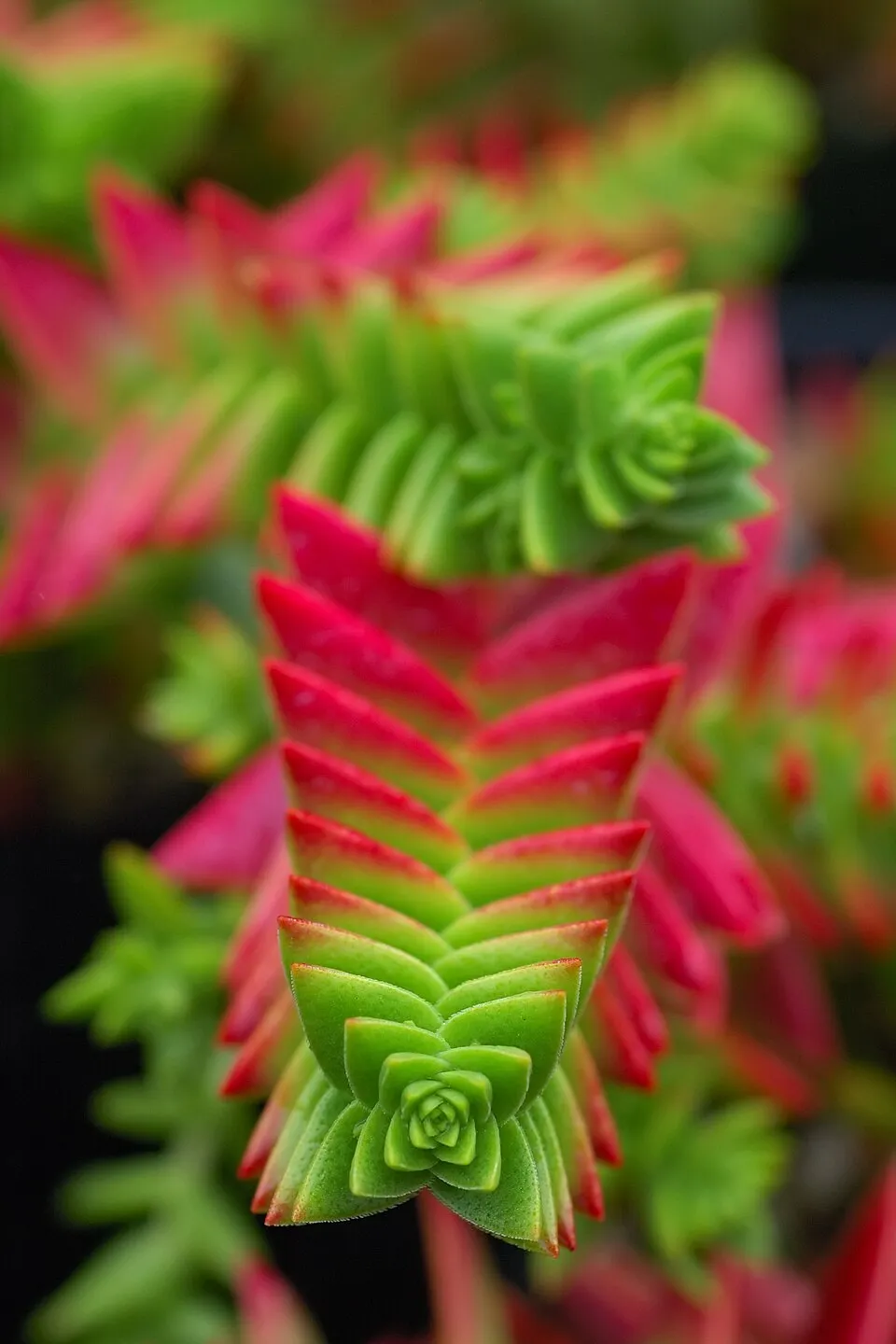
Crassula 'Buddha's Temple', a captivating and highly sought-after succulent cultivar, is botanically recognized as Crassula cv. 'Buddha's Temple'. This distinctive plant is a horticultural masterpiece, resulting from a meticulous cross between Crassula perfoliata var. minor (formerly Crassula falcata) and Crassula pyramidalis. The hybrid was first introduced in 1959 by Myron Kimnach at the Huntington Botanical Gardens.
Its common name perfectly encapsulates its unique morphology: tightly stacked, almost perfectly square, sometimes 5- or 6-angled leaves that are fused along their edges, forming a striking columnar structure. This geometric arrangement evokes the serene architecture of ancient pagodas or ziggurats, resembling a miniature Buddha temple. Unlike many Crassula species, 'Buddha's Temple' does not occur naturally in the wild; its existence is a testament to human horticultural innovation. As a member of the Crassulaceae family, which typically hails from arid and semi-arid regions, particularly South Africa, it exhibits classic succulent adaptations. The plant's slow growth habit contributes to its meticulous, self-forming structure.
Its leaves are a beautiful powdery silvery-grey to grayish-green, often developing attractive reddish or purplish tints along the edges or tips when exposed to sufficient sunlight or environmental stress. Small, delicate pink to nearly white flowers may appear in compact, rounded clusters, typically during spring and summer, further enhancing its ornamental appeal. Crassula 'Buddha's Temple' is primarily cultivated as an aesthetic specimen, prized for its striking architectural form and relatively low maintenance requirements, making it a favorite among succulent collectors and indoor plant enthusiasts.
Trusted Scientific References
1. Authoritative external sources for Crassula Buddha Temple
1.1 Wikipedia — Crassula Buddha Temple
1.2 Kew POWO (Plants of the World Online)
1.3 PubMed — peer-reviewed research
1.4 NCBI Taxonomy Browser
1.5 GBIF — Global Biodiversity
1.1.Crassula Buddha Temple — Key Features
- ✓ <strong>Unique Architectural Form</strong> — Tightly stacked, fused leaves create a striking columnar, pagoda-like structure.
- ✓ <strong>Horticultural Hybrid</strong> — A specific cross between Crassula perfoliata var. minor and Crassula pyramidalis, created in 1959.
- ✓ <strong>Slow Growing Succulent</strong> — Develops its intricate form gradually, making each specimen a long-term display.
- ✓ <strong>Silvery</strong> — Grey Foliage — Leaves exhibit a powdery grey-green hue, often with reddish or purplish tints under sun stress.
- ✓ <strong>Low Maintenance</strong> — Requires minimal watering and care, typical of drought-tolerant succulents.
- ✓ <strong>Non</strong> — Toxic to Pets and Humans — Generally considered safe for households with children and animals.
- ✓ <strong>Ornamental Value</strong> — Highly prized for its aesthetic appeal in succulent collections, terrariums, and indoor displays.
- ✓ <strong>Drought Tolerant</strong> — Adaptable to arid conditions, storing water in its fleshy leaves.
- ✓ <strong>Distinctive Flowers</strong> — Produces small, compact clusters of pink to nearly white blooms, usually in spring and summer.
- ✓ <strong>Collector's Plant</strong> — Its rarity and distinctive appearance make it a sought-after item among succulent enthusiasts.
1.2.Crassula Buddha Temple — Quick Summary
- ✓ Crassula 'Buddha's Temple' is a unique architectural succulent hybrid, prized for its distinctive columnar form.
- ✓ It is a low-maintenance, ornamental plant, ideal for collectors and indoor environments.
- ✓ While the hybrid has no direct traditional medicinal uses, the Crassula genus is known for topical anti-inflammatory, wound-healing, and antiseptic properties.
- ✓ The plant is generally considered non-toxic to humans and pets, making it a safe choice for homes.
- ✓ Requires bright light, well-draining soil, and minimal watering, especially in winter.
- ✓ Its slow growth and striking appearance make it a captivating addition to any plant collection.
2.Crassula Buddha Temple — Scientific Identity
3.Crassula Buddha Temple — Quick Facts
4.Crassula Buddha Temple — Appearance & Identification
5.Crassula Buddha Temple — Native Habitat
6.Crassula Buddha Temple — Water Requirements
- ✓ Light Requirements — Provide full sun to partial shade; protect from intense, scorching afternoon sun during peak summer, especially in hot climates. Can be grown indoors with ample bright light.
- ✓ Soil Composition — Requires a very porous, well-draining succulent or cactus potting mix. Good aeration is crucial to prevent root rot, and soil pH is not a major concern.
- ✓ Watering Schedule — Employ the 'soak and dry' method: water thoroughly, allowing excess to drain, then let the soil dry out completely before rewatering. Reduce frequency significantly in winter.
- ✓ Temperature and Hardiness — Tolerates temperatures from 25°F to 50°F (-3.9°C to 10°C), thriving in USDA hardiness zones 9b to 11b. Protect from frost.
- ✓ Fertilization — Feed sparingly with a diluted organic or balanced liquid fertilizer, typically once in mid-spring, at the onset of its active growth period.
- ✓ Repotting Practices — Repot only when root-bound, preferably in spring. Choose a pot slightly larger than the current one, ensuring it has drainage holes.
- ✓ Propagation Techniques — Easily propagated from stem cuttings or individual leaves. Allow cuttings to callus for a few days before planting in well-draining soil.
- ✓ Pest and Disease Management — Generally resilient, but watch for common succulent pests like mealybugs or spider mites. Ensure good air circulation to prevent fungal issues.
Reviewed by the Flora Medical Global Botanical Review Panel
Multi-disciplinary editorial group · Botany · Ethnobotany · Herbal-medicine literature
Who reviewed this: This page was checked by the Flora Medical Global Botanical Review Panel — an in-house editorial group of botany graduates, ethnobotany researchers, and horticulture practitioners who collectively maintain our 7,000+ plant encyclopedia. Meet the team.
Our 4-step verification process
1. Taxonomic verification
Scientific names and synonyms cross-checked against Kew POWO, World Flora Online, and The Plant List.
2. Phytochemical & medicinal cross-reference
Active compounds, traditional uses, and reported activities are cross-referenced with PubMed, USDA Dr. Duke's database, and peer-reviewed ethnobotanical literature.
3. Conservation & distribution check
Distribution, ecology, and conservation status confirmed against GBIF occurrence records and the IUCN Red List.
4. Editorial & safety review
Every entry passes an editorial pass for clarity, originality, and safety notices (toxicity, contraindications, dosage caveats) before publication.
Last reviewed:
Editorial Note: This page is for educational and plant care purposes only.
Written by: Flora Medical Global Editorial Team
Reviewed by: Flora Medical Global Botanical Review Panel
Last Updated: June 15, 2026







Crassula Buddha Temple — Comments & Community Reviews
Rate this plant