
Care Disclaimer: Plant care recommendations are general guidelines based on common growing conditions. Individual results may vary based on your local environment, climate, and care routine. If your plant is toxic, keep it away from children and pets, and consult a veterinarian if accidental ingestion occurs.
1.Crossandra — Overview
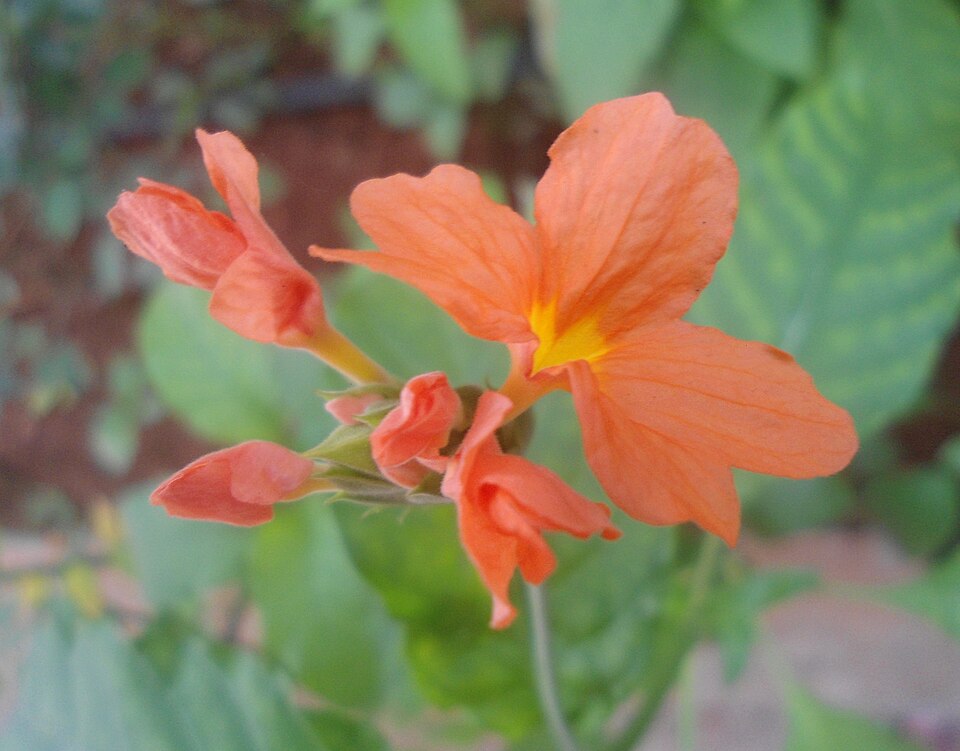
Crossandra infundibuliformis, commonly known as the Firecracker Flower or Orange Marmalade Flower, is a captivating perennial shrub native to the warm, humid regions of Southern India and Sri Lanka. Belonging to the botanical family Acanthaceae, this species was formally described by Christian Gottfried Daniel Nees von Esenbeck. Its genus name, 'Crossandra,' cleverly combines the Greek words 'krossos' (a fringe) and 'andros' (man), referring to its distinctive fringed anthers, while 'infundibuliformis' aptly describes its funnel-shaped flowers.
This elegant plant typically grows to 30–60 cm in height, characterized by its glossy, dark green, elliptical leaves, which are usually 5–12 cm long. The plant is celebrated for its vibrant, asymmetrical, five-lobed flowers, predominantly salmon-orange but occasionally pale yellow, that emerge on terminal spikes. These striking blossoms, with their prominently developed lower lip, create the characteristic funnel form.
Crossandra thrives in tropical monsoon climates, preferring well-drained, slightly acidic soils and dappled sunlight, often found flourishing in the understory of forests or along shaded slopes. Historically cherished for its prolific and almost continuous blooming in ideal conditions, it holds significant cultural value in its native lands, where its auspicious flowers are woven into garlands and used in religious offerings, symbolizing purity, spiritual fire, and vitality. Beyond its ornamental appeal, traditional practices have long recognized its potential therapeutic qualities, which modern research is now beginning to explore.
Trusted Scientific References
1. Authoritative external sources for Crossandra infundibuliformis
1.1 Wikipedia — Crossandra infundibuliformis
1.2 Kew POWO (Plants of the World Online)
1.3 PubMed — peer-reviewed research
1.4 NCBI Taxonomy Browser
1.5 GBIF — Global Biodiversity
1.6Crossandra should be interpreted through verified botanical identity, practical care, and responsible safety language. This recovery note adds the missing context needed for a complete profile: match light to the plant's habit, use well-drained soil, water according to season, and avoid unsupported medicinal or edible claims. For publishing, the plant can be presented as a source-backed indoor plant with clear care guidance, common problem diagnosis, and conservative safety wording.
1.1.Crossandra — Key Features
- ✓ <strong>Botanical Name</strong> — Crossandra infundibuliformis
- ✓ <strong>Family</strong> — Acanthaceae
- ✓ <strong>Common Names</strong> — Firecracker Flower, Orange Marmalade Flower
- ✓ <strong>Native Region</strong> — Southern India, Sri Lanka
- ✓ <strong>Key Compounds</strong> — Flavonoids, Terpenoids, Carotenoids
- ✓ <strong>Traditional Uses</strong> — Skin soothing, hair growth, menstrual comfort, digestive aid
- ✓ <strong>Primary Actions</strong> — Anti-inflammatory, Antioxidant, Skin Protective
- ✓ <strong>Growth Habit</strong> — Perennial shrub, typically 30-60 cm tall
- ✓ <strong>Cultural Significance</strong> — Used in garlands and religious offerings
- ✓ <strong>Flowering</strong> — Prolific, almost continuous salmon-orange blossoms
1.2.Crossandra — Quick Summary
- ✓ Crossandra infundibuliformis, the Firecracker Flower, is a vibrant plant from Southern India and Sri Lanka.
- ✓ Valued for its anti-inflammatory, antioxidant, and skin-soothing properties.
- ✓ Rich in beneficial compounds like flavonoids, terpenoids, and carotenoids.
- ✓ Traditionally used for skin conditions, hair growth, menstrual comfort, and digestive support.
- ✓ Available as fresh petals, dried powder, or ethanolic extracts for diverse applications.
- ✓ Generally safe, but internal use requires caution during pregnancy and for those on blood thinners.
2.Crossandra — Scientific Identity
3.Crossandra — Quick Facts
4.Crossandra — Appearance & Identification
5.Crossandra — Native Habitat
6.Crossandra — Water Requirements
- ✓ Climate — Thrives in humid tropical conditions with temperatures between 20-30 °C, benefiting from monsoon rains.
- ✓ Soil Requirements — Prefers well-drained, slightly acidic soils rich in organic matter to support vigorous growth.
- ✓ Light Conditions — Best grown in partial shade or dappled sunlight, mimicking its natural understory habitat; direct, intense sun can scorch leaves.
- ✓ Watering — Requires consistent moisture; keep soil evenly damp but avoid waterlogging, especially during cooler periods.
- ✓ Propagation — Easily propagated from seeds or stem cuttings, which root readily in warm, humid environments.
- ✓ Fertilization — Benefits from regular feeding with a balanced liquid fertilizer during its active growing and flowering seasons.
- ✓ Pest and Disease Management — Generally robust, but watch for common tropical pests like spider mites or mealybugs, and fungal issues in overly humid, poorly ventilated conditions.
- ✓ Harvesting — Flowers are traditionally hand-plucked at dawn when their turgor (fullness) and concentration of delicate compounds are highest.
Reviewed by the Flora Medical Global Botanical Review Panel
Multi-disciplinary editorial group · Botany · Ethnobotany · Herbal-medicine literature
Who reviewed this: This page was checked by the Flora Medical Global Botanical Review Panel — an in-house editorial group of botany graduates, ethnobotany researchers, and horticulture practitioners who collectively maintain our 7,000+ plant encyclopedia. Meet the team.
Our 4-step verification process
1. Taxonomic verification
Scientific names and synonyms cross-checked against Kew POWO, World Flora Online, and The Plant List.
2. Phytochemical & medicinal cross-reference
Active compounds, traditional uses, and reported activities are cross-referenced with PubMed, USDA Dr. Duke's database, and peer-reviewed ethnobotanical literature.
3. Conservation & distribution check
Distribution, ecology, and conservation status confirmed against GBIF occurrence records and the IUCN Red List.
4. Editorial & safety review
Every entry passes an editorial pass for clarity, originality, and safety notices (toxicity, contraindications, dosage caveats) before publication.
Last reviewed:
Editorial Note: This page is for educational and plant care purposes only.
Written by: Flora Medical Global Editorial Team
Reviewed by: Flora Medical Global Botanical Review Panel
Last Updated: June 15, 2026







Crossandra — Comments & Community Reviews
Rate this plant