
Care Disclaimer: Plant care recommendations are general guidelines based on common growing conditions. Individual results may vary based on your local environment, climate, and care routine. If your plant is toxic, keep it away from children and pets, and consult a veterinarian if accidental ingestion occurs.
1.Cryptanthus Bivittatus — Overview
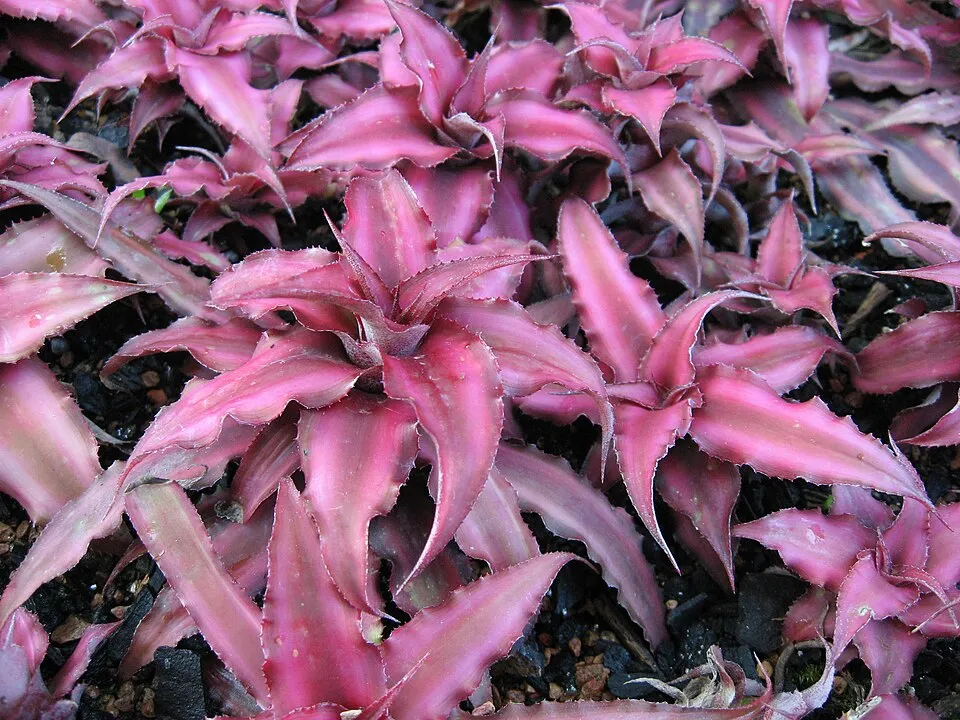
Cryptanthus bivittatus, commonly known as Earth Star, is an intriguing terrestrial and lithophytic herbaceous perennial belonging to the extensive Bromeliaceae family. Native to the humid, shaded undergrowth of southeastern Brazil, particularly in states like Espirito Santo and Rio de Janeiro, this species thrives on mossy rocks and decaying organic matter on the forest floor, distinguishing itself from many epiphytic bromeliads. Its discovery and introduction to cultivation in the 19th century captivated botanists with its radially symmetrical rosette growth habit, which typically spans 10-15 cm in diameter.
The species epithet 'bivittatus' aptly describes its characteristic two longitudinal stripes on its leaves, although modern cultivars exhibit a stunning array of colors, including deep greens, bronzes, vibrant reds, pinks, and yellows, often complemented by silvery bands or intricate variegation. These striking patterns are not merely ornamental but serve as adaptive mechanisms, aiding in light filtration within its naturally shaded environment. In its natural ecosystem, Cryptanthus bivittatus plays a vital role in forest floor biodiversity and nutrient cycling.
Its specialized trichomes, which are minute, scale-like structures on the leaf surface, are highly efficient at absorbing atmospheric moisture and nutrients, enabling the plant to flourish without an extensive root system. While primarily valued for its aesthetic appeal in horticulture, its unique adaptations and natural habitat contribute significantly to its ecological profile, making it a fascinating subject for botanical study.
Trusted Scientific References
1. Authoritative external sources for Cryptanthus bivittatus
1.1 Wikipedia — Cryptanthus bivittatus
1.2 Kew POWO (Plants of the World Online)
1.3 PubMed — peer-reviewed research
1.4 NCBI Taxonomy Browser
1.5 GBIF — Global Biodiversity
1.6Cryptanthus Bivittatus should be interpreted through verified botanical identity, practical care, and responsible safety language. This recovery note adds the missing context needed for a complete profile: match light to the plant's habit, use well-drained soil, water according to season, and avoid unsupported medicinal or edible claims. For publishing, the plant can be presented as a source-backed indoor plant with clear care guidance, common problem diagnosis, and conservative safety wording.
1.1.Cryptanthus Bivittatus — Key Features
- ✓ <strong>Distinctive Rosette Form</strong> — Forms a flat, star-shaped rosette of leaves, giving it its common name 'Earth Star'.
- ✓ <strong>Vibrant Foliage Colors</strong> — Displays a wide spectrum of leaf colors, including reds, pinks, greens, and bronzes, often with intricate stripes or bands.
- ✓ <strong>Terrestrial/Lithophytic Growth</strong> — Unusually for a bromeliad, it primarily grows terrestrially on the forest floor or lithophytically on rocks.
- ✓ <strong>Compact Size</strong> — Typically small, reaching 10-15 cm in diameter, making it ideal for small spaces and terrariums.
- ✓ <strong>Specialized Trichomes</strong> — Features scale-like trichomes on leaves for efficient water and nutrient absorption from the air.
- ✓ <strong>Low</strong> — Maintenance Ornamental — Relatively easy to care for as a houseplant once its specific light and humidity needs are met.
- ✓ <strong>Non</strong> — Toxic for Pets — A safe plant choice for homes with cats and dogs.
- ✓ <strong>Propagation by Pups</strong> — Easily multiplied through the division of offsets, ensuring continued growth.
- ✓ <strong>Humidity Loving</strong> — Thrives in high humidity environments, mimicking its native tropical rainforest habitat.
- ✓ <strong>Aesthetic Appeal</strong> — Highly valued for its unique visual impact in horticultural displays.
1.2.Cryptanthus Bivittatus — Quick Summary
- ✓ Cryptanthus bivittatus, or Earth Star, is a striking terrestrial bromeliad native to Brazil.
- ✓ Known for its vibrant, star-shaped rosettes and distinctive striped foliage.
- ✓ Primarily an ornamental plant, popular in terrariums and as a houseplant.
- ✓ Requires bright, indirect light, high humidity, and well-drained soil.
- ✓ Propagated via 'pups' or offsets; mother plant dies after flowering.
- ✓ Generally considered non-toxic to humans and pets, with minimal irritation risk.
2.Cryptanthus Bivittatus — Scientific Identity
3.Cryptanthus Bivittatus — Quick Facts
4.Cryptanthus Bivittatus — Appearance & Identification
5.Cryptanthus Bivittatus — Native Habitat
6.Cryptanthus Bivittatus — Water Requirements
- ✓ Soil Preference — Requires well-drained, humus-rich soil, ideally a mix designed for bromeliads or a blend of peat, perlite, and bark.
- ✓ Light Requirements — Thrives in bright, indirect light; morning and evening sun are ideal, while strong midday sun should be avoided to prevent leaf scorching.
- ✓ Watering Schedule — Water thoroughly when the topsoil feels dry to the touch, ensuring the root zone is adequately moistened but not waterlogged.
- ✓ Humidity Needs — Prefers high humidity, making it an excellent choice for terrariums, vivariums, or areas with regular misting.
- ✓ Temperature Range — Frost tender, requiring warm tropical temperatures, typically above 15°C (60°F), to prevent cold damage.
- ✓ Propagation — Primarily propagated by dividing offsets, known as 'pups,' which emerge from the base of the mother plant, typically when they are one-third its size.
- ✓ Fertilization — Feed sparingly with a diluted liquid fertilizer during the growing season, typically once a month, applied to the soil.
- ✓ Container Growing — Ideal for indoor containers, allowing for controlled environmental conditions and easy relocation.
Reviewed by the Flora Medical Global Botanical Review Panel
Multi-disciplinary editorial group · Botany · Ethnobotany · Herbal-medicine literature
Who reviewed this: This page was checked by the Flora Medical Global Botanical Review Panel — an in-house editorial group of botany graduates, ethnobotany researchers, and horticulture practitioners who collectively maintain our 7,000+ plant encyclopedia. Meet the team.
Our 4-step verification process
1. Taxonomic verification
Scientific names and synonyms cross-checked against Kew POWO, World Flora Online, and The Plant List.
2. Phytochemical & medicinal cross-reference
Active compounds, traditional uses, and reported activities are cross-referenced with PubMed, USDA Dr. Duke's database, and peer-reviewed ethnobotanical literature.
3. Conservation & distribution check
Distribution, ecology, and conservation status confirmed against GBIF occurrence records and the IUCN Red List.
4. Editorial & safety review
Every entry passes an editorial pass for clarity, originality, and safety notices (toxicity, contraindications, dosage caveats) before publication.
Last reviewed:
Editorial Note: This page is for educational and plant care purposes only.
Written by: Flora Medical Global Editorial Team
Reviewed by: Flora Medical Global Botanical Review Panel
Last Updated: June 15, 2026







Cryptanthus Bivittatus — Comments & Community Reviews
Rate this plant