
Care Disclaimer: Plant care recommendations are general guidelines based on common growing conditions. Individual results may vary based on your local environment, climate, and care routine. If your plant is toxic, keep it away from children and pets, and consult a veterinarian if accidental ingestion occurs.
1.Dieffenbachia Camilla — Overview
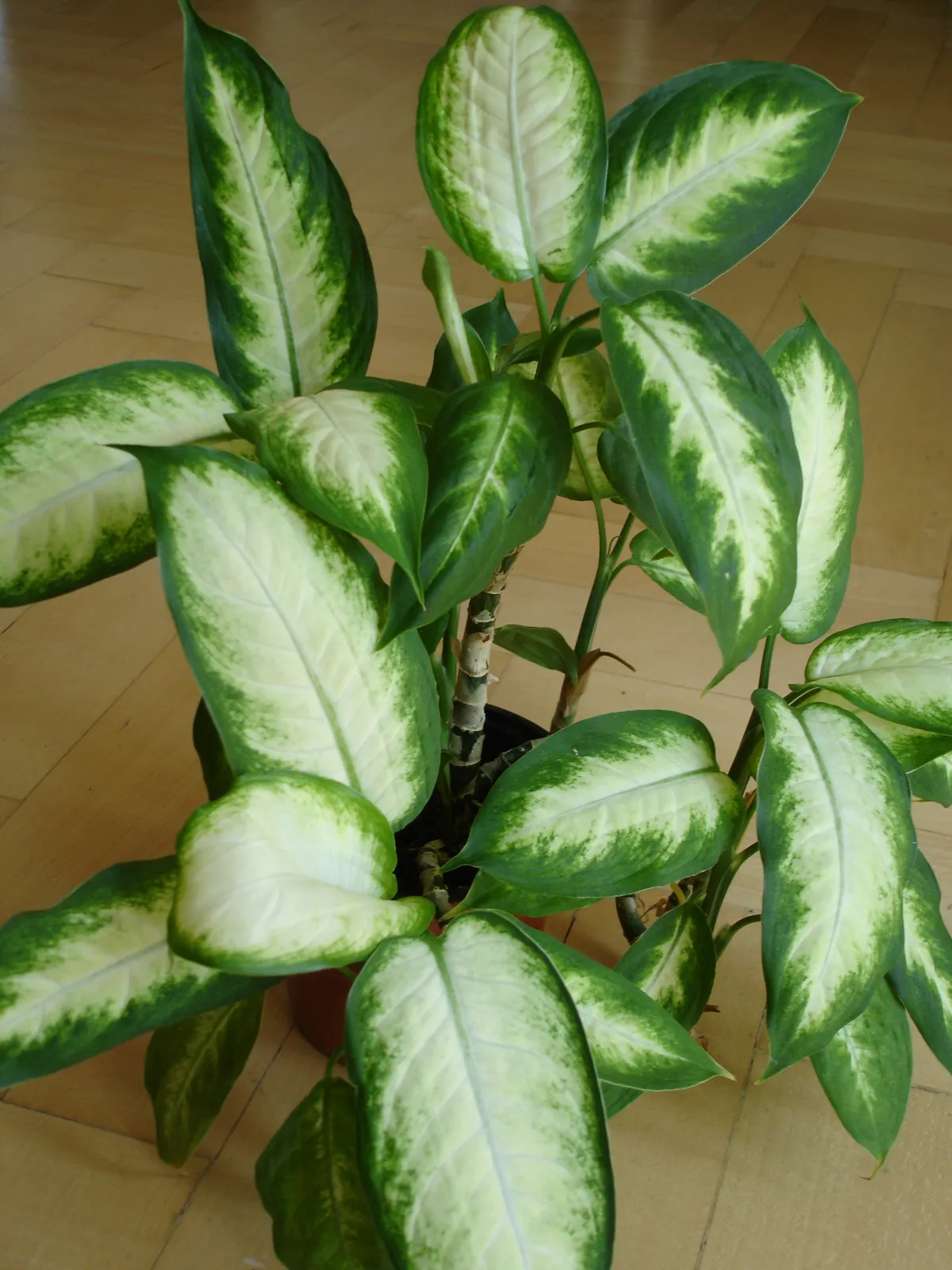
Dieffenbachia Camilla, a highly cherished cultivar within the Dieffenbachia genus, stands as a prominent indoor ornamental plant celebrated for its exceptionally striking foliage. Botanically, this cultivar is firmly rooted within the Araceae family, a diverse and extensive group renowned for its characteristic spadix and spathe inflorescences, although Dieffenbachia Camilla is cultivated almost exclusively for its decorative leaves rather than its inconspicuous blooms. Morphologically, Dieffenbachia Camilla presents with large, ovate to elliptic leaves, typically attaining lengths of 20-30 cm. These leaves are uniquely characterized by a vibrant creamy-white or pale yellow variegation that prominently dominates the central lamina, creating a sharp and aesthetically pleasing contrast with its distinct dark green margins. The leaf venation is pinnate, featuring a pronounced midrib and lateral veins that collectively enhance its textural depth and visual appeal.
The stem is typically erect, fleshy, and generally unbranched in its younger stages, gradually becoming more woody and occasionally branching as the plant matures. While Dieffenbachia species are capable of producing flowers, these are usually diminutive and rarely observed in indoor cultivation, comprising the characteristic Araceae spadix—a spike of minute flowers—encased by a spathe, which is typically pale green or white. The plant’s root system is fibrous and relatively shallow, an adaptation suited to the well-drained, humus-rich soils found in its native tropical understory environments. The broader Dieffenbachia genus originates from the lush tropical rainforests of the Americas, spanning a vast geographical range from Mexico southward to Argentina and including the West Indies. Dieffenbachia Camilla, specifically developed through horticultural breeding, was selected for its superior aesthetic qualities, particularly its distinctive leaf coloration, establishing it as a foundational staple in global horticulture.
Taxonomically, it is classified within the subfamily Aroideae, a group widely recognized for containing numerous plants that produce calcium oxalate crystals, which are central to Dieffenbachia's infamous properties. Historically and culturally, Dieffenbachia species have been acknowledged by indigenous communities for their potent irritant effects, earning them the moniker 'Dumb Cane' due to the temporary speechlessness induced by oral contact with its sap. In contemporary culture, ...[CURRENT TEXT EXISTS: 2861 chars]
1.1.Dieffenbachia Camilla — Key Features
- ✓ <strong>Striking Variegated Foliage</strong> — Features large, ovate leaves with creamy-white centers and contrasting dark green margins.
- ✓ <strong>Popular Indoor Ornamental</strong> — Widely chosen as a houseplant for its exceptional aesthetic appeal and decorative value.
- ✓ <strong>Araceae Family Member</strong> — Belongs to the Arum family, sharing characteristics such as spadix and spathe inflorescences (though rarely seen).
- ✓ <strong>Calcium Oxalate Content</strong> — Contains irritating calcium oxalate raphides, the primary toxic compound responsible for its effects.
- ✓ <strong>'Dumb Cane' Common Name</strong> — Earned its name due to the temporary speechlessness caused by ingesting its sap.
- ✓ <strong>Tropical Rainforest Origin</strong> — Native to the understory of tropical rainforests across the Americas.
- ✓ <strong>Relatively Low Maintenance</strong> — Considered easy to grow with appropriate light, water, and humidity conditions.
- ✓ <strong>Minor Air</strong> — Purifying Qualities — Contributes to indoor air quality, albeit to a limited extent, by processing some airborne toxins.
- ✓ <strong>Potent Irritant Sap</strong> — Its sap causes burning, swelling, and irritation upon contact with skin or mucous membranes.
- ✓ <strong>Cultivar Specificity</strong> — 'Camilla' is a specifically bred cultivar known for its distinct and appealing leaf coloration.
1.2.Dieffenbachia Camilla — Quick Summary
- ✓ Ornamental Houseplant — Prized for its striking variegated foliage and ease of indoor cultivation.
- ✓ Highly Toxic — Contains calcium oxalate crystals and proteolytic enzymes causing severe irritation.
- ✓ 'Dumb Cane' Effect — Ingestion leads to oral swelling and temporary loss of speech.
- ✓ No Medicinal Use — Strictly an ornamental plant with no therapeutic applications.
- ✓ Handle with Caution — Requires gloves and careful handling to prevent sap contact.
- ✓ Pet and Child Hazard — Keep strictly out of reach of vulnerable individuals.
2.Dieffenbachia Camilla — Scientific Identity
3.Dieffenbachia Camilla — Quick Facts
4.Dieffenbachia Camilla — Appearance & Identification
5.Dieffenbachia Camilla — Native Habitat
6.Dieffenbachia Camilla — Water Requirements
- ✓ Light Requirements — Prefers bright, indirect light; direct sunlight can scorch the delicate variegated leaves, causing discoloration and damage.
- ✓ Watering Schedule — Water thoroughly when the top inch of soil feels dry to the touch, ensuring adequate drainage to prevent root rot, and reduce frequency in winter.
- ✓ Humidity Needs — Thrives in high humidity environments, making regular misting, a pebble tray, or placement near a humidifier beneficial, especially in dry indoor conditions.
- ✓ Soil Composition — Requires a well-draining, rich potting mix, typically an aroid-specific blend incorporating peat moss, perlite, and bark for optimal aeration and moisture retention.
- ✓ Temperature Range — Maintain indoor temperatures consistently between 65-75°F (18-24°C); avoid sudden drops or exposure to drafts below 60°F (15°C) to prevent stress.
- ✓ Fertilization — Feed with a balanced liquid fertilizer diluted to half strength every 2-4 weeks during the active growing season (spring and summer), withholding feeding in autumn and winter.
- ✓ Propagation Techniques — Can be successfully propagated through stem cuttings in water or moist soil, air layering, or division of mature plants, always ensuring proper safety precautions due to sap.
- ✓ Pruning and Maintenance — Prune older, leggy stems to encourage bushier growth and remove yellowing leaves, consistently wearing protective gloves to avoid contact with the irritant sap.
Reviewed by the Flora Medical Global Botanical Review Panel
Multi-disciplinary editorial group · Botany · Ethnobotany · Herbal-medicine literature
Who reviewed this: This page was checked by the Flora Medical Global Botanical Review Panel — an in-house editorial group of botany graduates, ethnobotany researchers, and horticulture practitioners who collectively maintain our 7,000+ plant encyclopedia. Meet the team.
Our 4-step verification process
1. Taxonomic verification
Scientific names and synonyms cross-checked against Kew POWO, World Flora Online, and The Plant List.
2. Phytochemical & medicinal cross-reference
Active compounds, traditional uses, and reported activities are cross-referenced with PubMed, USDA Dr. Duke's database, and peer-reviewed ethnobotanical literature.
3. Conservation & distribution check
Distribution, ecology, and conservation status confirmed against GBIF occurrence records and the IUCN Red List.
4. Editorial & safety review
Every entry passes an editorial pass for clarity, originality, and safety notices (toxicity, contraindications, dosage caveats) before publication.
Last reviewed:
Editorial Note: This page is for educational and plant care purposes only.
Written by: Flora Medical Global Editorial Team
Reviewed by: Flora Medical Global Botanical Review Panel
Last Updated: June 15, 2026







Dieffenbachia Camilla — Comments & Community Reviews
Rate this plant