
Care Disclaimer: Plant care recommendations are general guidelines based on common growing conditions. Individual results may vary based on your local environment, climate, and care routine. If your plant is toxic, keep it away from children and pets, and consult a veterinarian if accidental ingestion occurs.
1.Dog Tail Cactus — Overview
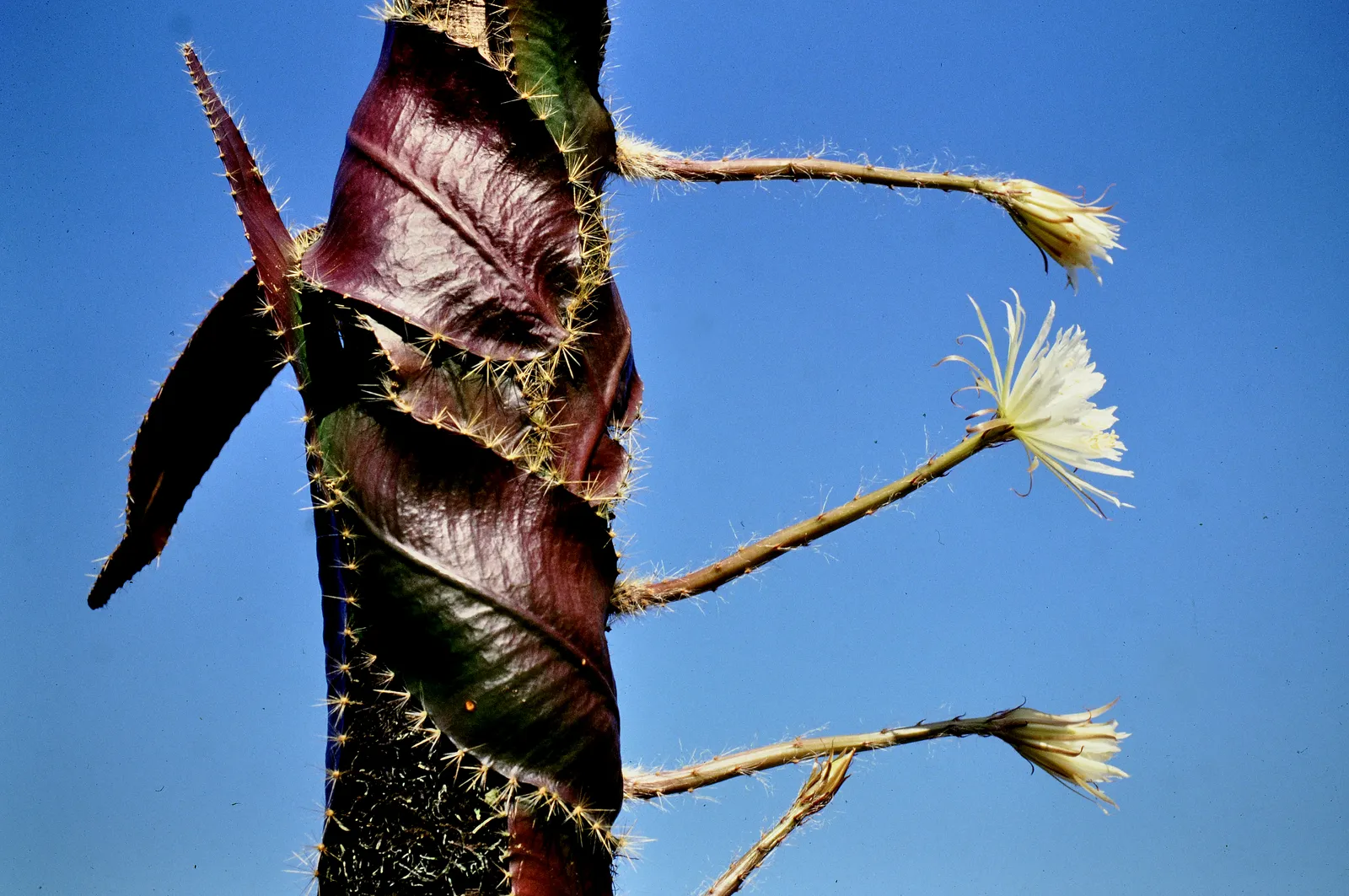
The Dog Tail Cactus, known scientifically as Strophocactus wittii, is an extraordinary epiphytic or lithophytic member of the Cactaceae family, native to the humid tropical forests of South America, primarily found clinging to trees or rocks in regions of Argentina, Bolivia, and Brazil. Unlike many terrestrial cacti, this species thrives in environments with higher humidity and dappled light, often found in the understory of large trees in the Amazon basin, a testament to its unique evolutionary adaptations. Its morphology is striking and highly distinctive, setting it apart from its more upright desert-dwelling relatives. The plant is characterized by its exceptionally long, trailing, and pendent stems, which can extend gracefully up to 2 feet (60 cm) or more, contributing to its common name. These stems are markedly flattened and segmented, typically measuring around 1 inch (2.5 cm) in width, with a vibrant green surface that can sometimes exhibit reddish tints under higher light exposure.
A defining feature is the prominent, spiraled tubercles that adorn the stems, giving them a textured appearance. As the stems mature, they develop a distinctive channeled pattern along their edges, adding to their unique aesthetic. Rather than sharp spines, its areoles typically bear soft, bristle-like spines that are less prominent than those of many other cacti. The stems emerge from a robust, calloused base, an adaptation that not only provides structural stability but also serves as a crucial reservoir for moisture and nutrients, essential for its survival in its native arboreal or rocky niches. When in bloom, the Dog Tail Cactus produces truly spectacular, nocturnal flowers.
These tubular blossoms are predominantly white, often with a delicate hint of pink or cream, and can reach an impressive length of approximately 6 inches (15 cm). The flowers typically emerge in clusters, creating a dramatic and attractive contrast against the verdant stems. Following successful pollination, the plant may produce small, fleshy fruits.
Trusted Scientific References
1. Authoritative external sources for Strophocactus wittii
1.1 Wikipedia — Strophocactus wittii
1.2 Kew POWO (Plants of the World Online)
1.3 PubMed — peer-reviewed research
1.4 NCBI Taxonomy Browser
1.5 GBIF — Global Biodiversity
1.1.Dog Tail Cactus — Key Features
- ✓ <strong>Epiphytic/Lithophytic Growth</strong> — Thrives naturally on trees or rocks in humid environments.
- ✓ <strong>Pendent, Trailing Stems</strong> — Characterized by exceptionally long stems that can extend over 2 feet.
- ✓ <strong>Flattened, Segmented Morphology</strong> — Distinctive flattened and segmented stem structure.
- ✓ <strong>Nocturnal, White Flowers</strong> — Produces large, fragrant, tubular white flowers that open at night.
- ✓ <strong>High Humidity Preference</strong> — Uniquely adapted to higher humidity levels, unlike many desert cacti.
- ✓ <strong>Soft Bristle</strong> — like Spines — Areoles bear soft, less prominent spines compared to typical cacti.
- ✓ <strong>Robust Calloused Base</strong> — Provides structural stability and acts as a reservoir for moisture and nutrients.
- ✓ <strong>Native to Amazon Basin</strong> — Found in tropical rainforests of Argentina, Bolivia, and Brazil.
- ✓ <strong>Ornamental Houseplant</strong> — Highly valued for its aesthetic appeal in hanging baskets and indoor displays.
- ✓ <strong>Unique Spiraled Tubercles</strong> — Stems feature prominent, spiraled tubercles, giving them a textured appearance.
1.2.Dog Tail Cactus — Quick Summary
- ✓ Unique Epiphytic Cactus — Strophocactus wittii is a distinctive trailing cactus native to the Amazonian rainforests, known for its epiphytic or lithophytic growth habit.
- ✓ Ornamental Value — Highly prized in horticulture for its long, pendent stems and spectacular, fragrant nocturnal white flowers.
- ✓ Specific Care Needs — Requires well-draining soil, more consistent moisture than desert cacti, high humidity, and protection from frost.
- ✓ Limited Medicinal Research — There are currently no documented traditional or modern medicinal uses for human consumption for this species.
- ✓ Ecological Importance — Plays a vital role in its native rainforest ecosystem, contributing to biodiversity and habitat support.
2.Dog Tail Cactus — Scientific Identity
3.Dog Tail Cactus — Quick Facts
4.Dog Tail Cactus — Appearance & Identification
5.Dog Tail Cactus — Native Habitat
6.Dog Tail Cactus — Water Requirements
- ✓ Light — Prefers full sun to partial sun; in its native habitat, it receives dappled light. Insufficient light can lead to thin, dull stems.
- ✓ Soil — Requires a fast-draining cactus mix, ideally two parts mineral (sand, perlite, fine gravel) to one part organic matter, to prevent root rot.
- ✓ Water — Needs more water than typical desert cacti, especially during summer. Allow the soil to dry out completely between waterings to avoid overwatering issues.
- ✓ Temperature and Humidity — Tolerates temperatures from 40°F to 90°F (4°C to 32°C) but cannot withstand frost. It prefers higher humidity, making it suitable for indoor growth in cooler regions.
- ✓ Fertilizer — Once root-bound and established, feed regularly with a diluted cactus-specific fertilizer during active growth periods. A bloom booster can encourage flowering in spring and summer.
- ✓ Propagation — Easily propagated from stem cuttings: allow cut pieces to callus for 3-4 days before planting in potting mix. Root division is also effective. Growing from seeds is challenging due to seedling fragility.
- ✓ Pruning — Pruning is generally not necessary unless stems are dead, damaged, or excessively long. Carefully remove affected parts at their branch point.
- ✓ Overwintering — Best overwintered indoors in cooler climates, ideally near a window or under grow lights, to protect from frost and dampness.
Reviewed by the Flora Medical Global Botanical Review Panel
Multi-disciplinary editorial group · Botany · Ethnobotany · Herbal-medicine literature
Who reviewed this: This page was checked by the Flora Medical Global Botanical Review Panel — an in-house editorial group of botany graduates, ethnobotany researchers, and horticulture practitioners who collectively maintain our 7,000+ plant encyclopedia. Meet the team.
Our 4-step verification process
1. Taxonomic verification
Scientific names and synonyms cross-checked against Kew POWO, World Flora Online, and The Plant List.
2. Phytochemical & medicinal cross-reference
Active compounds, traditional uses, and reported activities are cross-referenced with PubMed, USDA Dr. Duke's database, and peer-reviewed ethnobotanical literature.
3. Conservation & distribution check
Distribution, ecology, and conservation status confirmed against GBIF occurrence records and the IUCN Red List.
4. Editorial & safety review
Every entry passes an editorial pass for clarity, originality, and safety notices (toxicity, contraindications, dosage caveats) before publication.
Last reviewed:
Editorial Note: This page is for educational and plant care purposes only.
Written by: Flora Medical Global Editorial Team
Reviewed by: Flora Medical Global Botanical Review Panel
Last Updated: June 15, 2026







Dog Tail Cactus — Comments & Community Reviews
Rate this plant