
Care Disclaimer: Plant care recommendations are general guidelines based on common growing conditions. Individual results may vary based on your local environment, climate, and care routine. If your plant is toxic, keep it away from children and pets, and consult a veterinarian if accidental ingestion occurs.
1.Dorstenia — Overview
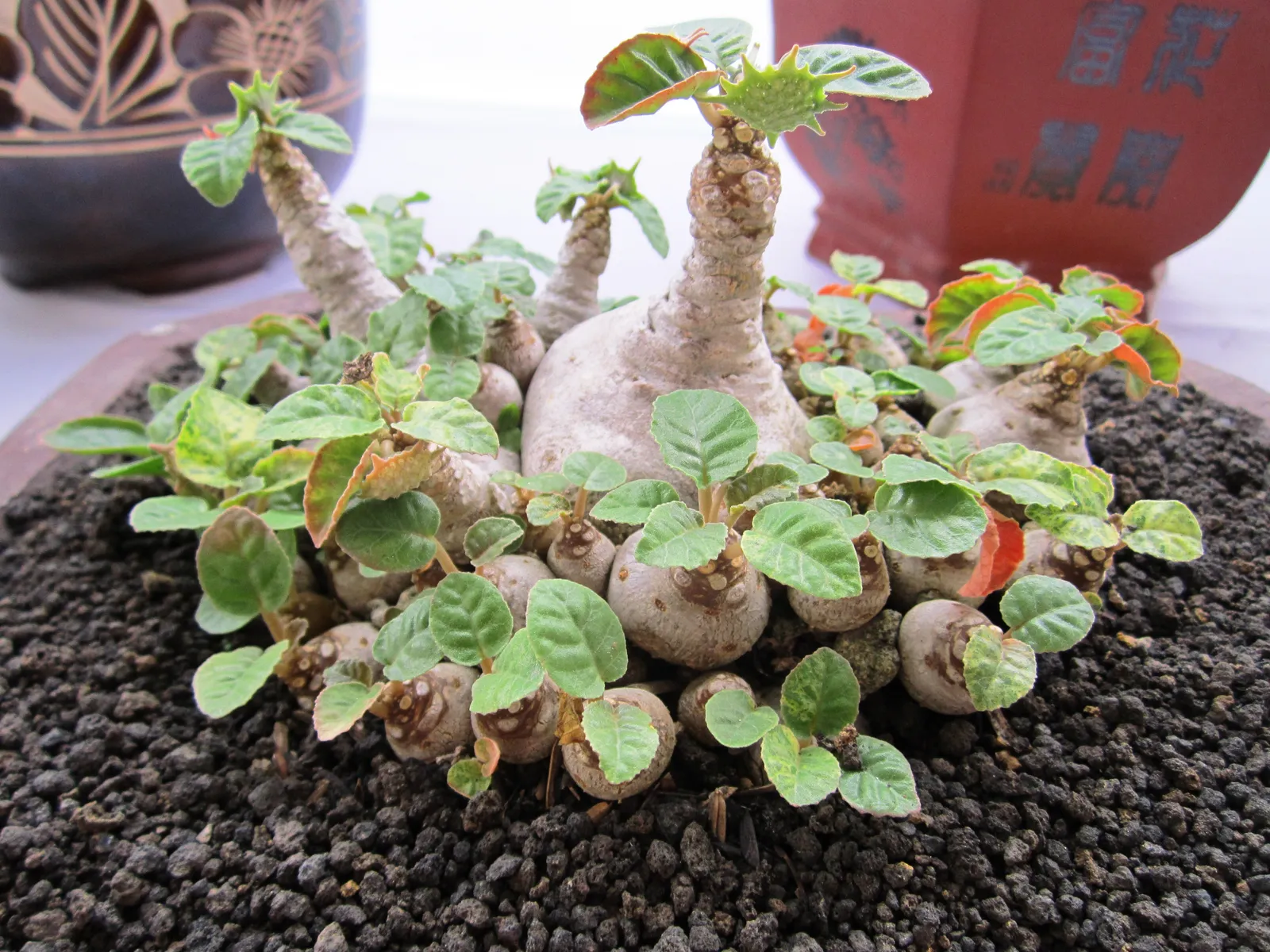
Dorstenia foetida, commonly known as the Shield Flower, is a distinctive succulent perennial belonging to the diverse Moraceae family, which also encompasses figs and mulberries. This captivating plant is native to the arid and semi-arid landscapes of Madagascar and extends across parts of East Africa, including Ethiopia, Somalia, Kenya, Tanzania, Saudi Arabia, Yemen, and Oman.
It thrives in challenging environments, typically found on rocky outcrops and open bushland at altitudes ranging from 100 to 2100 meters, showcasing remarkable adaptation to dry, nutrient-poor conditions.
The most prominent feature of Dorstenia foetida is its often contorted and gnarled caudex, a thickened stem base that serves as a vital water storage organ. This caudex, which can reach 15 cm in diameter and 30-40 cm in height, develops a unique sculptural form with thick, fleshy, and frequently wrinkled texture, often exhibiting peeling bark in older specimens. From the apex of the caudex emerge rosettes of light green to grayish-green leaves.
These leaves are highly variable in shape and size, ranging from narrowly lanceolate to broadly elliptical, 1-15 cm long, with undulate, crenate, or dentate margins. They can be evergreen or caducous, shedding during periods of dormancy.
Perhaps the most unusual aspect is its inflorescence, a flattened, disc-like structure called a hypanthodium, resembling a shield or umbrella, which gives the plant its common name. These hypanthodia, typically 0.5-2 cm wide and varying in color from yellow-green to grayish or even orange/pinkish, contain numerous minute individual flowers.
The specific epithet 'foetida' refers to the peculiar, often unpleasant odor emitted by these flower heads, believed to attract specific insect pollinators. After pollination, the plant produces fruits that, upon ripening, open explosively, dispersing seeds up to two meters away.
Trusted Scientific References
1. Authoritative external sources for Dorstenia foetida
1.1 Wikipedia — Dorstenia foetida
1.2 Kew POWO (Plants of the World Online)
1.3 PubMed — peer-reviewed research
1.4 NCBI Taxonomy Browser
1.5 GBIF — Global Biodiversity
1.1.Dorstenia — Key Features
- ✓ <strong>Caudiciform Succulent</strong> — Possesses a thick, water-storing caudex that develops into a sculptural form.
- ✓ <strong>Shield</strong> — like Inflorescence — Produces unique, flattened, disc-shaped flower structures called hypanthodia.
- ✓ <strong>'Foetida' Scent</strong> — Emits a peculiar, often unpleasant odor from its flowers, aiding in pollination.
- ✓ <strong>Drought</strong> — Tolerant — Highly adapted to arid and semi-arid environments of its native habitat.
- ✓ <strong>Variable Leaves</strong> — Leaves range from lanceolate to elliptical, with crinkly, undulate, or dentate margins.
- ✓ <strong>Explosive Seed Dispersal</strong> — Ripe fruits forcefully eject seeds up to two meters, a characteristic shared with some Euphorbias.
- ✓ <strong>Ornamental Value</strong> — Highly prized by succulent enthusiasts for its distinctive aesthetic and ease of cultivation.
- ✓ <strong>Moraceae Family Member</strong> — Belongs to the fig and mulberry family, sharing some botanical characteristics.
- ✓ <strong>Indigenous to East Africa and Madagascar</strong> — Found thriving in rocky outcrops and bushland.
- ✓ <strong>Evergreen or Caducous</strong> — Leaves may persist or drop depending on environmental conditions and dormancy.
1.2.Dorstenia — Quick Summary
- ✓ Dorstenia foetida, the Shield Flower, is a unique succulent from the Moraceae family.
- ✓ Features a distinctive caudex and shield-like inflorescences (hypanthodia).
- ✓ Native to arid regions of Madagascar and East Africa, highly adapted to drought.
- ✓ Its name 'foetida' refers to the flowers' peculiar scent, attracting pollinators.
- ✓ Primarily cultivated as an ornamental plant due to its striking morphology.
- ✓ Specific medicinal uses are largely undocumented, requiring further research.
2.Dorstenia — Scientific Identity
3.Dorstenia — Quick Facts
4.Dorstenia — Appearance & Identification
5.Dorstenia — Native Habitat
6.Dorstenia — Water Requirements
- ✓ Light Requirements — Dorstenia foetida thrives in bright light, tolerating partial to full shade, but prefers some direct sun for robust growth.
- ✓ Temperature — Requires warm temperatures, ideally above 10°C (50°F), and should be protected from frost.
- ✓ Soil Composition — Plant in a well-drained succulent or cactus potting mix to prevent root rot; soil must not remain soggy.
- ✓ Watering Schedule — Water moderately during the growing season, allowing the soil to dry slightly between waterings, but never letting it completely dry out. Reduce watering significantly in winter during dormancy.
- ✓ Humidity — Appreciates rather high air humidity, which can be provided through misting or a humidity tray.
- ✓ Fertilization — Fertilize once during the active growing season (spring/summer) with a balanced liquid fertilizer diluted to half the recommended strength.
- ✓ Dormancy — Expect partial leaf loss and reduced growth during winter dormancy; water sparingly during this period.
- ✓ Propagation — Primarily propagated by seeds, which germinate readily at around 21°C (70°F), or by stem cuttings.
Reviewed by the Flora Medical Global Botanical Review Panel
Multi-disciplinary editorial group · Botany · Ethnobotany · Herbal-medicine literature
Who reviewed this: This page was checked by the Flora Medical Global Botanical Review Panel — an in-house editorial group of botany graduates, ethnobotany researchers, and horticulture practitioners who collectively maintain our 7,000+ plant encyclopedia. Meet the team.
Our 4-step verification process
1. Taxonomic verification
Scientific names and synonyms cross-checked against Kew POWO, World Flora Online, and The Plant List.
2. Phytochemical & medicinal cross-reference
Active compounds, traditional uses, and reported activities are cross-referenced with PubMed, USDA Dr. Duke's database, and peer-reviewed ethnobotanical literature.
3. Conservation & distribution check
Distribution, ecology, and conservation status confirmed against GBIF occurrence records and the IUCN Red List.
4. Editorial & safety review
Every entry passes an editorial pass for clarity, originality, and safety notices (toxicity, contraindications, dosage caveats) before publication.
Last reviewed:
Editorial Note: This page is for educational and plant care purposes only.
Written by: Flora Medical Global Editorial Team
Reviewed by: Flora Medical Global Botanical Review Panel
Last Updated: June 15, 2026







Dorstenia — Comments & Community Reviews
Rate this plant