
Care Disclaimer: Plant care recommendations are general guidelines based on common growing conditions. Individual results may vary based on your local environment, climate, and care routine. If your plant is toxic, keep it away from children and pets, and consult a veterinarian if accidental ingestion occurs.
1.Dracula Orchid — Overview
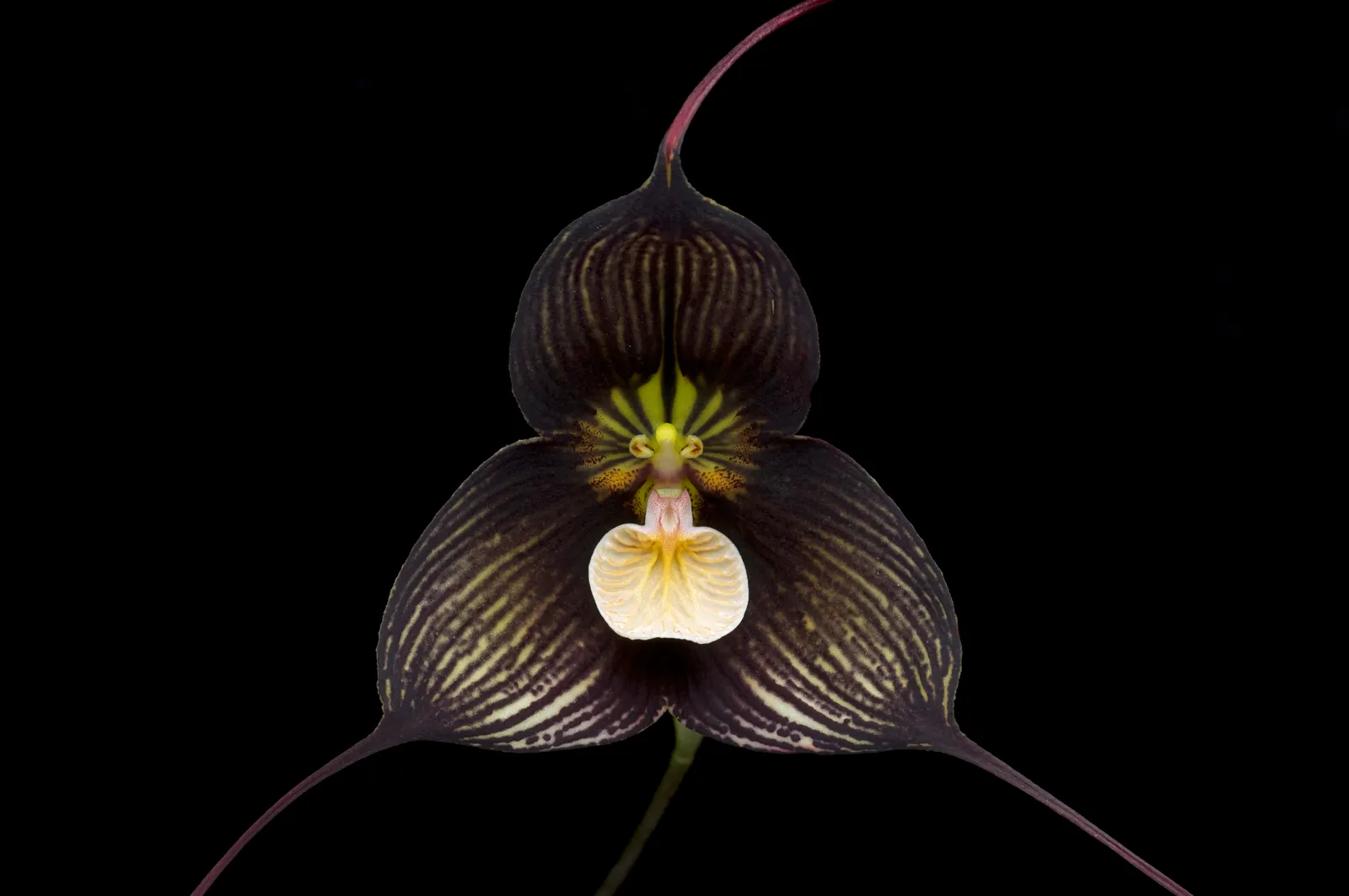
Dracula vampira, commonly known as the Dracula Orchid or Vampire Orchid, is a profoundly unique and captivating species within the genus Dracula, native to the perpetually moist cloud forests of Ecuador and Colombia. This intriguing herbaceous perennial typically reaches a height of up to 30 cm (approximately 12 inches). Its leaves are characteristically thick and leathery, usually dark green, measuring around 10-15 cm (4-6 inches) in length and 3-5 cm (1-2 inches) in width, with a distinct elongated shape optimized for capturing atmospheric moisture in its humid environment. The most striking feature of the Dracula Orchid is its peculiar, bat-like flowers, which often bloom in clusters.
Each blossom showcases deep maroon to dark purple petals with a creamy white and yellow lip, creating an exquisite and eerie contrast. The flowers have a diameter of approximately 5-8 cm (2-3 inches) and are typically held atop slender, often pendent stems that emerge from the basal foliage. A notable morphological trait is the presence of long, slender tails on its sepals, contributing to its dragon-like or 'vampire' appearance, while the apices of the short petals exhibit a warty texture, often interpreted as eye-like structures. The growth habitat of Dracula vampira is primarily shaded, high-humidity montane cloud forests, where it thrives in cool, consistent temperatures with filtered sunlight at elevations ranging from 1,400 to 2,000 meters (4,500–6,500 feet).
Taxonomically, it belongs to the diverse family Orchidaceae, which encompasses a vast array of orchids celebrated for their intricate floral structures and remarkable adaptations to various ecological niches. It predominantly grows as an epiphyte, residing on other plants or rocks, absorbing moisture and nutrients from the air and surrounding detritus, though some species can also be found terrestrially.
Trusted Scientific References
1. Authoritative external sources for Dracula vampira
1.1 Wikipedia — Dracula vampira
1.2 Kew POWO (Plants of the World Online)
1.3 PubMed — peer-reviewed research
1.4 NCBI Taxonomy Browser
1.5 GBIF — Global Biodiversity
1.1.Dracula Orchid — Key Features
- ✓ <strong>Bat</strong> — like Flowers — Distinctive deep maroon to dark purple blossoms with unique morphology.
- ✓ <strong>Epiphytic Growth Habit</strong> — Thrives on other plants or rocks, absorbing moisture from the air.
- ✓ <strong>Cloud Forest Native</strong> — Indigenous to high-altitude, perpetually humid montane regions.
- ✓ <strong>Cool</strong> — Growing Orchid — Requires consistently cool temperatures for optimal health and flowering.
- ✓ <strong>High Humidity Dependent</strong> — Demands 70-85% relative humidity for survival and vigor.
- ✓ <strong>Pendent Inflorescences</strong> — Flowers often emerge downwards, necessitating specialized potting methods.
- ✓ <strong>Warty Petal Apices</strong> — Unique texture on petals resembling small eyes, adding to its eerie charm.
- ✓ <strong>Long Sepal Tails</strong> — Characteristic elongated sepal tips contribute to its dragon-like appearance.
- ✓ <strong>Ornamental Value</strong> — Highly prized by orchid enthusiasts and collectors for its exotic beauty.
- ✓ <strong>Genus Dracula</strong> — Part of a fascinating group of approximately 134 species, known for their unique floral structures.
1.2.Dracula Orchid — Quick Summary
- ✓ Dracula vampira, or Dracula Orchid, is an exotic epiphytic orchid.
- ✓ Native to the cloud forests of Ecuador and Colombia.
- ✓ Features unique, bat-like, deep maroon flowers with long sepal tails.
- ✓ Primarily ornamental, highly prized by orchid collectors for its aesthetic.
- ✓ Requires cool temperatures, high humidity, and filtered light for cultivation.
- ✓ No significant traditional or modern medicinal uses are documented for this species.
2.Dracula Orchid — Scientific Identity
3.Dracula Orchid — Quick Facts
4.Dracula Orchid — Appearance & Identification
5.Dracula Orchid — Native Habitat
6.Dracula Orchid — Water Requirements
- Cultivating Dracula vampira, the Dracula Orchid, requires meticulous attention to specific environmental conditions to mimic its native cloud forest habitat. This species is often considered challenging for hobbyists but highly rewarding.
- ✓ Temperature Range — Maintain cool to intermediate temperatures; ideally 8-12°C (47-54°F) during winter nights and not exceeding 25°C (77°F) during summer days.
- ✓ High Humidity — Crucial for survival, consistently maintain 70-85% relative humidity, often requiring ultrasonic foggers or frequent misting throughout the day.
- ✓ Shaded Environment — Requires filtered, indirect sunlight; a north or east-facing window or a heavily shaded greenhouse location is ideal to prevent leaf scorch.
- ✓ Watering Regime — Keep the substrate continuously moist to wet; Dracula orchids do not tolerate drying out. Use low-salt water such as reverse osmosis, rainwater, or distilled water.
- ✓ Substrate Choice — A well-draining yet moisture-retentive mix is essential, typically a 1:1 mixture of New Zealand sphagnum moss and washed coconut chips, with annual repotting.
- ✓ Potting System — Use mesh pots or wooden baskets to accommodate the frequently pendent or decumbent inflorescences and ensure adequate air circulation around the roots.
- ✓ Air Circulation — Excellent air movement is vital to prevent fungal and bacterial diseases, particularly in high humidity environments; utilize fans in enclosed spaces.
- ✓ Nutrient Requirements — Fertilize sparingly every three to four weeks with a very dilute, low-salt fertilizer solution (e.g., 120-130 μS or 60-65 ppm TDS) adjusted to the water quality.
Reviewed by the Flora Medical Global Botanical Review Panel
Multi-disciplinary editorial group · Botany · Ethnobotany · Herbal-medicine literature
Who reviewed this: This page was checked by the Flora Medical Global Botanical Review Panel — an in-house editorial group of botany graduates, ethnobotany researchers, and horticulture practitioners who collectively maintain our 7,000+ plant encyclopedia. Meet the team.
Our 4-step verification process
1. Taxonomic verification
Scientific names and synonyms cross-checked against Kew POWO, World Flora Online, and The Plant List.
2. Phytochemical & medicinal cross-reference
Active compounds, traditional uses, and reported activities are cross-referenced with PubMed, USDA Dr. Duke's database, and peer-reviewed ethnobotanical literature.
3. Conservation & distribution check
Distribution, ecology, and conservation status confirmed against GBIF occurrence records and the IUCN Red List.
4. Editorial & safety review
Every entry passes an editorial pass for clarity, originality, and safety notices (toxicity, contraindications, dosage caveats) before publication.
Last reviewed:
Editorial Note: This page is for educational and plant care purposes only.
Written by: Flora Medical Global Editorial Team
Reviewed by: Flora Medical Global Botanical Review Panel
Last Updated: June 15, 2026







Dracula Orchid — Comments & Community Reviews
Rate this plant