

Care Disclaimer: Plant care recommendations are general guidelines based on common growing conditions. Individual results may vary based on your local environment, climate, and care routine. If your plant is toxic, keep it away from children and pets, and consult a veterinarian if accidental ingestion occurs.
1.Drosera Binata — Overview
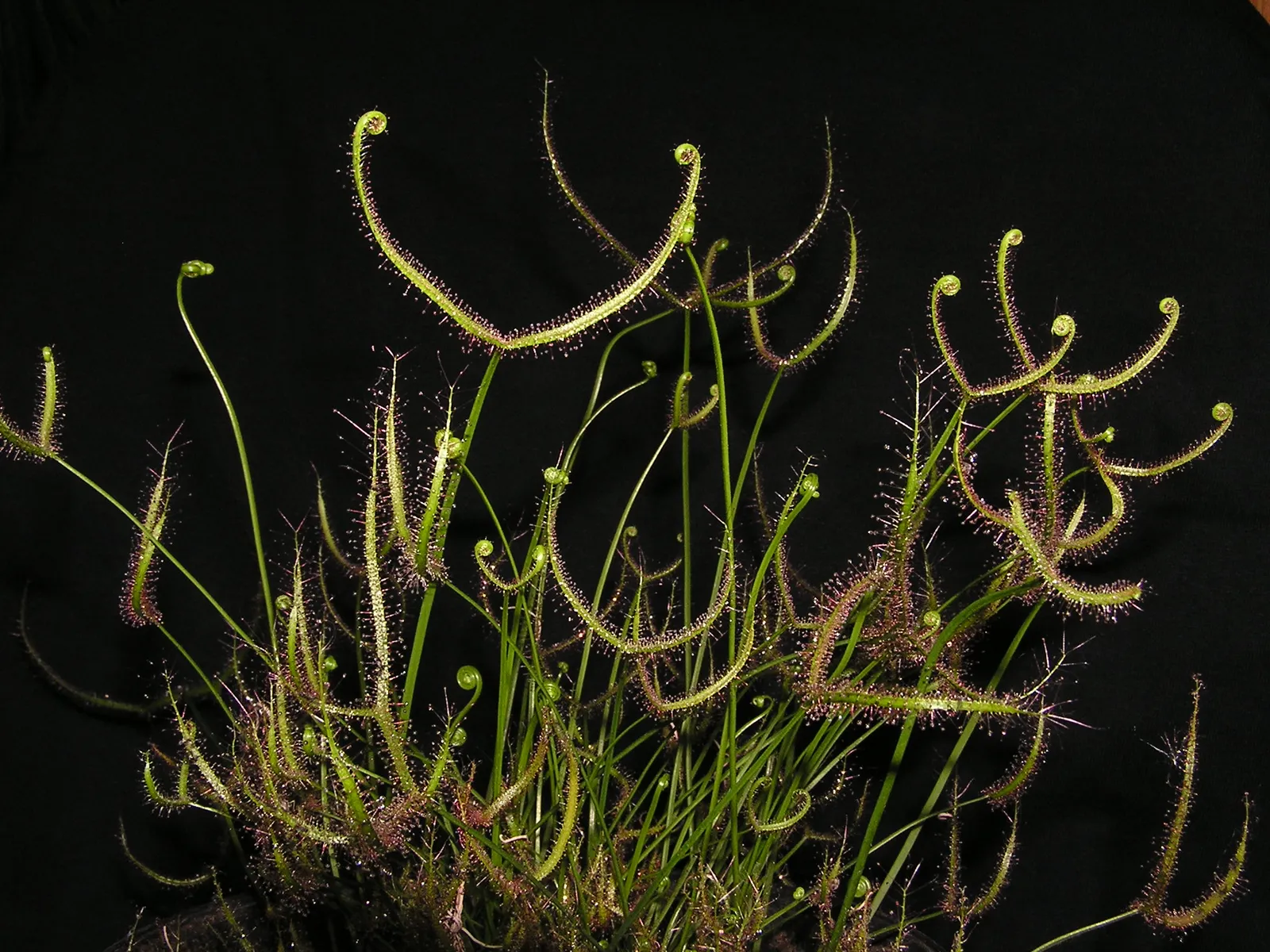
Drosera binata, commonly known as the forked sundew or fork-leaved sundew, is a striking perennial carnivorous plant renowned for its unique, dichotomously branching leaves. Native to the temperate and subtropical regions of southeastern Australia and New Zealand, this species thrives in wet, acidic soils typical of bogs and swamps, often found at elevations below 1,000 meters. The plant typically grows to an impressive height of 30 to 60 centimeters, with its elongated, strap-like leaves bifurcating multiple times, giving rise to its distinctive 'forked' appearance. These leaves are densely covered with numerous glandular tentacles, which exude a glistening, sticky mucilage used to trap and digest small insects, providing essential nutrients lacking in its poor soil habitat.
During the warmer months, usually from summer to early autumn, Drosera binata produces delicate, often white to pale pink flowers on slender, erect stalks, adding to its ornamental appeal. Taxonomically, it is the sole species within the Drosera section Phycopsis, highlighting its unique morphological characteristics within the genus. Several forms exist, including the 'T-form' with a single bifurcation, 'var. dichotoma' with typically four leaf points, and 'f.
multifida' or 'f. extrema' exhibiting numerous divisions, making it a favorite among carnivorous plant enthusiasts for its captivating beauty and relatively straightforward cultivation requirements.
Trusted Scientific References
1. Authoritative external sources for Drosera binata
1.1 Wikipedia — Drosera binata
1.2 Kew POWO (Plants of the World Online)
1.3 PubMed — peer-reviewed research
1.4 NCBI Taxonomy Browser
1.5 GBIF — Global Biodiversity
1.6Drosera Binata should be interpreted through verified botanical identity, practical care, and responsible safety language. This recovery note adds the missing context needed for a complete profile: match light to the plant's habit, use well-drained soil, water according to season, and avoid unsupported medicinal or edible claims. For publishing, the plant can be presented as a source-backed indoor plant with clear care guidance, common problem diagnosis, and conservative safety wording.
1.1.Drosera Binata — Key Features
- ✓ <strong>Distinctive Forked Leaves</strong> — Characterized by elongated leaves that dichotomously divide, often multiple times.
- ✓ <strong>Carnivorous Nature</strong> — Possesses glandular tentacles that secrete sticky mucilage to trap and digest insects.
- ✓ <strong>Perennial Growth Habit</strong> — A long-lived plant, returning year after year under favorable conditions.
- ✓ <strong>Native to Australasia</strong> — Naturally found in Australia and New Zealand's temperate and subtropical wet habitats.
- ✓ <strong>Medicinal Heritage</strong> — Traditionally recognized for its efficacy in treating various respiratory ailments.
- ✓ <strong>Rich in Naphthoquinones</strong> — Contains active compounds like plumbagin, known for therapeutic properties.
- ✓ <strong>Ornamental Value</strong> — Highly prized by plant enthusiasts for its striking appearance and unique predatory mechanism.
- ✓ <strong>Adaptable to Cultivation</strong> — Relatively easy to grow for experienced and novice carnivorous plant keepers with proper care.
- ✓ <strong>Produces Delicate Flowers</strong> — Bears small, often white to pink flowers on tall stalks during its blooming season.
- ✓ <strong>Environmental Indicator</strong> — Often found in pristine bog and swamp ecosystems, indicating healthy wetland habitats.
1.2.Drosera Binata — Quick Summary
- ✓ Carnivorous plant with unique forked leaves.
- ✓ Traditionally used for respiratory conditions, especially coughs.
- ✓ Contains beneficial naphthoquinones and flavonoids.
- ✓ Native to Australia and New Zealand, thrives in bogs.
- ✓ Requires specific care: distilled water, bright light, acidic soil.
- ✓ Caution advised for pregnant women and those on medications.
2.Drosera Binata — Scientific Identity
3.Drosera Binata — Quick Facts
4.Drosera Binata — Appearance & Identification
5.Drosera Binata — Native Habitat
6.Drosera Binata — Water Requirements
- ✓ Soil Medium — Use a nutrient-poor, acidic mix, typically 1:1 peat moss and perlite or coarse sand; avoid standard potting soil.
- ✓ Watering — Employ the tray method, keeping the pot in a tray of 1-2 inches of distilled, rainwater, or reverse osmosis water at all times; never use tap water.
- ✓ Lighting — Provide bright, direct sunlight for at least 6-8 hours daily; grow lights are essential if natural light is insufficient.
- ✓ Temperature & Humidity — Maintain temperatures between 18-30°C (65-85°F) during the growing season; high humidity (50-80%) is beneficial.
- ✓ Dormancy — Some forms of Drosera binata require a winter dormancy period, where temperatures drop and light decreases; reduce watering during this time.
- ✓ Feeding — The plant captures its own insects; supplemental feeding with small insects (e.g., fruit flies) can be done sparingly if grown indoors without access to prey.
- ✓ Propagation — Can be propagated from seeds, root cuttings, or leaf cuttings, with root cuttings being particularly effective for establishing new plants.
Reviewed by the Flora Medical Global Botanical Review Panel
Multi-disciplinary editorial group · Botany · Ethnobotany · Herbal-medicine literature
Who reviewed this: This page was checked by the Flora Medical Global Botanical Review Panel — an in-house editorial group of botany graduates, ethnobotany researchers, and horticulture practitioners who collectively maintain our 7,000+ plant encyclopedia. Meet the team.
Our 4-step verification process
1. Taxonomic verification
Scientific names and synonyms cross-checked against Kew POWO, World Flora Online, and The Plant List.
2. Phytochemical & medicinal cross-reference
Active compounds, traditional uses, and reported activities are cross-referenced with PubMed, USDA Dr. Duke's database, and peer-reviewed ethnobotanical literature.
3. Conservation & distribution check
Distribution, ecology, and conservation status confirmed against GBIF occurrence records and the IUCN Red List.
4. Editorial & safety review
Every entry passes an editorial pass for clarity, originality, and safety notices (toxicity, contraindications, dosage caveats) before publication.
Last reviewed:
Editorial Note: This page is for educational and plant care purposes only.
Written by: Flora Medical Global Editorial Team
Reviewed by: Flora Medical Global Botanical Review Panel
Last Updated: June 15, 2026







Drosera Binata — Comments & Community Reviews
Rate this plant