
Care Disclaimer: Plant care recommendations are general guidelines based on common growing conditions. Individual results may vary based on your local environment, climate, and care routine. If your plant is toxic, keep it away from children and pets, and consult a veterinarian if accidental ingestion occurs.
1.Dumb Cane Giant — Overview
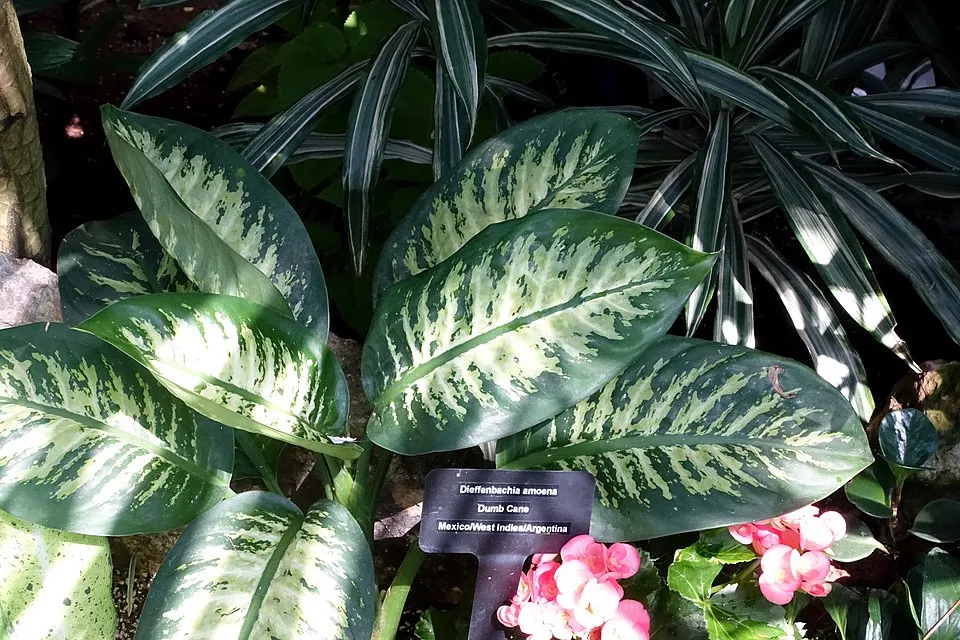
Dieffenbachia amoena, commonly known as the Dumb Cane Giant, stands as an imposing and visually captivating perennial herbaceous plant within the Araceae family. Characterized by its substantial size, mature specimens can typically reach heights of up to 6 feet, boasting robust, upright stems that are generally green to pale green. Its most striking feature is its large, ovate leaves, which can extend up to 12 inches in length and 6 inches in width.
These leaves display a dramatic and highly desirable variegation pattern, featuring prominent splashes and streaks of creamy white or pale yellow against a rich green background. While primarily cultivated for its lush foliage, Dieffenbachia amoena can occasionally produce an inflorescence, a typical Arum-type spadix encased within a greenish-white spathe, though this phenomenon is rare in indoor cultivation. Native to the humid tropical rainforests of Central and South America, this species thrives in warm, consistently moist environments.
Its taxonomic classification within the Araceae family places it alongside other popular indoor plants like Philodendron and Pothos, all sharing a common adaptability to indoor conditions and a propensity for lush, ornamental foliage. The plant's remarkable resilience to varying indoor light levels and its overall ease of care contribute significantly to its widespread popularity among houseplant enthusiasts, making it a prominent decorative feature in countless homes and offices.
Trusted Scientific References
1. Authoritative external sources for Dieffenbachia amoena
1.1 Wikipedia — Dieffenbachia amoena
1.2 Kew POWO (Plants of the World Online)
1.3 PubMed — peer-reviewed research
1.4 NCBI Taxonomy Browser
1.5 GBIF — Global Biodiversity
1.6Dumb Cane Giant should be interpreted through verified botanical identity, practical care, and responsible safety language. This recovery note adds the missing context needed for a complete profile: match light to the plant's habit, use well-drained soil, water according to season, and avoid unsupported medicinal or edible claims. For publishing, the plant can be presented as a source-backed indoor plant with clear care guidance, common problem diagnosis, and conservative safety wording.
1.1.Dumb Cane Giant — Key Features
- ✓ <strong>Striking variegated foliage</strong> — Striking variegated foliage with prominent green and creamy white patterns.
- ✓ <strong>Large, ovate leaves,</strong> — Large, ovate leaves, often reaching up to 12 inches in length, creating a dramatic visual.
- ✓ <strong>Primarily cultivated as</strong> — Primarily cultivated as a popular tropical indoor ornamental plant for its aesthetic appeal.
- ✓ <strong>Contains highly toxic</strong> — Contains highly toxic calcium oxalate raphides in all its parts, particularly the sap.
- ✓ <strong>Can cause severe</strong> — Can cause severe oral irritation, swelling, and temporary speechlessness if ingested.
- ✓ <strong>Requires bright, indirect</strong> — Requires bright, indirect light and consistent moisture for optimal growth and vibrant coloration.
- ✓ <strong>Relatively easy to</strong> — Relatively easy to care for as a houseplant, tolerant of various indoor conditions.
- ✓ <strong>Belongs to the</strong> — Belongs to the Araceae family, characterized by its distinctive spadix inflorescence (though rare indoors).
- ✓ <strong>Native to the</strong> — Native to the tropical regions of Central and South America, thriving in warm, humid environments.
1.2.Dumb Cane Giant — Quick Summary
- ✓ Highly toxic ornamental plant, primarily due to calcium oxalate crystals.
- ✓ Ingestion causes severe oral pain, swelling, and temporary speech loss.
- ✓ Not used in traditional or modern medicine for internal applications.
- ✓ Requires careful handling with gloves to prevent skin and eye irritation.
- ✓ Essential to keep entirely out of reach of children and pets at all times.
2.Dumb Cane Giant — Scientific Identity
3.Dumb Cane Giant — Quick Facts
4.Dumb Cane Giant — Appearance & Identification
5.Dumb Cane Giant — Native Habitat
6.Dumb Cane Giant — Water Requirements
- ✓ Light Requirements — Provide bright, indirect sunlight; direct sun can scorch leaves, while insufficient light leads to leggy growth and reduced variegation, compromising its aesthetic appeal.
- ✓ Soil Composition — Utilize a fertile, well-draining potting mix, ideally with high peat or coco coir content, to ensure good aeration and prevent root rot, which is detrimental to plant health.
- ✓ Watering Schedule — Maintain consistent moisture during the growing season (spring and summer), watering thoroughly when the top inch or two of soil feels dry, and significantly reduce frequency in winter.
- ✓ Temperature and Humidity — Thrive in warm conditions (65-75°F or 18-24°C) and appreciate high humidity, though average household levels are often sufficient, especially if grouped with other plants.
- ✓ Fertilization Regime — Feed every four to six weeks during the active growing period with a balanced, diluted liquid fertilizer (e.g., 20-20-20) to support vigorous foliage development.
- ✓ Pruning for Health and Shape — Prune to maintain desired size and shape, removing any leggy stems or yellowing lower leaves with sterilized tools to encourage bushier growth and overall plant vigor.
- ✓ Repotting Frequency — Repot annually or biennially into a slightly larger container when roots become crowded or emerge from drainage holes, typically in spring, to provide fresh nutrients and space.
Reviewed by the Flora Medical Global Botanical Review Panel
Multi-disciplinary editorial group · Botany · Ethnobotany · Herbal-medicine literature
Who reviewed this: This page was checked by the Flora Medical Global Botanical Review Panel — an in-house editorial group of botany graduates, ethnobotany researchers, and horticulture practitioners who collectively maintain our 7,000+ plant encyclopedia. Meet the team.
Our 4-step verification process
1. Taxonomic verification
Scientific names and synonyms cross-checked against Kew POWO, World Flora Online, and The Plant List.
2. Phytochemical & medicinal cross-reference
Active compounds, traditional uses, and reported activities are cross-referenced with PubMed, USDA Dr. Duke's database, and peer-reviewed ethnobotanical literature.
3. Conservation & distribution check
Distribution, ecology, and conservation status confirmed against GBIF occurrence records and the IUCN Red List.
4. Editorial & safety review
Every entry passes an editorial pass for clarity, originality, and safety notices (toxicity, contraindications, dosage caveats) before publication.
Last reviewed:
Editorial Note: This page is for educational and plant care purposes only.
Written by: Flora Medical Global Editorial Team
Reviewed by: Flora Medical Global Botanical Review Panel
Last Updated: June 15, 2026







Dumb Cane Giant — Comments & Community Reviews
Rate this plant