
Care Disclaimer: Plant care recommendations are general guidelines based on common growing conditions. Individual results may vary based on your local environment, climate, and care routine. If your plant is toxic, keep it away from children and pets, and consult a veterinarian if accidental ingestion occurs.
1.Easter Cactus — Overview
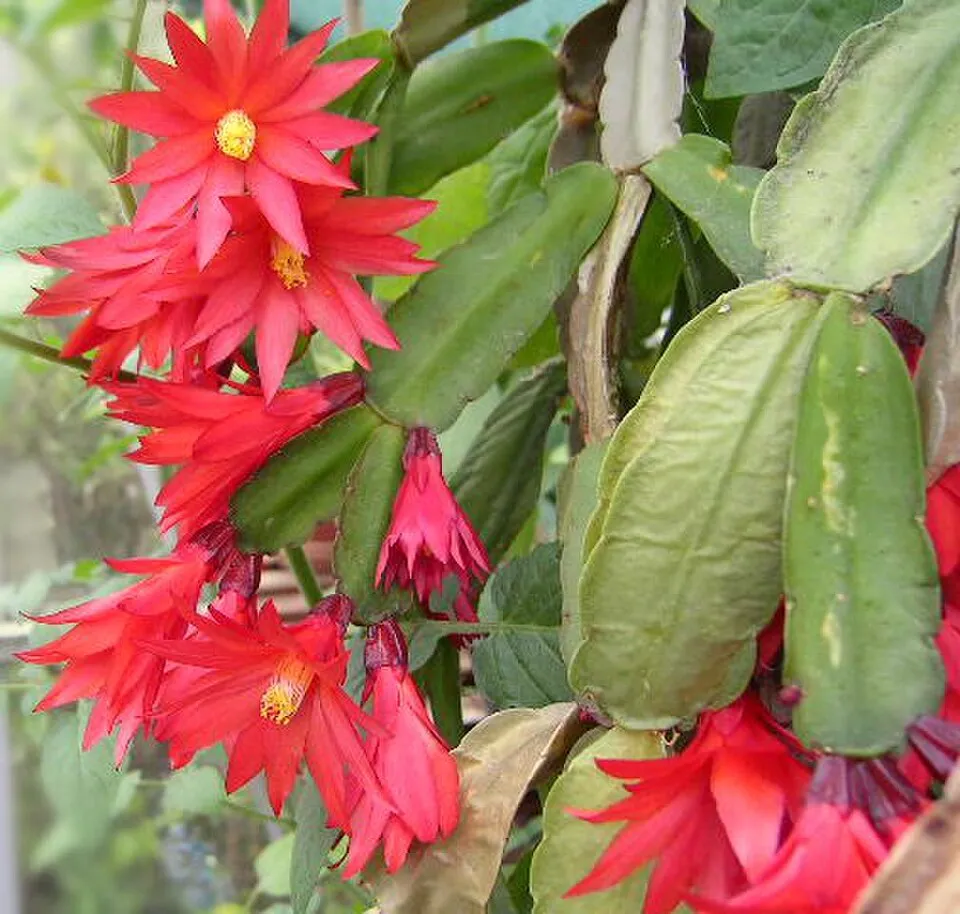
The Easter Cactus, scientifically known as Hatiora gaertneri, is a captivating epiphytic cactus native to the humid, shaded environments of the Atlantic Forest in southeastern Brazil. Unlike many of its desert-dwelling Cactaceae relatives, Hatiora gaertneri thrives by growing on trees (epiphytically) or occasionally on rocks (lithophytically) in high-altitude forest canopies, requiring consistent moisture and protection from direct sun. Its common name, 'Easter Cactus', is derived from its spectacular blooming period, which typically coincides with the Easter holiday in the Northern Hemisphere, spanning from late winter through mid-spring.
This species is characterized by its distinctive flattened, segmented stems, or cladodes, which are often a vibrant green, sometimes acquiring reddish margins when exposed to optimal light conditions. These segments are typically elliptical or oblong, measuring approximately 4-7 cm in length and 2-3 cm in width, and feature two or three distinct teeth along their margins. From these terminal segments emerge the striking, star-shaped, zygomorphic flowers, which can range from vivid red to orange-red and are typically 4-7 cm long.
Historically, while indigenous communities in Brazil have a rich tradition of utilizing native flora, specific documented medicinal applications for Hatiora gaertneri are not prominent in classical ethnomedical texts or modern pharmacological research, which has largely focused on its considerable ornamental value and horticultural characteristics. It is also important to note its taxonomic history, having previously been classified under genera such as Rhipsalidopsis and Schlumbergera, leading to occasional confusion with other 'holiday cacti'.
Trusted Scientific References
1. Authoritative external sources for Hatiora gaertneri
1.1 Wikipedia — Hatiora gaertneri
1.2 Kew POWO (Plants of the World Online)
1.3 PubMed — peer-reviewed research
1.4 NCBI Taxonomy Browser
1.5 GBIF — Global Biodiversity
1.6Easter Cactus should be interpreted through verified botanical identity, practical care, and responsible safety language. This recovery note adds the missing context needed for a complete profile: match light to the plant's habit, use well-drained soil, water according to season, and avoid unsupported medicinal or edible claims. For publishing, the plant can be presented as a source-backed indoor plant with clear care guidance, common problem diagnosis, and conservative safety wording.
1.1.Easter Cactus — Key Features
- ✓ <strong>Epiphytic Growth Habit</strong> — Naturally grows on trees or rocks in its native habitat.
- ✓ <strong>Flattened, Segmented Stems</strong> — Distinctive cladodes with rounded margins.
- ✓ <strong>Vibrant Star</strong> — Shaped Flowers — Typically red to orange-red, blooming profusely.
- ✓ <strong>Seasonal Spring Bloomer</strong> — Flowers appear reliably around the Easter period.
- ✓ <strong>Native to Humid Brazilian Forests</strong> — Thrives in high humidity and indirect light.
- ✓ <strong>Non</strong> — Toxic — Safe for homes with children and pets.
- ✓ <strong>Ornamental Value</strong> — Highly prized as a decorative houseplant.
- ✓ <strong>Day</strong> — Length Sensitive — Requires specific light conditions for flower bud formation.
- ✓ <strong>Confusion with Holiday Cacti</strong> — Often mistaken for Christmas or Thanksgiving cacti, but has rounded stem segments.
- ✓ <strong>Low Maintenance (with proper care)</strong> — Relatively easy to grow once its specific needs are met.
1.2.Easter Cactus — Quick Summary
- ✓ Epiphytic cactus native to Brazil's Atlantic Forest.
- ✓ Features flattened, segmented stems and vibrant, star-shaped flowers.
- ✓ Blooms in spring, typically coinciding with Easter.
- ✓ Primarily valued as an ornamental houseplant.
- ✓ Non-toxic to humans and common household pets.
- ✓ Requires bright, indirect light, high humidity, and specific watering for optimal growth and flowering.
- ✓ Limited to no documented traditional or modern medicinal uses.
2.Easter Cactus — Scientific Identity
3.Easter Cactus — Quick Facts
4.Easter Cactus — Appearance & Identification
5.Easter Cactus — Native Habitat
6.Easter Cactus — Water Requirements
- ✓ Light — Provide bright, indirect light; direct sun, especially in hot afternoons, can scorch the cladodes.
- ✓ Soil — Use a well-draining, slightly acidic potting mix, ideally a blend formulated for cacti and succulents with added organic matter.
- ✓ Watering — Keep soil consistently moist during the growing and blooming seasons, but avoid overwatering, which can lead to root rot; reduce watering significantly in winter dormancy.
- ✓ Humidity — Prefers high humidity; misting, using a pebble tray, or placing in a bathroom can be beneficial, especially in dry indoor environments.
- ✓ Temperature — Maintain temperatures between 60-75°F (15-24°C) during active growth; a cooler period of 50-55°F (10-13°C) in late winter for 6-8 weeks helps induce blooming.
- ✓ Fertilization — Fertilize monthly during active growth (spring and summer) with a balanced liquid fertilizer diluted to half strength.
- ✓ Dormancy — Provide a dormant period in winter with reduced water and cooler temperatures to encourage flower bud formation.
- ✓ Outdoor Placement — Can be moved outdoors to a shady spot during warm summer months to harden growth and promote bud set, then brought indoors before fall frosts.
Reviewed by the Flora Medical Global Botanical Review Panel
Multi-disciplinary editorial group · Botany · Ethnobotany · Herbal-medicine literature
Who reviewed this: This page was checked by the Flora Medical Global Botanical Review Panel — an in-house editorial group of botany graduates, ethnobotany researchers, and horticulture practitioners who collectively maintain our 7,000+ plant encyclopedia. Meet the team.
Our 4-step verification process
1. Taxonomic verification
Scientific names and synonyms cross-checked against Kew POWO, World Flora Online, and The Plant List.
2. Phytochemical & medicinal cross-reference
Active compounds, traditional uses, and reported activities are cross-referenced with PubMed, USDA Dr. Duke's database, and peer-reviewed ethnobotanical literature.
3. Conservation & distribution check
Distribution, ecology, and conservation status confirmed against GBIF occurrence records and the IUCN Red List.
4. Editorial & safety review
Every entry passes an editorial pass for clarity, originality, and safety notices (toxicity, contraindications, dosage caveats) before publication.
Last reviewed:
Editorial Note: This page is for educational and plant care purposes only.
Written by: Flora Medical Global Editorial Team
Reviewed by: Flora Medical Global Botanical Review Panel
Last Updated: June 15, 2026







Easter Cactus — Comments & Community Reviews
Rate this plant