
Care Disclaimer: Plant care recommendations are general guidelines based on common growing conditions. Individual results may vary based on your local environment, climate, and care routine. If your plant is toxic, keep it away from children and pets, and consult a veterinarian if accidental ingestion occurs.
1.Echeveria Black Prince — Overview
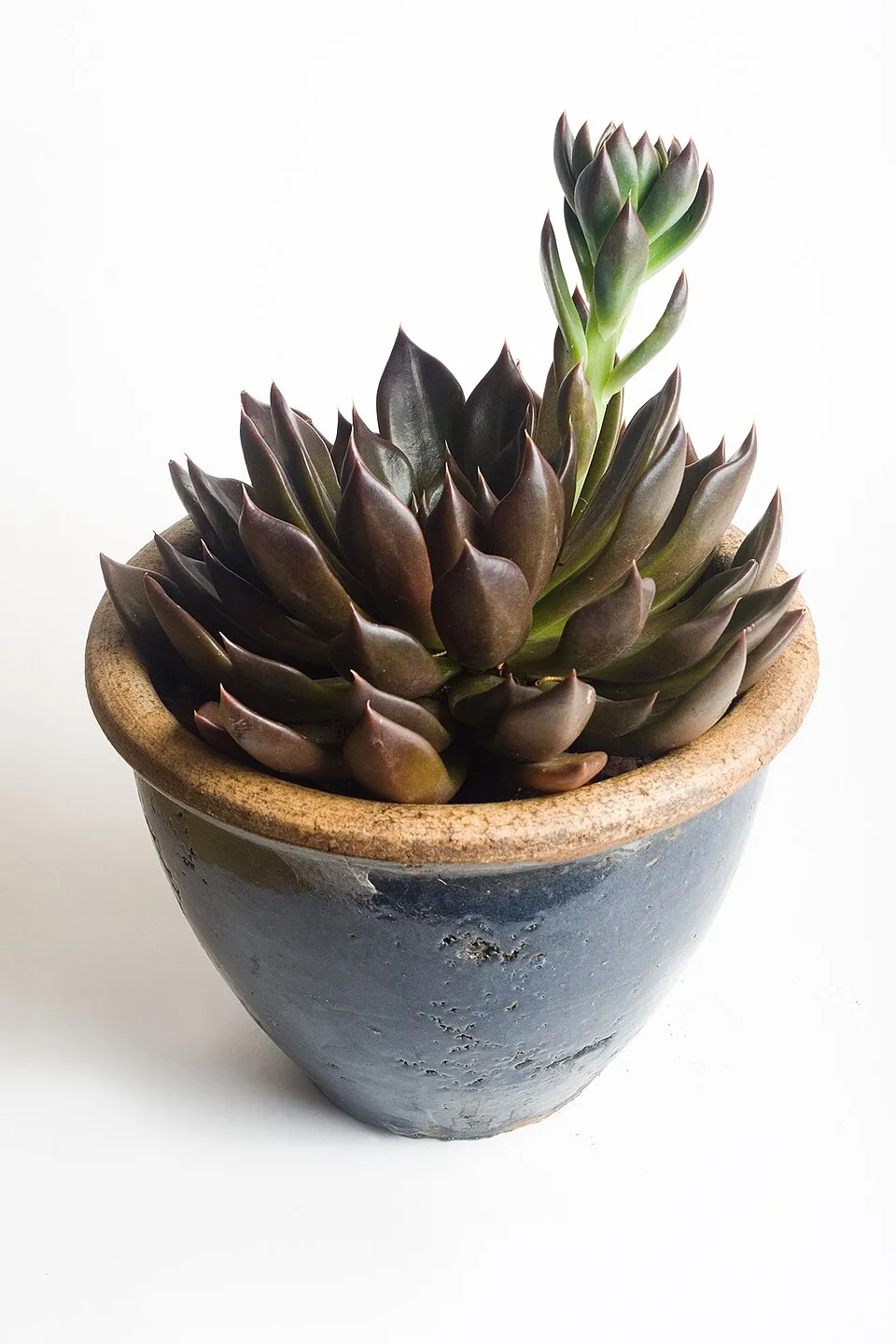
Echeveria 'Black Prince' is a striking hybrid succulent, a captivating member of the Crassulaceae family, renowned for its dramatic, deep burgundy to nearly black foliage. This distinctive plant forms dense, star-shaped rosettes that typically reach a height of up to 5 inches (12.5 cm) and spread to about 6 inches (15 cm) in diameter. Its fleshy, pointed leaves are the plant's most notable feature, developing an even richer, darker hue when exposed to ample sunlight.
New growth emerging from the center of the rosette often displays a contrasting bright green, adding to its visual appeal. The 'Black Prince' is a creation by Frank Reinelt of Capitola, California, resulting from a cross between Echeveria shaviana and Echeveria affinis, and was introduced in the CSSA Journal in 1970. While it does not possess a native habitat in the wild, it is widely cultivated globally as an ornamental houseplant and garden specimen.
During late fall and winter, it produces tall, arching stalks, sometimes reaching up to 12 inches (30 cm), adorned with vibrant coral-red, bell-shaped flowers. These inflorescences are characterized by numerous large, leaf-like bracts, a key feature distinguishing it from its parent, Echeveria affinis. Like other Echeveria species, it is well-adapted to arid conditions, storing water efficiently in its succulent leaves, making it an excellent, low-maintenance choice for various indoor and outdoor settings.
Trusted Scientific References
1. Authoritative external sources for Echeveria black prince
1.1 Wikipedia — Echeveria black prince
1.2 Kew POWO (Plants of the World Online)
1.3 PubMed — peer-reviewed research
1.4 NCBI Taxonomy Browser
1.5 GBIF — Global Biodiversity
1.6Echeveria Black Prince should be interpreted through verified botanical identity, practical care, and responsible safety language. This recovery note adds the missing context needed for a complete profile: match light to the plant's habit, use well-drained soil, water according to season, and avoid unsupported medicinal or edible claims. For publishing, the plant can be presented as a source-backed indoor plant with clear care guidance, common problem diagnosis, and conservative safety wording.
1.1.Echeveria Black Prince — Key Features
- ✓ <strong>Deep Burgundy to Black Foliage</strong> — Unique coloration intensifies with ample light.
- ✓ <strong>Rosette Growth Habit</strong> — Forms compact, star-shaped arrangements of fleshy leaves.
- ✓ <strong>Hybrid Origin</strong> — A cross between Echeveria shaviana and Echeveria affinis.
- ✓ <strong>Vibrant Coral</strong> — Red Flowers — Bell-shaped blossoms appear on tall stalks in cooler months.
- ✓ <strong>Low Water Requirements</strong> — Highly drought-tolerant due to succulent nature.
- ✓ <strong>Easy to Propagate</strong> — Readily multiplies from leaf cuttings and offsets.
- ✓ <strong>Ornamental Appeal</strong> — Highly valued for its sculptural form and dramatic color in decor.
- ✓ <strong>Adaptable Houseplant</strong> — Thrives in bright indoor environments with minimal care.
- ✓ <strong>Produces Offsets (Pups)</strong> — Forms new plantlets around the base, creating dense clumps.
- ✓ <strong>Waxy Leaf Coating</strong> — Provides a subtle sheen and aids in water retention.
1.2.Echeveria Black Prince — Quick Summary
- ✓ Striking ornamental succulent with deep burgundy to black foliage.
- ✓ A hybrid, Echeveria 'Black Prince' is known for its star-shaped rosettes.
- ✓ Offers potential traditional skin-soothing benefits due to mucilage content.
- ✓ Low-maintenance plant, ideal for indoor gardens and succulent enthusiasts.
- ✓ Produces vibrant coral-red flowers on tall stalks in fall/winter.
- ✓ Generally considered non-toxic for pets and children, primarily grown for aesthetic appeal.
2.Echeveria Black Prince — Scientific Identity
3.Echeveria Black Prince — Quick Facts
4.Echeveria Black Prince — Appearance & Identification
5.Echeveria Black Prince — Native Habitat
6.Echeveria Black Prince — Water Requirements
- ✓ Light Requirement — Provide full sun to partial shade; bright, indirect light indoors is ideal to maintain its dark coloration. Gradual acclimatization is crucial when moving outdoors.
- ✓ Soil Preference — Use a well-draining succulent or cactus potting mix, or create your own with equal parts potting soil, perlite, and coarse sand.
- ✓ Watering Schedule — Employ the 'soak and dry' method; water thoroughly when the soil is completely dry, then allow it to dry out fully before the next watering. Reduce watering significantly in winter.
- ✓ Temperature Needs — Thrives in USDA Hardiness Zones 10a-11b, preferring temperatures between 65-80°F (18-27°C). Protect from frost, as it is not cold-hardy.
- ✓ Fertilization — Feed sparingly with a diluted, balanced liquid succulent fertilizer (half-strength) once or twice during the active growing season (spring and summer).
- ✓ Repotting Guidelines — Repot in spring or early summer when the plant outgrows its container, ensuring the soil is dry. Always use a pot with drainage holes.
- ✓ Propagation — Easily propagated from leaf cuttings or by separating offsets (pups) that form around the base of the mother plant. Allow cuttings to callus before planting.
- ✓ Pest Management — Monitor for common succulent pests like mealybugs and aphids; treat with insecticidal soap or neem oil if infestations occur.
Reviewed by the Flora Medical Global Botanical Review Panel
Multi-disciplinary editorial group · Botany · Ethnobotany · Herbal-medicine literature
Who reviewed this: This page was checked by the Flora Medical Global Botanical Review Panel — an in-house editorial group of botany graduates, ethnobotany researchers, and horticulture practitioners who collectively maintain our 7,000+ plant encyclopedia. Meet the team.
Our 4-step verification process
1. Taxonomic verification
Scientific names and synonyms cross-checked against Kew POWO, World Flora Online, and The Plant List.
2. Phytochemical & medicinal cross-reference
Active compounds, traditional uses, and reported activities are cross-referenced with PubMed, USDA Dr. Duke's database, and peer-reviewed ethnobotanical literature.
3. Conservation & distribution check
Distribution, ecology, and conservation status confirmed against GBIF occurrence records and the IUCN Red List.
4. Editorial & safety review
Every entry passes an editorial pass for clarity, originality, and safety notices (toxicity, contraindications, dosage caveats) before publication.
Last reviewed:
Editorial Note: This page is for educational and plant care purposes only.
Written by: Flora Medical Global Editorial Team
Reviewed by: Flora Medical Global Botanical Review Panel
Last Updated: June 15, 2026







Echeveria Black Prince — Comments & Community Reviews
Rate this plant