
Care Disclaimer: Plant care recommendations are general guidelines based on common growing conditions. Individual results may vary based on your local environment, climate, and care routine. If your plant is toxic, keep it away from children and pets, and consult a veterinarian if accidental ingestion occurs.
1.Echeveria Lola — Overview
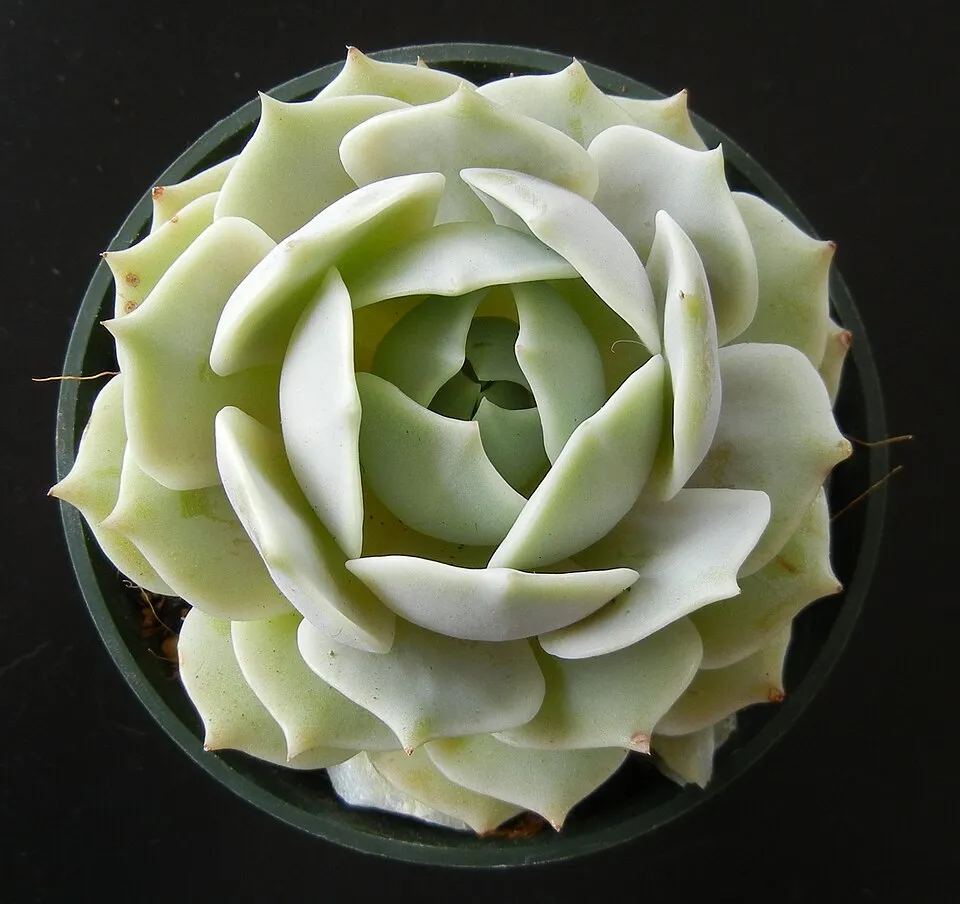
Echeveria Lola (Echeveria lola) is a highly prized succulent hybrid within the extensive Crassulaceae family, renowned for its ethereal beauty and distinctive rosette formation. This charming succulent typically forms compact rosettes, growing up to 10-15 centimeters (4-6 inches) in height and spreading approximately 10 centimeters (4 inches) wide. Its thick, fleshy leaves are spatulate to obovate, exhibiting a soft, pale blue-green or grayish-lavender hue, often infused with delicate pink or purple tones, especially when exposed to ample sunlight or cooler temperatures.
A powdery farina, a natural waxy coating, covers the leaves, giving them a frosted appearance and providing protection against intense sun and water loss. The stem is short, often obscured by the dense leaf rosette, and typically green to reddish, smooth, and unbranched. In spring, Echeveria Lola produces slender, arching flower stalks, reaching up to 15-20 centimeters (6-8 inches) in height, bearing bell-shaped flowers that transition from pale yellow to a soft apricot or coral, contrasting beautifully with the pastel foliage.
Native to arid and semi-arid regions of Mexico, like many Echeveria species, it is adapted to rocky, well-drained soils and environments with intermittent rainfall and abundant sunshine. Its classification within the Crassulaceae family highlights its shared characteristics with other succulents, including efficient water storage and a robust resilience, making Echeveria Lola a favored choice for indoor cultivation and xeriscaping.
Trusted Scientific References
1. Authoritative external sources for Echeveria lola
1.1 Wikipedia — Echeveria lola
1.2 Kew POWO (Plants of the World Online)
1.3 PubMed — peer-reviewed research
1.4 NCBI Taxonomy Browser
1.5 GBIF — Global Biodiversity
1.6Echeveria Lola should be interpreted through verified botanical identity, practical care, and responsible safety language. This recovery note adds the missing context needed for a complete profile: match light to the plant's habit, use well-drained soil, water according to season, and avoid unsupported medicinal or edible claims. For publishing, the plant can be presented as a source-backed indoor plant with clear care guidance, common problem diagnosis, and conservative safety wording.
1.1.Echeveria Lola — Key Features
- ✓ <strong>Striking Rosette Form</strong> — Features a perfectly shaped, symmetrical rosette of fleshy leaves.
- ✓ <strong>Ethereal Pastel Hues</strong> — Exhibits soft blue-green, grayish-lavender, pink, or purple coloration.
- ✓ <strong>Farina Coating</strong> — Covered in a powdery, protective farina that gives a frosted look.
- ✓ <strong>Drought Tolerant</strong> — Highly adapted to arid conditions, requiring minimal water.
- ✓ <strong>Low Maintenance</strong> — Easy to care for, making it ideal for beginners and busy individuals.
- ✓ <strong>Ornamental Value</strong> — A popular choice for indoor decor, rock gardens, and succulent arrangements.
- ✓ <strong>Spring Blooms</strong> — Produces delicate, bell-shaped yellow to apricot flowers on tall stalks.
- ✓ <strong>Easy Propagation</strong> — Readily propagates from leaves, stem cuttings, and offsets.
- ✓ <strong>Generally Pet</strong> — Safe — Considered non-toxic for most common household pets.
- ✓ <strong>Air Purification (Aesthetic)</strong> — Contributes to a visually refreshing indoor environment.
1.2.Echeveria Lola — Quick Summary
- ✓ Echeveria Lola is a beautiful, low-maintenance succulent known for its pastel rosettes.
- ✓ Primarily an ornamental plant, it offers aesthetic and potential minor wellness benefits.
- ✓ Contains flavonoids and terpenes with antioxidant and anti-inflammatory properties.
- ✓ Thrives in bright light and well-draining soil, requiring infrequent watering.
- ✓ Generally non-toxic to humans and pets, safe for indoor display.
- ✓ Easily propagated from leaves, cuttings, and offsets.
2.Echeveria Lola — Scientific Identity
3.Echeveria Lola — Quick Facts
4.Echeveria Lola — Appearance & Identification
5.Echeveria Lola — Native Habitat
6.Echeveria Lola — Water Requirements
- ✓ Sunlight — Provide Echeveria Lola with at least 6 hours of full sun to partial shade daily; bright, indirect light is ideal for indoor growth to maintain vibrant coloration.
- ✓ Watering — Employ the 'soak and dry' method; water thoroughly only when the soil is completely dry to prevent root rot, reducing frequency in winter due to dormancy.
- ✓ Soil — Utilize a well-draining succulent or cactus potting mix, ideally amended with perlite or pumice to ensure excellent aeration and prevent waterlogging.
- ✓ Temperature & Hardiness — Prefers temperatures between 20-29°C (68-85°F) and is not cold hardy; bring indoors if temperatures drop below 4°C (40°F) or if frost is expected (USDA Zone 9+).
- ✓ Container Gardening — Thrives in containers with drainage holes, allowing for easy relocation to protect from adverse weather and to control soil conditions.
- ✓ Fertilization — Fertilize sparingly during the growing season (spring/summer) with a diluted, balanced succulent fertilizer, typically once or twice a year.
- ✓ Pest Management — Monitor for common succulent pests like mealy bugs; treat infestations promptly with 70% isopropyl alcohol or insecticidal soap, avoiding overwatering to deter pests.
Reviewed by the Flora Medical Global Botanical Review Panel
Multi-disciplinary editorial group · Botany · Ethnobotany · Herbal-medicine literature
Who reviewed this: This page was checked by the Flora Medical Global Botanical Review Panel — an in-house editorial group of botany graduates, ethnobotany researchers, and horticulture practitioners who collectively maintain our 7,000+ plant encyclopedia. Meet the team.
Our 4-step verification process
1. Taxonomic verification
Scientific names and synonyms cross-checked against Kew POWO, World Flora Online, and The Plant List.
2. Phytochemical & medicinal cross-reference
Active compounds, traditional uses, and reported activities are cross-referenced with PubMed, USDA Dr. Duke's database, and peer-reviewed ethnobotanical literature.
3. Conservation & distribution check
Distribution, ecology, and conservation status confirmed against GBIF occurrence records and the IUCN Red List.
4. Editorial & safety review
Every entry passes an editorial pass for clarity, originality, and safety notices (toxicity, contraindications, dosage caveats) before publication.
Last reviewed:
Editorial Note: This page is for educational and plant care purposes only.
Written by: Flora Medical Global Editorial Team
Reviewed by: Flora Medical Global Botanical Review Panel
Last Updated: June 15, 2026







Echeveria Lola — Comments & Community Reviews
Rate this plant